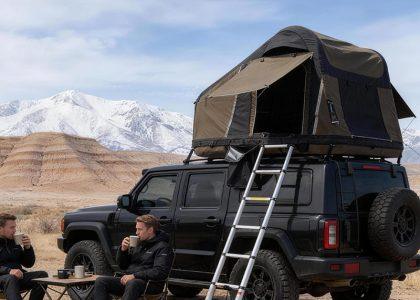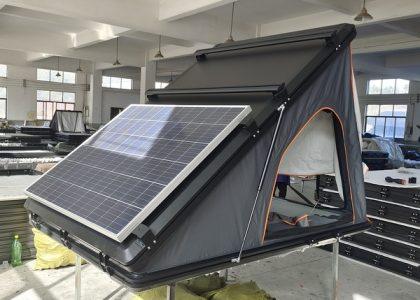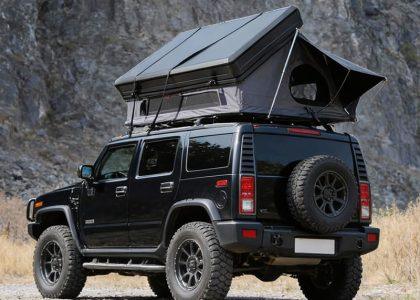
Neither ABS nor aluminum is universally superior for a hard-shell rooftop tent. While buyers often try to choose between a plastic or metal enclosure, “ABS” frequently refers only to the outer skin of a tent that still relies on an internal aluminum structural frame. Aluminum can support stiff structural assemblies and integrated rail systems, while ABS is well suited to thermoformed shell geometry. Finished weight still depends on the complete tent design.
Complete tent design, including frame architecture, structural rails, and UV protection systems, strongly influences real-world performance. Compare the exact finished weight, load-rated accessory rails, and specific weatherproofing treatments rather than making a purchase decision based on the shell material label alone.
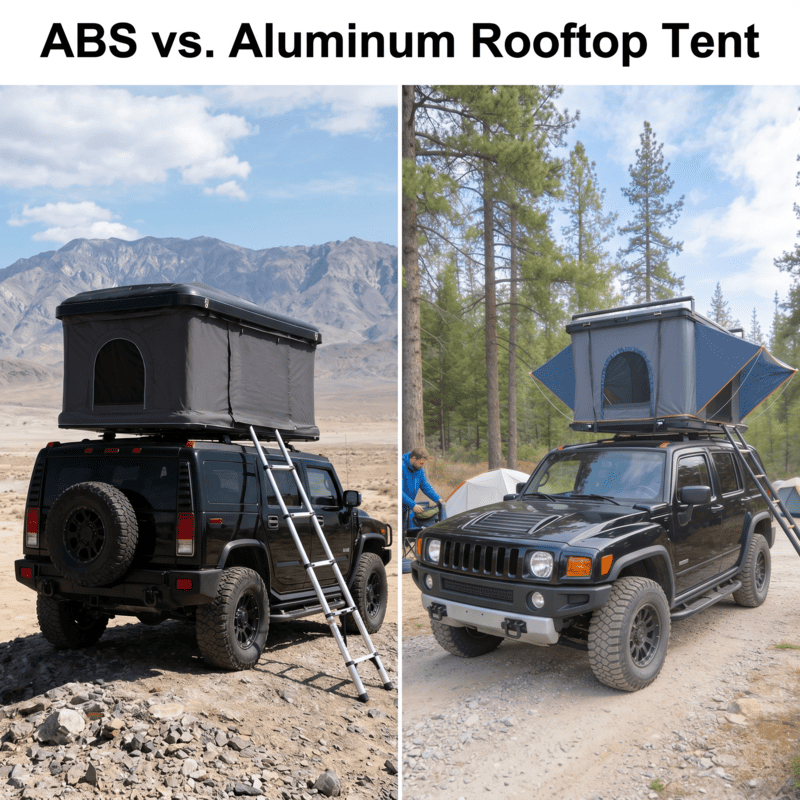
ABS vs Aluminum Rooftop Tent: Quick Comparison
| Attribute | ABS (PC+ABS varies by formulation) | Aluminum | Evidence Rule |
|---|---|---|---|
| Weathering | Standard ABS grades have limited weathering resistance, while UV-resistant ABS grades are available. | Aluminum does not undergo polymer UV embrittlement, but coatings, sealants, plastics, fabrics and other components still weather. | Exact grade, coating, finish and overall construction affect outdoor weathering performance. |
| Formability | Excellent for thermoforming complex curved shapes. | Fabricated, welded, or extruded construction. | Achievable shapes are architecture-specific. |
| Thermal Conductivity | Much lower than aluminum. | High thermal conductivity. | Whole-tent insulation and ventilation matter most. |
| Impact Response | ABS is recognized for impact resistance, but cracking/deformation behavior depends on grade, temperature, wall geometry and support. | Aluminum structures can dent, deform, fatigue or crack depending on alloy, thickness, joining method and panel construction. | Exact design, core structure and thickness determine outcome. |
| Top Accessories | Possible when paired with structural rails/frame. | Often easy to integrate T-slots and load rails. | Follow the exact product’s published accessory/roof-bar load rating. |
| Finished Weight | Can be lower in comparable designs. | Can be higher, but not always. | Compare the finished product weight, not the raw material. |
Note: PC+ABS is a distinct polymer blend; standard ABS property data should not be assumed to apply unchanged to every PC+ABS formulation.
First, Understand What “ABS Tent” and “Aluminum Tent” Actually Mean
Categorizing tents as strictly “ABS” or “aluminum” hides major structural differences. Some ABS RTTs use separate aluminum structural frames. For example, Everlead’s DC-03 Electric Rooftop Tent explicitly uses a PC+ABS outer shell over an internal aluminum frame.
An “aluminum” tent is not a single uniform construction type, either. It might be fabricated from sheet aluminum, constructed from aluminum honeycomb sandwich panels, or built around extruded structural frames with internal insulation layers.
When comparing models, you are evaluating these complete structural systems—not just the outer skin.
Is an Aluminum Rooftop Tent Always Heavier?
No.
To reduce cross-model noise, NatureNest’s closely matched Sirius 2 ABS and Sirius 2 Aluminum variants provide a useful commercial comparison.
Same-Platform Reality Check
| Specification | Sirius 2 ABS | Sirius 2 Aluminum |
|---|---|---|
| Capacity | 2–3 | 2–3 |
| Closed Size | ~63 × 49 × 11 in | ~63 × 49.2 × 11.8 in |
| Open Size | ~63 × 86.6 × 47 in | ~63 × 86.6 × 47.2 in |
| Published Weight | 165.13 lb | 181.6 lb |
| Difference | — | +16.47 lb |
The aluminum version is approximately 10% heavier in this exact pair. However, this does not prove aluminum RTTs are generally 10% heavier; other configuration details can still differ.
More importantly, NatureNest’s larger Sirius 2 XL ABS and Sirius 2 XL Aluminum are both currently listed at an identical finished weight of 215.1 lb.
That counterexample matters: shell material influences finished weight, but it does not determine finished product mass by itself.
Everlead’s own catalog demonstrates the same comparison problem from another angle. Its ABS vertical-lift model lists a 76.5 kg gross weight, while an aluminum honeycomb X-frame model lists a 70 kg net weight. Because those products differ in architecture, dimensions and even weight definitions, they should not be used to conclude that one material is inherently lighter.
The practical rule is simple:
Compare the exact finished product weight against your vehicle and rack limits rather than assuming ABS is automatically lighter or aluminum automatically heavier.
Which Handles Sun and Weather Better?
According to the Curbell ABS material guide, standard ABS grades have limited weathering resistance, while UV-resistant ABS grades are available.
That means outdoor RTT performance should not be judged from the word “ABS” alone. The exact polymer grade, blend and protective system matter.
For example, Everlead currently lists an ABS hard-shell RTT using a 4 mm reinforced ABS shell with UV-protection coating, illustrating how product-level UV treatment can differ from generic ABS material assumptions.
Aluminum does not undergo polymer UV embrittlement, but that does not make an aluminum rooftop tent immune to weathering. Coatings, sealants, plastic components, fabric, adhesives and hardware remain exposed to the environment, while corrosion design and surface finishes remain relevant over time.
There is therefore no evidence-based reason to assign a universal lifespan to either shell type.
Which Handles Impacts Better: Cracking vs Dents?
ABS is recognized for impact resistance, but cracking or deformation behavior depends on factors such as grade, temperature, wall geometry and structural support.
Aluminum structures can dent, deform, fatigue or crack depending on alloy, thickness, joining method and panel construction. An aluminum honeycomb sandwich panel should also be treated as a different structural system from a simple sheet-aluminum shell.
This is why the shortcut:
“ABS cracks, aluminum dents.”
is too simplistic.
Neither material is immune to trail damage, and determining a definitive winner would require comparable whole-product impact testing under the same conditions.
For buyers, construction details matter more than material stereotypes:
- shell thickness;
- internal frame;
- local reinforcement;
- panel construction;
- hinges and fasteners;
- support spacing;
- repair support from the manufacturer.
Does Aluminum Cause More Condensation?
Aluminum’s material properties help explain why this question comes up, but they do not prove that every aluminum tent will experience more condensation.
The MatWeb 5052-H32 aluminum datasheet lists thermal conductivity at approximately 138 W/m·K.
That relatively high thermal conductivity helps explain why exposed or poorly thermally isolated aluminum can form a stronger thermal bridge between exterior and interior conditions.
But whether condensation actually forms—and how much—depends on the complete tent system, including:
- interior surface temperature;
- outside temperature;
- humidity;
- occupant moisture;
- insulation;
- interior liners;
- ventilation;
- airflow.
Lower-conductivity polymer shells can reduce one thermal-bridging pathway, but ABS does not eliminate condensation.
Likewise, an aluminum tent with effective insulation, liners and ventilation cannot be judged from the conductivity of the raw metal alone.
So the useful comparison is not:
“ABS is warm and aluminum is cold.”
It is:
“How well does the complete tent manage thermal bridging, insulation and ventilation?”
Solar Panels, Roof Bars and Other Accessories
A common shortcut says ABS rooftop tents cannot carry top-mounted accessories.
That is false as a universal rule.
NatureNest’s Sirius 1 Plus XL combines an ABS shell with an aluminum alloy frame and lists roof bars that can carry 20 kg of solar panels or gear.
This example does not mean all ABS tents can support 20 kg. It demonstrates something more important:
Accessory capacity depends on the engineered load path, not simply on whether the visible shell is plastic or metal.
An ABS outer skin can be combined with:
- aluminum internal framing;
- structural rails;
- dedicated roof bars;
- reinforced mounting locations.
Aluminum RTTs can also make T-slot and rail integration convenient within a structural metal assembly.
Regardless of material, follow the exact product’s published:
- accessory or roof-bar load rating;
- approved mounting points;
- hardware requirements;
- installation instructions.
Do not drill into or load a shell based solely on assumptions about ABS or aluminum.
Which Is Easier to Maintain or Repair?
Neither material is universally easier to repair.
ABS / PC+ABS
Repair options depend on the exact resin or blend, shell construction and type of damage. Bonding, polymer repair or shell replacement may be possible on some products, but repair methods should follow manufacturer-approved procedures.
PC+ABS should not automatically be treated like standard ABS because blend formulation affects material behavior.
Aluminum
Repairability depends heavily on construction.
A tent may use:
- sheet aluminum;
- welded framing;
- extrusions;
- honeycomb sandwich panels;
- coated structural components.
Damage to each system can require a different repair approach. The finish and joining method also matter.
Instead of choosing shell material based on a generic repairability claim, check whether the manufacturer provides:
- replacement parts;
- shell components;
- rails or hardware;
- repair instructions;
- warranty support.
Which Material Is Better for Your Vehicle?
The material label should not make this decision for you.
If roof weight is the priority
Prioritize the actual finished tent weight when vehicle and rack dynamic roof-load constraints are limited.
Do not assume ABS is automatically lighter.
The NatureNest Sirius 2 pair shows an aluminum version that is 16.47 lb heavier, while its larger XL ABS and aluminum versions are both listed at 215.1 lb.
If you need solar panels or top-mounted gear
Prioritize an exact tent with manufacturer-rated structural rails or load paths.
Do not automatically choose aluminum or reject ABS.
If molded or curved shell geometry matters
Thermoformed ABS can make complex curved forms practical.
That is a manufacturing and geometry advantage—not proof of better aerodynamics.
Aerodynamic performance depends on the finished tent’s actual:
- height;
- frontal area;
- shape;
- leading edge;
- installation position.
If structural rails and modular hardware matter
Prioritize a structural system whose frame, rails and published ratings meet your accessory and mounting requirements.
An aluminum architecture may make integrated rails convenient, but the exact product design remains the deciding factor.
ABS vs Aluminum for OEM Product Development
For an OEM rooftop-tent project, the useful question is not simply:
“Should we use ABS or aluminum?”
It is:
“Which structural system achieves the required finished weight, geometry, accessory capability and production requirements?”
ABS or PC+ABS may suit projects that prioritize:
- molded curves;
- repeatable shell geometry;
- appearance-driven outer-shell forms.
Aluminum fabrication may suit projects requiring:
- dimensional variation;
- integrated extrusions or rails;
- modular structural layouts.
Tooling strategy, annual volume, dimensional customization and project economics should be evaluated case by case rather than inferred from the material label alone.
Everlead Outdoor works with both hard-shell architectures and supports OEM/ODM development involving custom dimensions, material specification and structural engineering.
Everlead’s own product range also illustrates why material categories are not binary. Its DC-03 Electric Rooftop Tent uses a PC+ABS outer shell with an internal aluminum frame, while other models use ABS composite shells or aluminum honeycomb structures.
For a product-development brief, specify the performance target first:
- target finished weight;
- shell geometry;
- closed height;
- target vehicle segment;
- accessory-load requirements;
- structural rail requirements;
- UV/weathering target;
- target markets and climates;
- desired finish;
- dimensional customization;
- repair/service expectations.
Then evaluate whether ABS, PC+ABS, aluminum or a hybrid structure best meets those requirements.
Bottom Line: Compare the Tent, Not Just the Shell Material
Neither ABS nor aluminum is automatically the better rooftop-tent material.
The structural system achieves the required weight, shape and capacity—not the raw material in isolation.
| Priority | What to Check | Material Shortcut to Avoid |
|---|---|---|
| Low Roof Weight | Actual finished tent weight | “ABS is always lighter.” |
| Solar / Gear Mounting | Rated structural rail and load system | “ABS cannot carry gear.” |
| Hot / Cold Climate | Insulation, ventilation and liners | “ABS is always warmer.” |
| Long Sun Exposure | Polymer grade/coating or metal finish | “Aluminum lasts forever.” |
| Trail Damage | Construction and repair method | “Aluminum never cracks.” |
Before buying, compare the exact tent’s:
- finished weight;
- vehicle and rack compatibility;
- shell and frame architecture;
- UV treatment or exterior finish;
- rated accessory system;
- closed geometry;
- maintenance and repair support.
The most useful rule is also the simplest:
Do not buy—or recommend—a rooftop tent based on the word “ABS” or “aluminum” alone.
For an OEM project, send Everlead your target finished weight, shell geometry, accessory-load requirements and vehicle segment so the team can evaluate whether an ABS, PC+ABS, aluminum or hybrid architecture best fits the project.