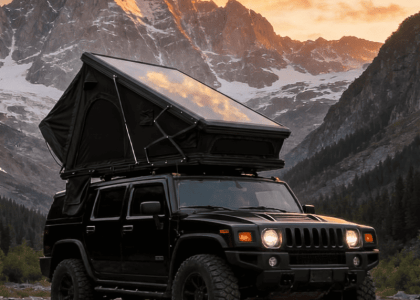
An off-road shop does not need to stock every rooftop tent it is willing to sell.
That distinction is the starting point for a better rooftop tent inventory for dealers strategy.
A shop can offer a broad rooftop-tent catalog while keeping only a focused group of products in physical inventory.
A practical structure is:
- Display inventory — tents used to explain product differences in person;
- Core stock — products intentionally kept available for normal sale;
- Special-order models — products offered without tying up warehouse space;
- Service stock — brackets, hardware, latches, straps, and other after-sales parts.
The goal is not to answer:
How many rooftop tents should we buy?
The better question is:
How many different customer problems does our inventory need to solve?
For most 4×4 retailers, inventory becomes easier to manage when every core SKU has a clear role.
If you are still deciding which product categories your shop should carry in the first place, start with our rooftop tent dealer guide.
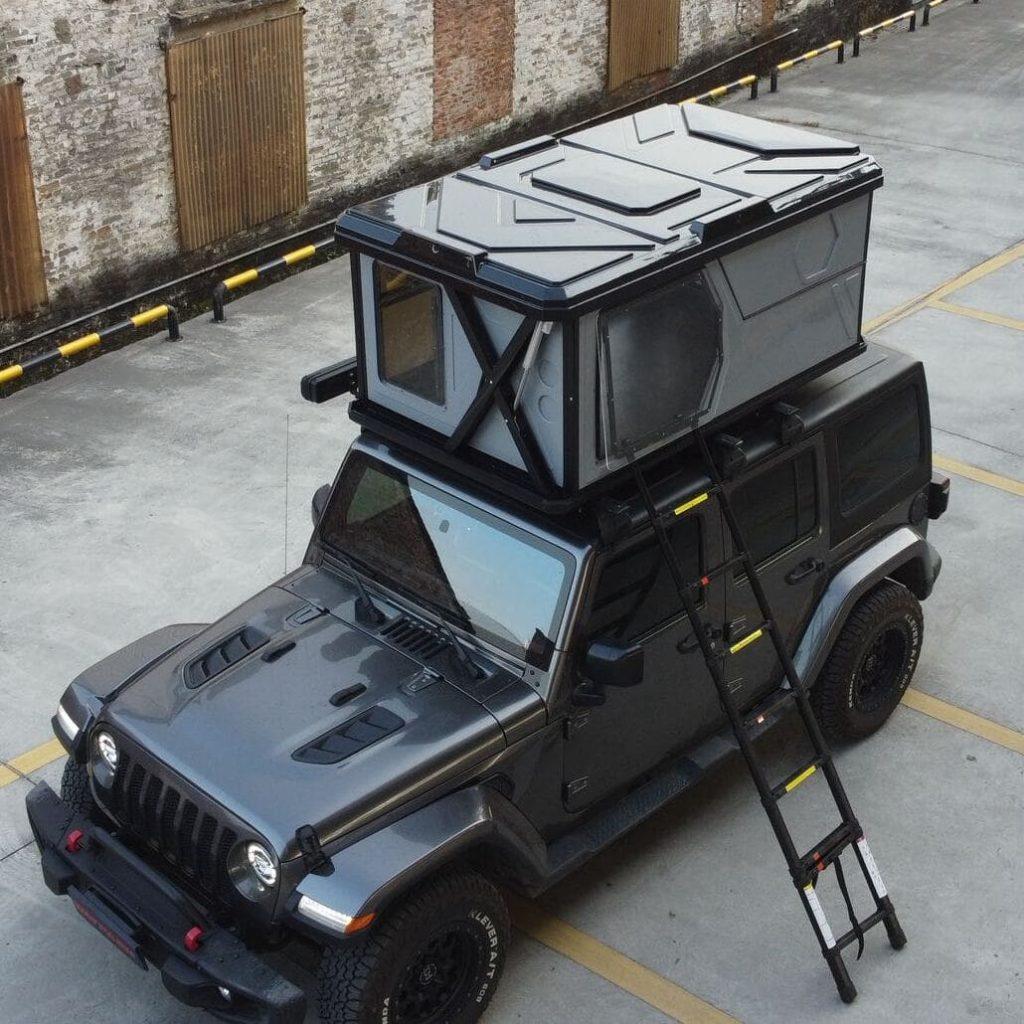
Quick Answer: How Many Rooftop Tent Models Should a 4×4 Shop Stock?
There is no universal number.
A dealer does not need ten physical tents simply because a manufacturer offers ten models.
A practical starting framework is to cover several distinct customer needs:
- Lightweight / compact
- Value soft shell
- Mainstream hard shell
- Family-size model
A fifth product may make sense later when local demand clearly supports:
- premium accessory-ready tents;
- aluminum-shell products;
- specialized vehicle applications;
- additional sleeping capacity.
This is not a rule that every shop should stock exactly four tents.
It is an assortment framework.
The purpose is to prevent several products from competing for the same customer while other buyer needs remain uncovered.
Stock use cases, not SKU count.
First Separate “What You Sell” From “What You Stock”
This distinction should come before individual model selection.
A dealer can sell:
- ten models;
- several capacities;
- multiple shell types;
- multiple colors;
without physically warehousing every variation.
Full Catalog
This is everything the shop is willing to sell.
It may include:
- core models;
- premium products;
- niche architectures;
- alternate colors;
- special-order sizes.
Your online or supplier catalog can therefore be much broader than your warehouse inventory.
Core Stock
Core-stock models are the products a shop intentionally keeps available for recurring local demand.
Each one should have a clear job.
Examples include:
- compact/lightweight option;
- value option;
- mainstream hard shell;
- family-capacity option.
Core stock should expand customer coverage—not simply make the product list longer.
Display Inventory
A display unit has a different purpose.
It helps customers understand things that are difficult to judge from product photography:
- opening style;
- shell architecture;
- sleeping area;
- ladder;
- fabric;
- interior layout;
- setup process.
iKamper’s authorized dealer information specifically directs customers to dealers and distributors where products can be viewed in person, and notes that some locations also provide installation services.
That supports an important retail distinction:
A display tent can have commercial value even when it is not normal warehouse inventory.
A display unit does not necessarily need to be a normal sellable SKU.
Special-Order Models
These remain part of the shop’s sales catalog but are ordered after customer commitment.
Possible examples include:
- uncommon capacity;
- premium niche architecture;
- very large family models;
- secondary colors;
- unusual accessory configurations.
Special ordering can expand customer choice without forcing the dealer to hold every option physically.
Service Stock
Service stock is a separate category from full tents.
Depending on the products installed by the shop, it may include:
- mounting brackets;
- fasteners;
- straps;
- latches;
- keys;
- ladder components;
- covers;
- model-specific gas struts;
- poles;
- hardware kits.
The purpose of service stock is to resolve eligible part-level issues without defaulting to a complete-unit replacement where a compatible replacement component is available.
Current suppliers such as NatureNest sell separate ladders, mounting brackets, gas springs, support poles, covers, and hardware kits, demonstrating that service parts can operate as their own inventory category.
Build a Starter Assortment Around Four Use Cases
The simplest way to build a focused RTT lineup is to assign every core model a different customer problem.
| Inventory Slot | Main Customer Need | Main Inventory Role |
|---|---|---|
| Lightweight / Compact | Smaller vehicles, lower roof-mounted mass | Expands fitment coverage |
| Value Soft Shell | First-time or price-conscious buyers | Accessible category entry |
| Mainstream Hard Shell | Quick deployment, rigid shell | Mainstream / showroom role |
| Family Capacity | Larger sleeping platform | Covers higher-capacity demand |
| Optional Premium | Accessory-focused builds | Adds specialty coverage |
Slot 1: Lightweight / Compact Rooftop Tent
Primary customer: couples, smaller SUVs, crossovers, and weight-sensitive builds.
Evaluate:
- travel weight;
- packed footprint;
- sleeping dimensions;
- mounting requirements;
- ladder arrangement;
- rack compatibility.
The point is not to buy the lightest tent available.
The model should solve a customer need that your mainstream or family products do not.
For current lightweight-product research, see our lightest rooftop tent guide.

Slot 2: Value Soft-Shell Rooftop Tent
Primary customer: first-time RTT buyers, customers with tighter budgets, and buyers prioritizing sleeping area.
The role of this SKU is not:
cheapest tent in the store.
A better definition is:
the most accessible complete rooftop-tent option that still fits the shop’s installation and support model.
Evaluate:
- folded footprint;
- sleeping area;
- travel cover;
- setup complexity;
- ladder;
- mounting hardware;
- replacement fabric/support components.
Slot 3: Mainstream Hard-Shell Rooftop Tent
Primary customer: frequent campers and buyers prioritizing quick deployment and rigid-shell architecture.
A hardshell can be useful on the showroom floor because its opening architecture is visually easy to demonstrate, especially when contrasted with a fold-out soft-shell model.
Evaluate:
- shell architecture;
- closed height;
- travel weight;
- latch system;
- gas struts where applicable;
- mounting interface;
- replacement-part availability.
For a deeper comparison of current architectures, link customers to your hard-shell rooftop tent guide.
Slot 4: Family-Size Rooftop Tent
Primary customer: families, larger SUVs, pickups, and buyers needing more sleeping space.
Evaluate the product using:
- actual sleeping-platform dimensions;
- tent weight;
- packed footprint;
- rack requirements;
- vehicle compatibility.
Do not stock a model simply because its label says:
4 person.
Advertised occupancy is not a standardized comfort measurement.
The family model should fill a real capacity gap in your lineup.
For model-level family research, see our best rooftop tents for a family of four.
Optional Slot 5: Premium Accessory-Ready Hard Shell
This can be considered when your shop sees recurring demand for:
- integrated roof rails;
- accessory mounting;
- aluminum-shell options;
- solar-ready configurations;
- permanent overland builds.
It should be added because it solves another use case—not simply because it has a higher retail price.
Do You Need 2-Person, 3-Person, and 4-Person Models?
Not necessarily.
Current major brands clearly segment their catalogs by both capacity and architecture.
Roofnest’s current U.S. rooftop-tent collection spans multiple occupancy categories and shell architectures.
Thule’s current rooftop-tent range likewise includes multiple capacity levels across hard- and soft-shell products.
That shows that capacity is a meaningful merchandising dimension.
It does not mean an independent dealer should stock every capacity category.
Before adding one, ask:
Does this model serve a customer we cannot already serve?
2-Person Models
May be relevant to:
- couples;
- solo travelers;
- compact vehicles;
- weight-sensitive builds.
Intermediate Capacity
Can bridge the gap between small two-person designs and very large family tents.

Family Capacity
Can serve:
- parents and children;
- larger vehicles;
- buyers needing wider sleeping platforms.
The dealer rule is:
Compare actual sleeping dimensions, not only the occupancy label.
Should You Stock Both Hard Shell and Soft Shell?
Often worth considering if they solve different customer needs.
But it is not mandatory.
Why Keep a Soft Shell?
It may provide:
- a different entry-price position;
- fold-out sleeping space;
- a different deployment experience;
- another option for customers who do not prioritize rigid shells.
Why Keep a Hard Shell?
It may provide:
- rigid closed architecture;
- a visually distinct showroom demonstration;
- another deployment style;
- access to a different buyer segment.
Do not carry both merely to say:
We sell both.
Each SKU should have a role.
And do not treat shell architecture as a durability score.
A hard shell is not automatically better built than a soft shell.
Which Rooftop Tents Belong on the Showroom Floor?
Choose showroom products for educational value, not only predicted sales.
Good display candidates demonstrate:
- different opening architecture;
- different shell type;
- different capacity;
- different interior layout;
- different ladder system.
For example, one traditional fold-out tent and one rigid hardshell may teach customers more than three visually similar hardshells.
Thule has historically even offered dedicated rooftop-tent retail display fixtures, illustrating the distinct merchandising role of a display unit.
The important distinction is:
Display inventory explains the category. Core stock fulfills recurring orders.
They may overlap, but they do not have to.
A Display Unit Does Not Have to Be Core Stock
A display tent may:
- remain assembled;
- serve as a demonstration unit;
- represent several related products;
- later be sold as a demo;
- be replaced when the product generation changes.
Do not confuse:
Customers need to see this.
with:
We need several unopened units in the warehouse.
A shop may choose to use a premium or architecturally distinctive model primarily as a display unit while fulfilling customer orders by special order.
That is a merchandising decision—not a statement about that model’s sales volume.
Which Models Should Be Special Order?
Special order is useful when a product broadens the catalog but does not yet justify warehouse stock.
Candidates may include:
- uncommon capacities;
- premium niche architecture;
- very large family tents;
- low-frequency colors;
- unusual accessory configurations.
This does not mean these are poor products or poor sellers.
It simply means the shop does not yet have enough local evidence to justify inventory commitment.
A useful model is:
See it → Stock it → Order it
Not every product has to live in the same inventory category.
Control Color Variants Before They Multiply Your SKUs
Color can increase inventory complexity without expanding use-case coverage.
For example:
4 tent models × 3 colors = 12 retail SKUs
The shop may still be serving essentially the same:
- compact buyer;
- value buyer;
- hardshell buyer;
- family buyer.
But purchasing, warehouse labeling, forecasting, and reordering become more complicated.
This does not mean every dealer should offer only one color.
Instead consider:
- stocking fewer representative colors;
- showing additional colors through photography or samples;
- special-ordering secondary colors where practical.
Do not claim one color performs better without your own sales data.
The point is SKU control, not color preference.
Should Mounting Kits Be Standard Inventory?
Mounting hardware deserves its own inventory strategy.
A dealer that has the tent in stock but repeatedly waits for a small mounting component can still delay installations.
Potential inventory includes:
- standard product brackets;
- model-specific hardware;
- low-profile brackets;
- common adapters;
- replacement fasteners.
The decision should depend on:
- which tents the shop actually sells;
- which rack systems appear repeatedly;
- whether several products share supported hardware.
Good Candidates for Stock
Parts repeatedly used across core products.
For example:
- the supported mounting kit used across several related models;
- brackets commonly needed for recurring local rack systems;
- replacement hardware for the shop’s main product family.
Better as Special Order
- rare adapters;
- unusual vehicle-specific hardware;
- components for models rarely installed.
Do not create a huge mounting-parts inventory simply because the parts are available.
For installation-side planning, see our professional rooftop tent installation checklist.
What Rooftop Tent Spare Parts Should a Dealer Stock?
The purpose of service stock is not to predict every possible failure.
It is to support the products already installed in your market.
Possible service items include:
- brackets;
- fasteners;
- straps;
- latches;
- keys;
- ladder feet;
- poles;
- covers;
- model-specific gas struts;
- zipper-related components where available.
NatureNest’s current accessory catalog demonstrates that separate ladders, brackets, gas springs, support poles, covers, and mounting hardware can be sold independently.
But service stock should follow the exact installed base.
Do not stock a gas strut simply because one exists.
Stock it because a supported product your shop actually sells uses that exact component.
Build Service Kits by Product Family, Not a “Universal RTT Kit”
A product-family service kit might contain:
- model-compatible brackets;
- correct fasteners;
- approved latch;
- strap;
- small hardware.
If related tent models genuinely share components, the shop may be able to support more products with fewer service SKUs.
That can simplify parts planning.
Do not create a box labeled:
Universal Rooftop Tent Repair Kit
unless every included component is actually approved for the models it is intended to support.
Track SKU Overlap Before Adding New Models
Before adding an RTT, compare it against your existing lineup.
Ask:
- Does it serve a new vehicle segment?
- Does it add useful capacity?
- Does it fill a different price position?
- Does it add another architecture?
- Does it solve a recurring customer request?
If the answer to all five is no, the new model may simply duplicate an existing SKU.
Example of High Overlap
Your shop already stocks a tent that is:
- 2-person;
- hardshell;
- mid-price;
- similar weight;
- similar footprint.
A new model arrives with:
- similar capacity;
- similar shell design;
- similar price;
- similar vehicle fit.
That may expand catalog width without expanding customer coverage.
When Should You Add Another Rooftop Tent SKU?
Do not use arbitrary rules such as:
Add another model after 20 sales.
Instead look for repeated unmet demand.
Examples include:
- customers repeatedly ask for lighter products;
- current tents do not work for common local vehicle types;
- families consistently require more space;
- buyers repeatedly request another shell architecture;
- pickup customers want bed-rack-oriented systems;
- premium customers ask for integrated accessory mounting.
One customer request is not automatically enough to justify a warehouse SKU.
The key signal is repetition.
When Should a Dealer Remove or Deprioritize a SKU?
Inventory management also means removing unnecessary complexity.
Review a model if it:
- substantially overlaps another SKU;
- repeatedly creates fitment difficulties;
- has poor technical documentation;
- lacks useful replacement-part support;
- has been replaced by a new generation;
- no longer has a distinct role.
This does not mean automatically removing a product because you assume it “sells slowly.”
Without actual store data, that cannot be known.
Ask instead:
Does this SKU still have a unique reason to exist?
Recommended Inventory Architecture
| Inventory Layer | Main Purpose | Typical Use |
|---|---|---|
| Display | Explain important product differences | Distinct architecture or demonstration model |
| Core Stock | Serve recurring local demand | Main local use cases |
| Special Order | Expand catalog without tying up stock | Niche, premium, uncommon variants |
| Service Stock | Support installed products | Brackets, latches, hardware, model-specific parts |
This is more useful than treating every product as ordinary sellable inventory.
Showroom Inventory vs. Warehouse Inventory
A common inventory mistake is assuming every showroom model needs multiple boxed units behind it.
Separate the jobs.
Showroom Goal
Help the customer understand:
- size;
- opening architecture;
- sleeping space;
- fabric;
- shell;
- ladder;
- setup.
Warehouse Goal
Keep products available for recurring installations and sales.
These priorities can overlap.
But they do not have to.
A distinctive premium model may be useful as a showroom demonstration even when orders are fulfilled individually.
Likewise, a compact product may deserve core stock even if it is not the most visually dramatic display unit.
Do Large Family Rooftop Tents Need to Be Stocked?

Only when they serve your market.
A larger-capacity tent can fill an important assortment gap, but larger models may also require consideration of:
- carton dimensions;
- warehouse space;
- product weight;
- vehicle-fitment range;
- handling requirements.
Do not assume:
family tents always sell slowly
or:
every dealer needs a family display.
Instead evaluate:
- customer vehicle mix;
- recurring family inquiries;
- rack capabilities;
- actual sleeping-space demand.
If inquiries are occasional, catalog or showroom representation plus special ordering may be enough.
If the demand becomes recurring, core stock may become easier to justify.
Warehouse Space Should Influence Model Selection
RTTs are bulky products.
Two models with similar wholesale value may require very different storage space.
Record:
- carton length;
- carton width;
- carton height;
- unit weight;
- stacking restrictions where specified.
A dealer inventory decision should therefore consider:
capital tied up + physical space tied up
not merely purchase price.
Do not invent a universal warehouse-cost figure unless your shop has its own operating data.
Common Rooftop Tent Dealer Inventory Mistakes
1. Copying the Manufacturer’s Entire Catalog
Manufacturers may need broad ranges to serve multiple markets.
A local dealer does not need to warehouse all of them.
2. Stocking Several Nearly Identical Hard Shells
If products serve the same customer at similar price and fitment positions, they may add complexity without meaningful coverage.
3. Treating Every Color as Core Stock
Every additional color creates another SKU.
Use actual demand.
4. Treating Display Inventory as Warehouse Inventory
A product can be useful to show without requiring multiple boxed units.
5. Adding Capacity Without Customer Need
Do not add another capacity merely because the supplier offers it.
6. Ignoring Carton Size
Warehouse burden is part of inventory planning.
7. Stocking Tents but Not Installation Hardware
A full tent in stock does not help if the required mounting kit is unavailable.
8. Keeping Irrelevant Service Parts
Service stock should reflect products actually installed and still supported.
9. Leaving Obsolete Generations in the Main Lineup
When a product generation changes, reassess:
- fitment;
- replacement parts;
- documentation;
- positioning;
- support.
10. Expanding Before Understanding Local Vehicle Mix
A shop serving compact SUVs will need a different assortment from a pickup-heavy overland retailer.
For a broader dealer-product framework, see our rooftop tent dealer selection guide.
How Inventory Connects to Complete Rooftop Tent Packages
Inventory planning should also account for how tents are actually sold and installed.
A model may require:
- crossbars;
- platform rack;
- bed rack;
- adapters;
- mounting hardware;
- installation.
That means tent inventory cannot always be planned separately from rack and mounting-system inventory.
For a full system approach, see our guide to building rooftop tent + roof rack packages for off-road shops.
What to Ask a Rooftop Tent Wholesale Supplier
A dealer inventory strategy becomes easier when the supplier supports focused assortment planning.
Ask:
Can we start with a focused product mix?
A new dealer may not need the full catalog.
Are showroom samples available?
Display inventory and normal retail stock may need different purchasing logic.
Which models share mounting hardware?
Only count components as shared when the supplier confirms compatibility across those exact models.
Which models share replacement parts?
This can help simplify service-parts planning.
Can secondary colors be special ordered?
This can limit color-based SKU expansion.
Are replacement parts available independently?
Important for after-sales support.
How are model revisions communicated?
A product revision can change:
- dimensions;
- brackets;
- hardware;
- fitment.
How are cartons labeled?
Clear labeling for:
- model;
- color;
- revision;
- SKU
can make receiving and warehouse identification easier.
Can discontinued models continue to receive service parts?
This matters to the installed customer base.
Can private-label models be designed around greater component commonality?
This can become a valuable OEM discussion where technically appropriate.
Manufacturer Perspective: Reduce Dealer Complexity at the Product-Family Level
For private-label or regional dealer programs, inventory efficiency can sometimes be addressed during product-family development—not only after products reach the warehouse.
Everlead Outdoor develops hard-shell and soft-shell rooftop tents for OEM and ODM projects.
For dealer-focused OEM or private-label programs, product-family development can aim to reduce inventory complexity by increasing component commonality where engineering permits.
That may include planning around:
- shared brackets where technically appropriate;
- common hardware families;
- replacement-parts planning;
- consistent packaging labels;
- controlled color variants;
- clear model naming;
- repeatable documentation.
The goal is not to force every tent onto one universal mounting platform.
Different products may still require different:
- dimensions;
- brackets;
- load requirements;
- hardware.
The useful objective is to reduce unnecessary variation where product architecture allows it.
For private-label dealers, inventory efficiency can be engineered into the product family itself.
A dealer catalog does not always become easier to manage simply because it contains fewer products.
It can also become easier when related products use clearer, more consistent component families.
Planning a Focused Dealer Rooftop Tent Line?
If you already know your target vehicles, shell types, capacities, colors, mounting requirements, packaging, and service-parts needs, Everlead can use those requirements as the starting point for an OEM/ODM product discussion.
Talk to Everlead About Your Dealer RTT Program
Frequently Asked Questions
How many rooftop tent models should a 4×4 shop stock?
There is no universal number.
Start by covering distinct customer needs instead of targeting a specific SKU count.
A useful framework may include:
- lightweight/compact;
- value soft shell;
- mainstream hard shell;
- family-size model.
Add another model when it fills a genuine assortment gap.
Does a rooftop tent dealer need every model on display?
No.
A showroom should demonstrate meaningful category differences.
One display unit may represent several related products.
Should dealers stock both hard-shell and soft-shell rooftop tents?
It can make sense when they solve different customer problems.
Do not stock both simply for category completeness.
Should premium rooftop tents be stocked or special ordered?
It depends on local demand and the product’s role.
A premium model may be:
- core stock;
- display-only;
- special order.
There is no universal rule.
Should dealers carry multiple rooftop tent colors?
They can, but every color variation creates another SKU.
Stock variants supported by real demand and special-order other colors where practical.
What mounting parts should a rooftop tent dealer keep?
Focus on components used by products the shop actually installs:
- brackets;
- fasteners;
- adapters;
- model-specific kits.
Avoid building inventory around hypothetical installations.
What spare rooftop tent parts should a dealer stock?
Depending on the installed product base:
- mounting brackets;
- straps;
- latches;
- ladder components;
- gas struts;
- covers;
- small hardware.
Every part should match a product the dealer actually supports.
When should a dealer add another RTT model?
When recurring customer demand exposes a gap the current assortment cannot solve.
Examples may include:
- lower weight;
- larger sleeping capacity;
- different architecture;
- accessory-ready design;
- fitment for another common vehicle segment.
Final Takeaway
A rooftop-tent dealer does not need to stock every product it can sell.
The stronger inventory model separates:
Display Inventory → Core Stock → Special Order → Service Stock
Then core models are selected by the customer problems they solve:
- lightweight;
- value;
- mainstream hard shell;
- family capacity;
- optional specialty demand.
The central rule is:
Stock use cases, not SKU count.
And before adding another rooftop tent, ask:
Does this product solve a customer problem that our current inventory cannot already solve?
If the answer is no, the new SKU may be adding complexity rather than useful coverage.