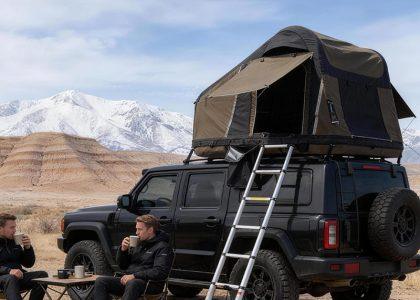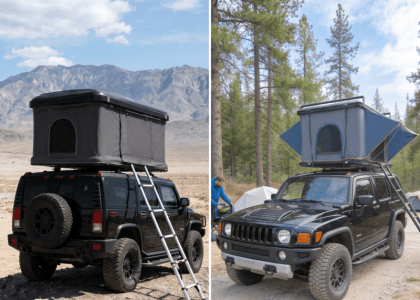
Stocking rooftop tents is different from selling ordinary camping gear.
A rooftop tent can look great in a showroom and still become a poor dealer SKU if it requires uncommon racks, takes too much workshop time to install, creates repeated fitment questions, occupies excessive warehouse space, or leaves the shop handling difficult after-sales issues.
For an off-road shop, 4×4 store, truck-accessory retailer, or vehicle upfitter, the best dealer product is not simply the tent with the longest feature list.
It should work for the customers and vehicles your shop actually serves.
A practical dealer evaluation should focus on five areas:
- Customer coverage
- Vehicle and rack fitment
- Installation labor
- Inventory efficiency
- After-sales support
The goal is not to build the largest rooftop-tent catalog.
It is to build a lineup your sales team can explain, your technicians can install, and your shop can support after the sale.
Start With Your Customer Mix, Not the Rooftop Tent Catalog
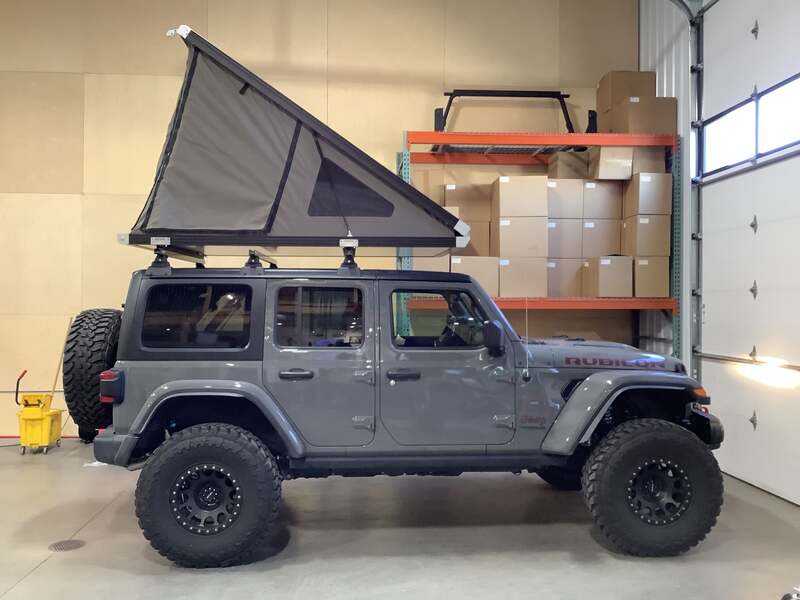
Before comparing hard shells, soft shells, fabrics, or mattresses, look at the vehicles already coming through your shop.
A store serving mostly pickup trucks may need a very different RTT assortment from a retailer serving compact SUVs and crossovers.
Start with one question:
What kinds of rooftop-tent buyers do we actually see?
Compact SUV and Crossover Customers
These buyers may prioritize:
- lower tent weight;
- smaller closed footprint;
- vehicle roof-load constraints;
- compact two-person layouts;
- rack compatibility.
A lower-weight rooftop tent can expand the number of products worth considering, but weight alone never proves fitment.
The exact vehicle, rack, tent weight, mounting system, and load requirements still have to be checked.
For deeper research into the lightweight category, use our Lightest Rooftop Tents: Current Weight Comparison guide.
Jeep and Mid-Size SUV Customers
These customers may care about:
- hard-shell designs;
- low closed profiles;
- quick deployment;
- platform-rack compatibility;
- hatch clearance;
- accessory integration.
For SUVs in particular, a tent can technically fit the rack while still interfering with rear-hatch use or occupying more roof area than expected.
Pickup and Overland-Build Customers
Pickup owners may use:
- bed racks;
- cab-height racks;
- full-height bed systems;
- platform racks;
- canopies.
For these customers, the rooftop tent is often only one part of the vehicle build.
They may also want:
- awnings;
- solar;
- lighting;
- traction boards;
- storage;
- recovery equipment.
That makes accessory and rack-system compatibility especially important.
Family and Larger-Vehicle Customers
Family buyers often need a larger sleeping platform.
But a “family tent” does not automatically imply one universal rack requirement.
Larger-capacity tents can have different travel weights, packed footprints, mounting spreads, and rack requirements, so every model should be checked against the exact vehicle and rack.
For model-level family comparisons, see our Best Rooftop Tent for a Family of 4 guide.
Build a Starter Rooftop Tent Assortment Around Four Buyer Needs
A new rooftop-tent dealer does not necessarily need ten models.
A more useful starting strategy is to cover several clearly different customer problems.
| Dealer Slot | Product Type | Typical Customer Need | Why It Earns a Place |
|---|---|---|---|
| Lightweight | Compact 2-person | Smaller SUVs, crossovers, weight-sensitive builds | Expands lower-weight fitment options |
| Value | Soft shell | First-time or budget-conscious buyer | Creates a lower entry price |
| Mainstream | Hard shell | Buyers prioritizing quick deployment and compact packing | Strong showroom/demo category |
| Family | Larger fold-out | Families, trucks, larger SUVs | Covers higher-capacity demand |
1. Lightweight / Compact Rooftop Tent
This slot can serve:
- crossovers;
- smaller SUVs;
- couples;
- buyers conscious of roof-mounted weight.
Do not evaluate it from tent weight alone.
Also verify:
- closed footprint;
- rack requirement;
- sleeping dimensions;
- mounting hardware;
- ladder architecture.
2. Entry-Level / Value Soft Shell
This slot can serve:
- first-time RTT buyers;
- budget-conscious customers;
- customers prioritizing sleeping area over shell architecture.
If your shop wants to benchmark current lower-price consumer options before defining a dealer price band, see our Best Rooftop Tents Under $1,500 guide.
3. Mainstream Hard Shell
This category can serve customers who prioritize:
- quick deployment;
- a rigid closed shell;
- compact packing;
- a cleaner showroom demonstration.
For current consumer-side architecture comparisons, our Best Hard Shell Rooftop Tent guide can help define the types of products buyers are already comparing.
4. Family / Larger-Capacity Rooftop Tent
This slot can cover:
- families;
- larger SUVs;
- trucks;
- customers needing wider sleeping platforms.
It should solve a genuinely different problem from your compact two-person SKUs.

Optional Fifth Slot: Accessory-Ready Premium Hard Shell
Once demand justifies a broader lineup, an additional SKU can target buyers looking for:
- aluminum construction;
- roof rails;
- accessory mounting;
- solar integration;
- expedition-oriented builds.
The principle is simple:
Stock rooftop tents by customer problem, not by model count.
Four products solving four different needs can be more useful than ten near-identical tents competing for the same customer.
Evaluate Installability Before Retail Features
Consumers often compare mattresses, fabrics, setup speed, and shell appearance.
A dealer should add another category:
Installability
Installability describes how practical a rooftop tent is for your technicians to fit correctly and repeatedly across the vehicles your shop services.
A product with attractive consumer specifications can still become a difficult dealer SKU if installation is poorly documented or unnecessarily complex.
1. Published Tent Weight
Weight affects more than the vehicle.
It also affects:
- unloading;
- warehouse handling;
- showroom setup;
- technician handling;
- installation planning.
Handling requirements depend on the tent’s actual weight, dimensions, shop procedures, and available lifting equipment.
IRONMAN 4X4’s dealer workshop guidance discusses rooftop tents in the 120–150 lb range in its own installation context, recommends at least two people for positioning bulky units, and notes that padded hoists or forklifts can also be useful where available.
That should not be treated as a universal weight threshold for every RTT.
The lesson for a dealer is simpler:
Know how your shop will physically receive, move, display, and install each product before you stock it.
2. Mounting Hardware
Ask:
- Is mounting hardware included?
- Is a separate bracket kit required?
- Are low-profile adapters needed?
- Can replacement brackets be ordered?
Every missing adapter creates another opportunity for a booked installation to become a delayed job.
3. Crossbar Compatibility
Your technicians should know:
- compatible crossbar width;
- compatible crossbar height;
- required front-to-back spread;
- side-to-side requirements where applicable;
- rack load requirements.
Do not rely on vague “universal fit” language.
Thule’s current rooftop-tent installation guidelines are a useful example. They specify crossbar dimensions and model-specific spacing requirements rather than treating every rack as interchangeable.
iKamper likewise publishes model-specific Skycamp installation requirements, including rack dynamic capacity, crossbar spacing, and mounting-bracket dimensions.
4. Platform-Rack Requirement
Some tents depend on a platform-style rack.
That may work well for a customer who already owns the correct rack.
But it can materially change the total installed package for a customer starting from a bare roof.
Your sales team should know the full system requirement before quoting the tent.
5. Hardware Access
Look at how easily technicians can reach:
- bolts;
- nuts;
- mounting rails;
- brackets.
Low-clearance systems can turn an otherwise straightforward installation into a much slower job if standard tools cannot reach the hardware.
6. Hatch and Tailgate Clearance
Check interaction with:
- rear hatches;
- truck cabs;
- canopy doors;
- tailgates;
- rear-mounted accessories.
A tent can physically mount to a rack and still create poor everyday usability.
7. Opening Direction
Side-opening and rear-opening tents can interact differently with:
- ladders;
- awnings;
- tailgates;
- side access;
- recovery gear;
- roof boxes.
This matters even more when the shop sells the RTT as part of a complete overland build.
Never Stock a Tent Without a Fitment Data Sheet
One of the easiest ways to reduce installation problems is to require a clear fitment sheet for every RTT SKU.
At minimum, technicians should be able to access:
- net or travel weight;
- closed dimensions;
- open dimensions;
- mounting rail spacing;
- acceptable crossbar dimensions;
- required bar spread;
- bracket dimensions;
- included hardware;
- vehicle or rack exclusions;
- ladder deployment direction;
- hatch-clearance guidance.
Thule and iKamper are useful examples of the level of model-specific fitment information a dealer can expect from a documented system.
If a supplier cannot provide clear fitment information, the dealer inherits the fitment problem.
Missing information can lead to:
- longer sales conversations;
- delayed installations;
- incorrect orders;
- returns;
- after-sales friction.
A good dealer SKU should be easy to evaluate before the customer’s vehicle enters the installation bay.
Sell the Rooftop Tent or Sell the Complete Setup?
A customer may walk in asking for a rooftop tent.
What they may actually need is:
rack + tent + mounting hardware + installation + accessories
That changes the way a dealer should quote the product.
Package A: Tent Only
Best suited to customers who already have a verified compatible rack.
Before the sale, confirm:
- rack model;
- rack rating;
- crossbar dimensions;
- spacing;
- mounting compatibility.
Do not rely on:
“My rack is strong enough.”
Package B: Tent + Crossbars
This can work well for SUV and crossover customers when an approved crossbar system is available.
It also gives the shop more control over compatibility.
Package C: Tent + Platform Rack
Useful for:
- Jeep builds;
- larger SUVs;
- overland vehicles;
- accessory-heavy setups.
A platform can also provide room for future accessories.
Package D: Tent + Bed Rack
Useful for pickup customers.
The package can be designed around:
- bed configuration;
- rack height;
- cab clearance;
- tailgate use;
- tonneau compatibility;
- awning placement;
- overall vehicle height.
Package E: Complete Camping System
This may combine:
- rooftop tent;
- rack;
- awning;
- lighting;
- storage;
- solar;
- installation.
The advantage is not simply a higher invoice.
The dealer gains more control over system compatibility.
iKamper’s Seattle showroom provides a useful real-world example of the channel model: installation is offered as a separate paid service, and vehicle information is collected before installation through a pre-installation process.
That demonstrates why the “installed product” can be a different commercial proposition from the tent alone.
Hard Shell vs. Soft Shell: Which Should a Dealer Stock?
Most shops can justify both if the two categories serve different customers.
Do not treat them as direct substitutes.
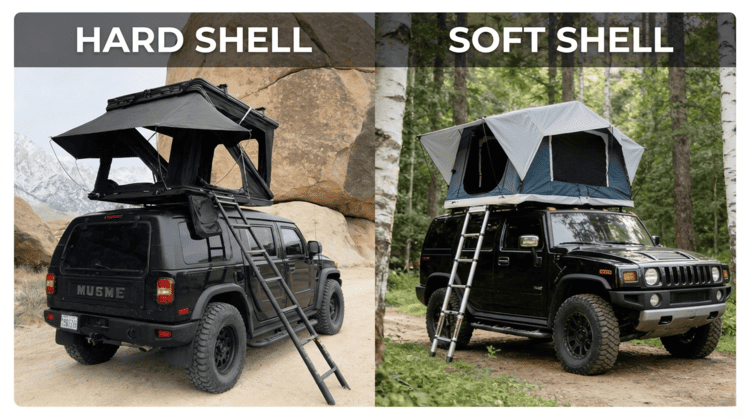
Soft-Shell Rooftop Tents
Dealer advantages
- accessible entry pricing on many models;
- large fold-out sleeping platforms;
- familiar architecture;
- useful entry point for first-time RTT customers.
Dealer considerations
- more fabric components;
- covers and straps may require more handover explanation;
- larger deployed footprint;
- some designs use additional poles or supports.
Hard-Shell Rooftop Tents
Dealer advantages
- strong showroom presentation;
- quick open-and-close demonstration;
- attractive to frequent campers;
- strong fit with many premium overland builds.
Dealer considerations
- higher inventory capital on many models;
- large shipping cartons;
- heavier units in some product families;
- shell, latch, hinge, or gas-strut service considerations.
Do not assume:
- every hard shell is more durable;
- every hard shell is easier to install;
- every soft shell is cheaper.
Compare the exact SKU.
Match the Product Line to Your Installation Capacity
Not every 4×4 shop has the same workshop.
A smaller retailer may have:
- one installation bay;
- limited warehouse space;
- no ceiling hoist;
- a small technician team.
A larger upfitter may have:
- multiple bays;
- forklifts;
- lifting equipment;
- platform-rack experience;
- fabrication capability.
Your assortment should reflect the shop you actually operate.
Smaller Shop
Prioritize:
- manageable handling requirements;
- straightforward mounting;
- commonly supported rack interfaces;
- fewer core SKUs;
- strong documentation.
Larger Installation Center
You may be better positioned to handle:
- heavier aluminum tents;
- platform systems;
- complex accessory builds;
- specialized mounting;
- premium integrated packages.
IRONMAN’s dealer installation resource specifically discusses work platforms, multiple-person handling, and lifting equipment for RTT installation in its own workshop context.
The broader lesson is:
The best catalog is not the biggest catalog. It is the one your shop can install consistently.
Calculate Dealer Cost Beyond the Tent Price
The wholesale product price is only one part of the equation.
Rooftop tents are bulky SKUs.
A dealer should also evaluate:
Freight
Large cartons may require different receiving arrangements and cost more to move than ordinary accessories.
Warehouse Space
One RTT carton can consume storage space that could otherwise hold many smaller products.
Showroom Samples
A display tent can help close a sale, but it also ties up inventory capital.
Installation Labor
Some systems require more preparation, hardware access, or rack work than others.
Adapter Inventory
Your shop may need to stock:
- brackets;
- low-profile mounts;
- crossbar adapters;
- hardware kits.
Returns
Returning or replacing a large RTT is operationally different from returning a small accessory.
Warranty Labor
Even when the manufacturer supplies a replacement component, the shop may still spend time:
- diagnosing the problem;
- coordinating the claim;
- removing hardware;
- fitting replacement parts;
- communicating with the customer.
Those operational costs should be part of the product-selection conversation.
Warranty Length Is Not the Same as After-Sales Burden
A long warranty can be valuable.
But warranty duration alone does not tell the dealer how much work a claim will create.
Ask:
- Who submits the claim?
- Does the customer deal directly with the manufacturer?
- Is the dealer expected to manage the process?
- Are replacement components available?
- Can a failed component be replaced separately?
- Who handles installation labor?
- What documentation is required?
iKamper’s current RTT warranty information, for example, publishes a two-year limited rooftop-tent warranty and describes replacement-part treatment, while installation responsibility remains separate.
The useful dealer principle is:
Evaluate warranty duration together with parts availability, claim responsibility, replacement scope, and installation labor.
Do not use warranty length by itself as a proxy for after-sales workload.
What Rooftop Tent Spare Parts Should a 4×4 Shop Keep?
A dealer does not necessarily need another complete tent to solve every service issue.
Depending on the models you sell, useful service components may include:
- mounting hardware;
- brackets;
- latches;
- straps;
- keys;
- ladder feet;
- awning poles;
- zipper pulls;
- model-specific gas struts;
- replacement fasteners.
Only stock parts that match the exact products in your catalog.
Avoid building a generic “universal RTT repair kit” without confirmed compatibility.
A small product-specific service-parts inventory can sometimes solve a customer problem without tying up capital in a complete replacement tent.
Dealer Product Evaluation Matrix
Before adding a new rooftop tent to your lineup, evaluate every candidate with the same framework.
| Factor | What the Shop Should Verify | Why It Matters |
|---|---|---|
| Tent weight | Exact travel/net weight | Fitment + handling |
| Rack requirement | Crossbars, platform, or bed rack | Total customer package |
| Bar compatibility | Width, height, spread | Avoids failed installation |
| Packed footprint | L × W × H | Roof space + clearance |
| Capacity | Actual sleeping area + stated occupancy | Customer matching |
| Installation access | Hardware/tool clearance | Workshop labor |
| Spare parts | Brackets, latches, ladders, hardware | After-sales workload |
| Warranty process | Claimant, replacement scope, labor | Dealer burden |
| Packaging | Carton dimensions and protection | Freight + storage |
| SKU overlap | Unique customer problem | Inventory efficiency |
This kind of matrix is generally more useful to a dealer than comparing fabric specifications alone.
Ask These 10 Questions Before Choosing a Rooftop Tent Supplier
A supplier should reduce uncertainty before the first order arrives.
1. Can you provide exact net or travel weight?
Avoid relying on unclear shipping-weight figures.
2. Can you provide mounting-dimension drawings?
Technicians need more than marketing photos.
3. Which rack systems or crossbar profiles have been validated?
Do not assume universal fit.
4. What mounting hardware is included?
Clarify adapters, bracket kits, and required tools.
5. Which replacement parts can be ordered separately?
Ask about:
- ladders;
- brackets;
- latches;
- struts;
- fabric components;
- fasteners.
6. Which failures require full-unit replacement?
This can materially affect dealer workload and customer downtime.
7. How is the product packaged for freight?
Rooftop tents may pass through several logistics stages before reaching your shop.
8. Can showroom or demo samples be ordered separately?
A dealer may want to treat display inventory differently from normal retail stock.
9. Can branding, packaging, colors, or accessories be customized?
This becomes especially important for regional and private-label programs.
10. Can the shop start with a focused model mix?
A dealer should be able to validate local demand before expanding into overlapping SKUs.
A Practical Starter Lineup for a New Rooftop Tent Dealer
A focused assortment may be more useful than a large initial catalog.
SKU 1 — Compact / Lightweight 2-Person
Purpose: Serve smaller vehicles and weight-sensitive buyers.
SKU 2 — Value Soft Shell
Purpose: Create an accessible entry point for first-time rooftop-tent customers.
SKU 3 — Mainstream Hard Shell
Purpose: Serve customers prioritizing quick deployment and rigid-shell architecture.
SKU 4 — Family-Capacity Model
Purpose: Cover larger SUVs, trucks, and higher-capacity demand.
Optional SKU 5 — Accessory-Ready Premium Hard Shell
Purpose: Serve expedition-oriented and higher-value overland builds.
This assortment works because each SKU has a different job.
It does not require a dealer to predict an arbitrary percentage mix.
When Should a Dealer Add More Models?
Expand when actual demand shows that your current assortment has a gap.
Examples include:
- repeated requests for larger family tents;
- local demand for lightweight products;
- customers specifically asking for all-aluminum shells;
- frequent pickup builds needing bed-rack-compatible tents;
- demand for premium accessory-ready systems;
- rental or fleet customers with standardized vehicle platforms.
Do not expand simply because another supplier has more SKUs.
Inventory should respond to your market.
Common Rooftop Tent Dealer Mistakes
Stocking Too Many Similar Models
Several two-person hard shells at similar prices may create inventory overlap instead of meaningful customer choice.
Focusing Only on Tent Price
A lower-priced tent that requires an expensive rack may not create the lowest installed price.
Ignoring Installation Labor
A product that looks attractive at wholesale can become less attractive if every installation creates unnecessary workshop complexity.
Assuming Factory Crossbars Are Compatible
Never assume.
Verify:
- vehicle requirements;
- rack approval;
- tent mounting requirements;
- bar dimensions;
- spacing.
Ignoring Replacement Parts
Small product-specific service components can prevent unnecessary full-unit returns.
Checking Fitment After the Sale
The most expensive time to discover a fitment problem is after the product has arrived and the installation has already been booked.
Manufacturer Perspective: What Everlead Can Support
For retailers, distributors, and 4×4 shops developing a regional or private-label RTT line, supplier selection should go beyond picking a finished catalog product.
A manufacturer should be able to discuss:
- target customer segment;
- vehicle mix;
- desired tent weight;
- sleeping capacity;
- shell architecture;
- mounting requirements;
- accessories;
- packaging;
- branding.
Everlead Outdoor develops hard-shell and soft-shell rooftop tents for OEM and ODM projects.
Depending on the project, customization can include:
- dimensions;
- shell architecture;
- materials;
- fabrics;
- mattresses;
- accessories;
- branding;
- packaging.
Everlead’s current OEM/ODM rooftop-tent product information also identifies branding, packaging, and accessory specifications as part of the B2B discussion.
For a dealer-focused program, the product brief should also define:
- preferred rack types;
- installation constraints;
- replacement-part strategy;
- showroom requirements;
- shipping configuration.
The goal is not to create the largest catalog.
It is to build a product line your technicians can install, your sales staff can explain, and your customers can support after purchase.
Planning a Dealer or Private-Label Rooftop Tent Line?
If you already know your target vehicle mix, price segment, preferred architecture, and core customer types, Everlead can use those requirements as the starting point for a rooftop-tent project discussion.
Talk to Everlead About Your Rooftop Tent Requirements
Frequently Asked Questions
How many rooftop tent models should an off-road shop stock?
There is no universal number.
Start by covering distinct customer needs rather than stocking multiple overlapping products.
A practical assortment structure can include:
- lightweight 2-person;
- value soft shell;
- mainstream hard shell;
- family-size model.
Expand when real customer demand exposes a missing category.
Should a 4×4 shop stock hard-shell or soft-shell rooftop tents?
Both can make sense if they serve different customers.
Soft shells can cover lower-price and large fold-out sleeping-space demand.
Hard shells can serve buyers prioritizing rigid-shell architecture, compact packing, and quick deployment.
Should rooftop tents be sold together with roof racks?
If the customer already owns a verified compatible rack, a tent-only sale can work.
If compatibility is uncertain, quoting the rack and tent together gives the shop more control over the final fitment.
What information should a rooftop tent supplier provide?
At minimum:
- exact product weight;
- closed/open dimensions;
- mounting requirements;
- crossbar requirements;
- included hardware;
- warranty terms;
- replacement-parts information;
- packaging details.
Can rooftop tents be installed on factory crossbars?
Sometimes, but never assume compatibility.
Check the exact:
- vehicle;
- rack/crossbar system;
- dynamic load requirements;
- tent mounting requirements;
- crossbar dimensions;
- required spread.
Do rooftop tent dealers need lifting equipment?
It depends on the products and the shop.
Handling requirements should be based on actual product weight and dimensions, staff procedures, and available workshop equipment.
For bulky products, manufacturer or dealer guidance may recommend multiple-person handling, work platforms, hoists, or forklifts.
What is the most important factor when choosing a rooftop tent supplier?
There is no single factor.
For a dealer, useful supplier signals include:
- clear specifications;
- fitment documentation;
- consistent mounting hardware;
- separately available service parts;
- appropriate packaging;
- product-level support.
Final Takeaway
An off-road shop should not choose rooftop tents exactly the way a consumer does.
Consumers often begin with:
- price;
- shell type;
- mattress;
- appearance.
A dealer also has to consider:
- customer coverage;
- rack compatibility;
- installation labor;
- warehouse space;
- warranty workload;
- replacement parts;
- packaging.
The most useful rule is:
Stock rooftop tents by customer problem, not by SKU count.
And before adding any product, ask:
Can our sales team explain it, can our technicians install it efficiently, and can we support it after the sale?
If the answer to all three is yes, the product is much more likely to become a useful dealer SKU instead of an expensive box sitting in the warehouse.