When researching the lightest rooftop tent, the number on the specification sheet does not always describe the same amount of hardware.
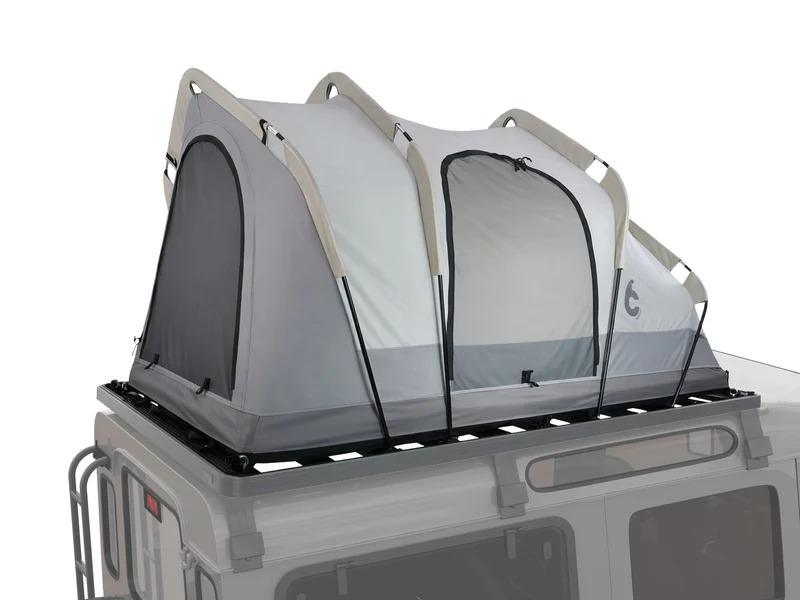
The C6 Rev Rack Tent G2 Element publishes a tent weight of just 25 lb / 11.5 kg, but it relies on a buyer-supplied platform rack as its sleeping support surface and does not include a ladder.
By comparison, the TentBox GO is published at 33 kg / ~72.8 lb, while the Inspired Overland Standard is published at 76 lb / 34 kg. Both use their own sleeping-support structures rather than using a full-size platform rack as the tent floor.
That makes the central question more useful than simply asking which tent has the smallest headline number:
What does the published weight actually represent, and how much total mass will your vehicle carry while driving?
Quick Answer: What Is the Lightest Rooftop Tent?
There is no single unqualified “lightest rooftop tent” because current products use fundamentally different architectures.
Lightest verified rack-dependent tent in this research:
The C6 Rev Rack Tent G2 Element weighs 25 lb / 11.5 kg. It requires a compatible platform-style roof rack at least 48 × 84 in and does not include the roof rack or ladder.
Lightweight complete-tent candidates:
The TentBox GO publishes a weight of 33 kg / ~72.8 lb and uses a stretched-fabric sleeping structure. TentBox separately lists its ladder and vehicle mounting kit as included, while roof bars are supplied separately.
The Inspired Overland Standard publishes a weight of 76 lb / 34 kg. Inspired separately lists mounting hardware, a telescoping ladder, a 1.5 in foam mattress and an anti-condensation pad as included equipment.
Conventional lightweight comparison:
The Roofnest Meadowlark publishes a weight of 90 lb and includes its tent platform, mattress, ladder and universal mounting kit.
Mainstream compact benchmark:
The Thule Approach S weighs 110 lb, providing a useful comparison point for a conventional compact 2-person fold-out RTT.
The important distinction is that these published weights should not automatically be treated as identical system boundaries.
Comparison Table: What Does Each Published Weight Actually Represent?
| Model | Published Product Weight | Sleeps | Sleeping Platform Included? | Ladder Listed as Included? | Vehicle Rack / Crossbars Still Required? | System Classification |
|---|---|---|---|---|---|---|
| C6 Rev Rack Tent G2 Element | 25 lb / 11.5 kg | 2 | No — compatible platform rack acts as sleeping support | No | Yes — ≥48 × 84 in compatible platform rack | Rack-dependent tent |
| TentBox GO | 33 kg / ~72.8 lb | 2 | Yes — stretched-fabric bed structure | Yes | Yes — compatible roof bars | Complete lightweight tent |
| Inspired Overland Standard | 76 lb / 34 kg | 2 | Yes — structural base | Yes | Yes — compatible rack/crossbars | Complete lightweight tent |
| Roofnest Meadowlark | 90 lb | 2 | Yes | Yes | Yes — compatible crossbars | Conventional lightweight tent |
| Thule Approach S | 110 lb | 2 | Yes | Yes | Yes — compatible rack/crossbars | Mainstream compact comparison |
Important: “Published product weight” does not necessarily mean every manufacturer uses the same weighing boundary. Some manufacturers separately identify included ladders, mounting hardware, mattresses and other components without explicitly stating that every detachable component was present when the published product weight was measured.
The vehicle rack or crossbars also remain outside the tent’s headline product weight and still matter for the vehicle’s moving roof load.
C6 Rev Rack Tent: 25 lb, but the Platform Rack Is Part of the Architecture
At 25 lb / 11.5 kg, the C6 Rev Rack Tent G2 Element is the lightest verified tent unit in this comparison.
Its architecture explains why.
C6 specifies that the tent mounts directly to a platform-style rack measuring at least 48 × 84 in, with rack slats separated by no more than 8 in. The platform rack functions as the sleeping support surface.
C6 also states that the roof rack and ladder are not included.
The tent itself provides:
- a 2-person sleeping space;
- 48 × 84 in open exterior dimensions;
- approximately 47 × 81 in interior dimensions;
- a built-in mattress;
- hardware for compatible platform-rack mounting.
This creates an important comparison boundary.
The C6 tent unit is 51 lb lighter than a 76 lb product such as the Inspired Overland Standard, but that does not equal a 51 lb installed-system saving. The C6 requires a separate full-size platform rack.
To calculate the real moving roof load, use the published weight of the exact rack installed on your vehicle rather than assuming the 25 lb tent weight represents the complete rooftop system.
TentBox GO: ~72.8 lb Published Product Weight
TentBox publishes the GO at 33 kg / approximately 72.8 lb.
Its design differs sharply from both the C6 rack-dependent architecture and more conventional rigid-floor folding tents.
The GO sleeps two people on a stretched-fabric bed structure supported by a powder-coated aluminum tubular frame.
TentBox separately lists the following as included:
- telescoping ladder;
- storage pockets;
- vehicle mounting kit;
- installation parts and tools other than roof bars.
Roof bars are supplied separately.
One detail matters when comparing comfort specifications: TentBox sells a separate self-inflating GO mattress as an optional accessory. The standard tent therefore should not be compared with other RTTs as though a conventional foam mattress is automatically included in the published product configuration.
Its sleeping area measures approximately 110 × 210 cm, while its closed dimensions are approximately 122 × 225 × 45 cm.
TentBox also states that bedding can remain inside the GO when closed, which is a useful reminder that low product weight does not automatically determine bedding-storage capability.
Inspired Overland Standard: 76 lb Published Weight
The Inspired Overland Standard publishes a product weight of 76 lb / 34 kg.
Its product page separately lists:
- mounting brackets;
- required mounting hardware;
- telescoping ladder;
- 1.5 in foam mattress;
- anti-condensation pad.
The tent sleeps two people and provides:
- 82 × 50 in exterior dimensions;
- 78 × 48 in interior sleeping space;
- 48 in open interior height;
- 6 in closed height including its mounting crossbar.
The published difference between the TentBox GO and Inspired Standard is only about 3.2 lb.
That number should not be interpreted as a direct engineering winner, however, because the two products use different sleeping structures, mattress configurations and overall architectures.
Their closeness in headline weight is more useful as evidence that multiple design approaches can reach the low-70-to-mid-70-lb range.
Other Lightweight Current Options
Roofnest Meadowlark — 90 lb
The Roofnest Meadowlark publishes a weight of 90 lb.
Roofnest separately lists an integrated 2.5 in foam mattress, 7.5 ft telescoping ladder and universal mounting kit with the tent.
It sleeps two people and provides an approximately 80 × 43 in interior sleeping area.
It is heavier than the TentBox GO and Inspired Standard, but it remains a useful conventional lightweight soft-shell comparison.
Thule Approach S — 110 lb
The Thule Approach S weighs 110 lb.
Thule lists:
- 2-person sleeping capacity;
- 82 × 43 in sleeping footprint;
- 660 lb static weight capacity;
- minimum 28 in crossbar spread.
At 110 lb, the Approach S provides a mainstream compact 2-person comparison point rather than an ultralight specialist benchmark.
Tent Weight vs. Total Moving Roof Load
A rooftop tent does not travel on the vehicle by itself.
Thule’s current fit guidance states that a rooftop tent combined with the roof racks must remain within the vehicle manufacturer’s dynamic roof-load limit.
For a dynamic roof-load check, account for every component actually carried on the roof while driving:
tent + rack/crossbars + mounting components not already included in the published tent weight + roof-mounted accessories or cargo
Then compare that total with the applicable vehicle and rack limits.
| Weight Concept | What It Means | How to Use It |
|---|---|---|
| Published Tent/Product Weight | Manufacturer’s listed product mass | Useful starting point, but confirm what the manufacturer says is included |
| Rack/Crossbar Weight | Vehicle mounting system supporting the tent | Must also be considered in the vehicle’s dynamic roof load |
| Roof-Mounted Accessories/Cargo | Gear actually remaining on the roof while driving | Include when checking moving roof load |
| Total Moving Roof Mass | Combined roof-mounted system while driving | Compare against applicable vehicle and rack dynamic limits |
This distinction is especially important for the C6.
A 25 lb rack-dependent tent and a 76 lb complete tent product are not automatically separated by 51 lb once installed on the vehicle, because their supporting rack requirements differ.
How Light Does Your Vehicle Setup Actually Need to Be?
Three constraints matter more than chasing the lowest possible tent number.
Vehicle Dynamic Roof-Load Capacity
Check the vehicle manufacturer’s documentation for the maximum roof load permitted while driving.
This is vehicle-specific. Do not assume similar-size SUVs, crossovers, wagons or sedans share the same rating.
Rack Capacity and Compatibility
Roof racks have their own dynamic capacity and fit requirements.
Thule’s rooftop-tent guidelines note that bars, feet and fit kits can have different ratings, with the lowest-rated component determining the rack system’s maximum capacity for that system.
Crossbar spacing and tent mounting compatibility must also be checked separately from weight capacity.
Handling and Storage
Lower product mass can reduce handling effort during installation, removal and off-season storage.
However, the number on the scale is not the only factor. Actual handling difficulty also depends on:
- overall dimensions;
- shape;
- grip points;
- vehicle height;
- installation method;
- lifting equipment.
A lighter rooftop tent should therefore not automatically be assumed to be suitable for solo lifting.
How Lightweight RTTs Achieve Lower Published Weight
There is no single “ultralight formula.” Current lightweight RTTs reach low published weights through different architectures.
C6: Use the Vehicle Platform as Sleeping Support
The 25 lb C6 Rev Rack Tent does not bring its own conventional full-size structural sleeping platform.
Instead, it uses a compatible platform roof rack as the support surface.
This dramatically changes what the 25 lb headline number represents compared with a conventional tent package.
TentBox GO: Stretched-Fabric Sleeping Structure
The TentBox GO uses a stretched-fabric bed supported by a tubular frame rather than the rigid folding platform architecture used by many RTTs.
TentBox publishes the GO at 33 kg and sells a separate self-inflating mattress as an optional accessory.
Inspired Overland: Lightweight Conventional Package
Inspired Overland takes a more conventional approach while publishing a 76 lb product weight.
Its package includes a structural base and separately lists a 1.5 in foam mattress, anti-condensation pad, ladder and mounting equipment.
Mattress Configuration Does Not Follow One Weight Rule
The current products illustrate why mattress thickness should not be treated as a universal ultralight trade-off:
- C6 lists a built-in 4 in mattress despite its 25 lb tent-unit weight.
- Inspired lists a 1.5 in foam mattress at 76 lb.
- TentBox sells a separate self-inflating mattress for the GO.
Headline tent weight alone does not predict mattress configuration.
Beware of Discontinued “Lightest” Recommendations
Search results and older forum discussions often include ultralight tents that are no longer active retail products.
A notable example is the Go Fast Campers SuperLite, which was historically discussed around an approximately 80 lb published weight.
GFC announced the final SuperLite release in 2023.
That means the SuperLite can still be relevant to the used market, but it should not be ranked beside currently available first-party products as though it remains an active retail recommendation.
For any “lightest rooftop tent” shortlist, current manufacturer availability should be verified before relying on an older specification.
Manufacturer Perspective: Lightweight Architecture Is a System Decision
Everlead’s current catalog illustrates how different structural concepts can arrive in a similar lightweight range without being directly equivalent products.
Everlead Inflatable Dual-Use RTT — 35 kg Net
Everlead’s Inflatable Dual-Use RTT lists:
- 35 kg net weight
- 38 kg gross weight
- inflatable PVC air-column structure;
- roof and ground-use configuration;
- 95 × 50 × 45 cm packed dimensions.
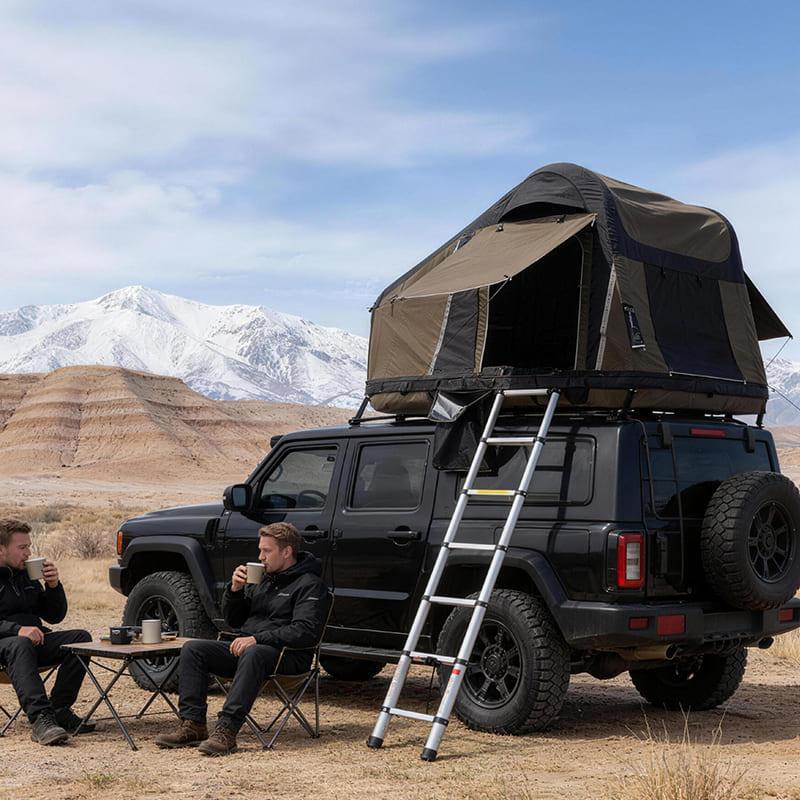
This should be treated as an inflatable architecture example rather than directly ranked against U.S. retail tents whose included-component boundaries may differ.
Everlead Hydraulic Soft Shell — 40 kg Net
Everlead’s Hydraulic 2-Person Soft Shell RTT lists:
- 40 kg net weight
- 52 kg gross weight
- aluminum frame and base;
- gas-strut opening system;
- 19 cm closed height.
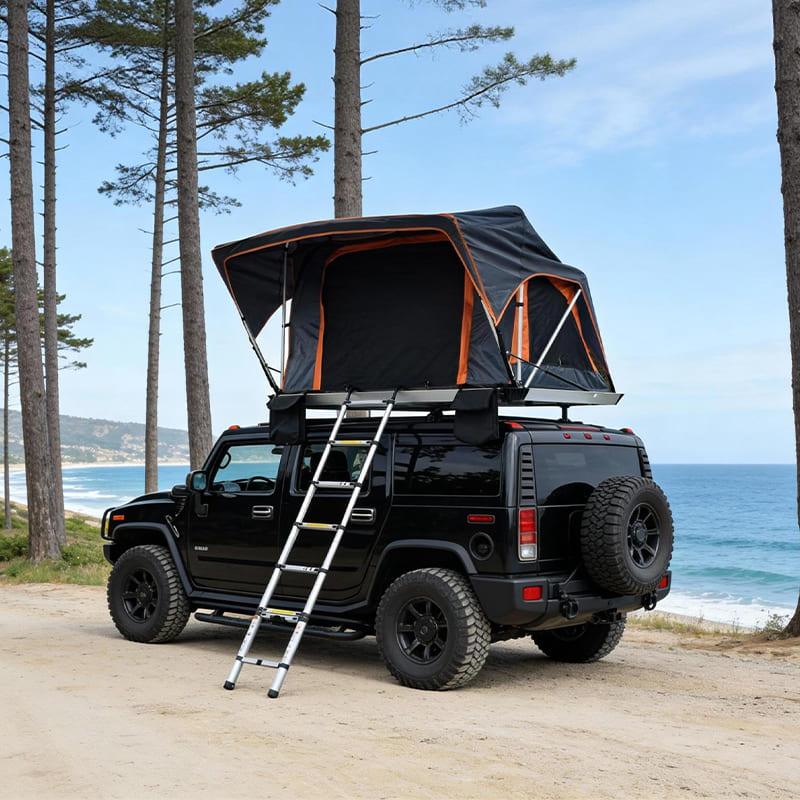
Again, the useful comparison is architectural rather than simply numerical.
Everlead OEM Lightweight Architecture Examples
| Everlead Model | Published Net Weight | Architecture | Key Published Configuration | Comparison Role |
|---|---|---|---|---|
| Inflatable Dual-Use RTT | 35 kg / 77.2 lb | Inflatable rooftop / ground-use tent | Inflatable structural system; 95 × 50 × 45 cm packed size | OEM lightweight architecture example |
| Hydraulic 2-Person Soft Shell RTT | 40 kg / 88.2 lb | Hydraulic-assisted soft shell | Aluminum frame/base; 19 cm closed height | OEM compact soft-shell example |
For OEM development, the product brief should define the target published product weight and its component boundary before architecture is optimized.
Brands should specify:
- target finished/net weight;
- what that weight must include;
- sleeping-support architecture;
- rack interface;
- ladder strategy;
- mattress requirements;
- packed dimensions;
- target vehicle segment.
A 35 kg inflatable design and a 40 kg hydraulic soft-shell design solve the weight target through different structural systems, so the numbers should not be compared without first defining what each product includes.
Bottom Line: Compare System Boundaries, Not Just Weight Numbers
The lightest published rooftop tent in this research set is the 25 lb C6 Rev Rack Tent G2 Element, but that number describes a rack-dependent tent rather than a complete vehicle roof system.
Among the complete lightweight candidates reviewed here, the TentBox GO publishes 33 kg / ~72.8 lb, while the Inspired Overland Standard publishes 76 lb / 34 kg.
The important buying rule is not:
Choose the rooftop tent with the smallest number.
It is:
Compare the published product weight, identify what structural components that product supplies, add the vehicle rack system and anything else carried on the roof while driving, and verify the resulting setup against the vehicle and rack limits.
That gives you a far more meaningful answer to “What is the lightest rooftop tent for my vehicle?” than the headline tent weight alone.