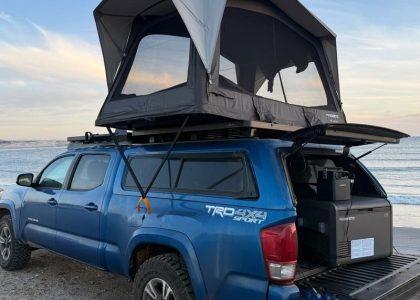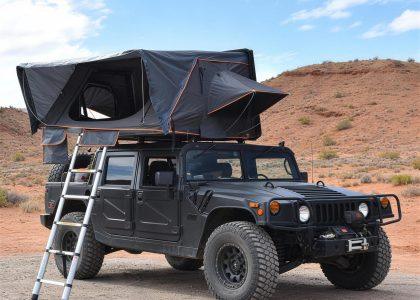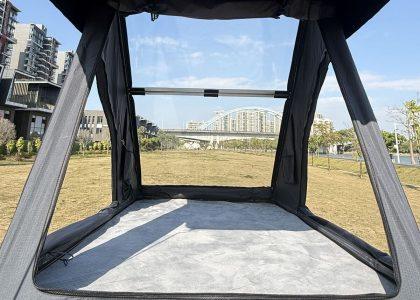
No single rooftop tent is the universal best choice for every family of four. The market is filled with family-sized options, but a “4-person” rating does not mean the same amount of space across all brands. Assuming that any tent labeled “sleeps 4” will comfortably fit four full-grown adults is a buying mistake to avoid. Thule’s earlier Approach L—published with the same 95 × 67 in sleeping footprint as its current model—was explicitly described by Thule as fitting 2 adults + 2 children or 3 adults comfortably. That manufacturer wording illustrates why a “4-person” label should not automatically be read as “four adults comfortably.”
While larger sleeping platforms such as the iKamper Skycamp 4.0 Quad and Smittybilt Gen2 Overlander XL merit serious consideration, their physical dimensions are only part of the equation. Your vehicle and rack capacity must be verified before any tent can safely be selected. A family-size rooftop tent is a heavy piece of equipment, and dynamic roof-load limits can eliminate a spacious tent from your shortlist before comfort or features even matter. This comparison uses actual manufacturer dimensions and specifications instead of relying on generic capacity labels, helping you balance your specific family composition with your vehicle’s exact requirements.
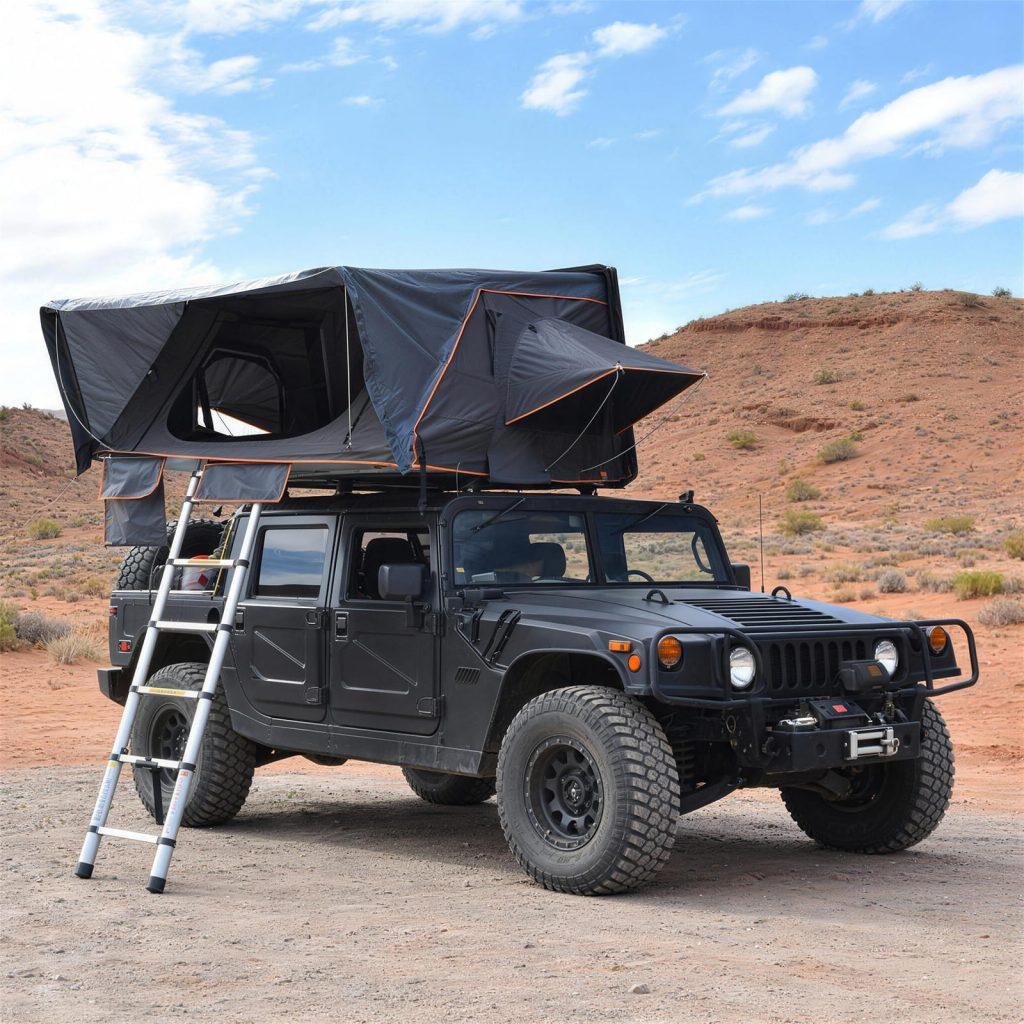
What Does “4-Person Rooftop Tent” Actually Mean?
In the rooftop tent industry, “4-person” is a manufacturer occupancy category, not a standardized comfort guarantee. Because there is no universal testing standard for human sleeping comfort, tent makers use nominal capacity labels that require careful interpretation. Practical fit depends on the actual platform dimensions, occupant mix, sleeping orientation and how much gear shares the space.
For some manufacturers, a four-person tent is explicitly designed for a mixed family. Before ordering, it is critical to compare the actual dimensions of the sleeping platform against your family’s needs.
Quick Comparison: Best Family-of-4 Rooftop Tent Candidates
The Family-of-Four Decision requires passing two independent gates: Human Fit (does the sleeping platform actually accommodate your family?) and Vehicle Fit (can your roof and rack safely carry it?).
Below is the Family Fit Matrix, comparing current validated family rooftop tents by their physical dimensions and mounting requirements rather than just their capacity labels.
Table 1 — Family Fit Matrix: Capacity Label vs. Actual Sleeping Platform
| Model | Manufacturer Capacity | Sleeping Dimensions | Calculated Area | Published Weight | Published Vehicle / Rack / Mounting Requirement | Main Family Use Case |
| iKamper Skycamp 4.0 Quad | 3–4 people | 84⅝ × 83⅛ in | ≈48.85 sq ft | 157 lb (tent + brackets) + 13 lb ladder + 12 lb mattress | ≥185 lb dynamic rating; 30–60 in crossbar range | Spacious current hardshell |
| Thule Approach 2 L | 4 people | 95 × 67 in | ≈44.20 sq ft | 150 lb | Requires at least 165 lb (75 kg) dynamic capacity. Verify current rack type and both front-to-back and side-to-side spacing requirements. | Current Thule 4-person soft-shell candidate |
| Roofnest Condor 2 XL Air | 3–4 people | 89 × 68 in interior | ≈42.03 sq ft | 170 lb | 30 in min crossbar spread | Compact-folding 3–4 person hardshell |
| Smittybilt Gen2 Overlander XL | 3–4 people | 92.5 × 74.8 in bed | ≈48.05 sq ft | Not verified in this pass | Verify vehicle/rack dynamic capacity independently | Large soft-shell footprint |
Source Note: Product data is sourced directly from current official manufacturer documentation (iKamper Skycamp 4.0 Quad, Thule Approach 2 L, Roofnest Condor 2 XL Air, and Smittybilt Gen2 Overlander XL).
Product Note on OVS: OVS currently sells an HD Nomadic 4 Extended, but the legacy OVS documents used in earlier comparisons refer to a different part number. This guide therefore excludes it from the normalized ranking until exact current-generation first-party dimensions and traveling weight are verified.
Conditional Top Picks:
- Best spacious current hardshell candidate: iKamper Skycamp 4.0 Quad. It offers ≈48.85 sq ft calculated from the published dimensions, but requires a robust verified dynamic vehicle/rack rating of at least 185 lbs.
- Current Thule 4-person soft-shell candidate: Thule Approach 2 L. It offers 95 inches of length, but its 67-inch width makes Thule’s previous assessment of “2 adults + 2 children” highly relevant for this footprint.
- Best compact-folding 3–4-person hardshell candidate: Roofnest Condor 2 XL Air. A solid candidate if your vehicle can carry 170 lb and handle the 30-inch minimum crossbar spread.
- Best large soft-shell sleeping footprint candidate: Smittybilt Gen2 Overlander XL. Features an expansive 92.5 × 74.8 inch bed.
How Much Sleeping Space Does a Family of Four Actually Get?
To cut through the marketing terminology, look at the physical sleeping footprint and the calculated sleeping area based on manufacturer dimensions.
- iKamper Skycamp 4.0 Quad: ≈48.85 sq ft calculated from the published dimensions.
- Thule Approach 2 L: ≈44.20 sq ft calculated from the published dimensions.
- Roofnest Condor 2 XL Air: Published interior dimensions: 89 × 68 in; calculated plan area ≈42.03 sq ft. (Manufacturer terminology differs: some brands publish sleeping/mattress dimensions while Roofnest labels this measurement “interior.”)
- Smittybilt Gen2 Overlander XL: ≈48.05 sq ft calculated from the published dimensions.
Two Adults + Two Kids vs. Four Adults
Will the tent still fit when the kids grow? Buying for today’s toddlers is different than buying for tomorrow’s teenagers.
Table 2 — Family Configuration Decision
| Family configuration | What to prioritize | What not to assume |
| 2 adults + 2 young children | Verified 4-person label + dimensions | That it will remain roomy indefinitely |
| 2 adults + 2 older/larger children | Larger actual platform | That “sleeps 4” equals comfort |
| 4 adults | Maximum verified dimensions + manufacturer occupancy guidance | That every 4-person model is appropriate |
| Family + substantial interior gear | Platform room + annex/storage | That nominal occupancy leaves gear space |
If your children are growing rapidly or you take long trips, prioritize larger verified sleeping dimensions, or consider splitting your sleeping arrangements between the rooftop tent and an annex/ground tent.
Can Your Vehicle Carry a Family Rooftop Tent?
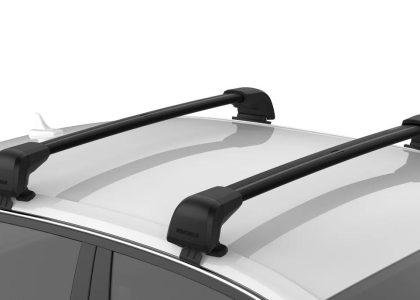
A family RTT can easily be eliminated by your vehicle’s roof or rack limitations before comfort or features ever come into play. You must understand the difference between dynamic and static capacity. Thule defines dynamic capacity as the allowable roof weight while driving, and static capacity as the capacity while parked. For further guidance on vehicle and rack fitment, refer to our 4 Person Rooftop Tent: Capacity, Size & Vehicle Fit Guide.
The tent’s in-use/static rating is separate from the vehicle and rack’s driving limits. Verify the current tent, rack, and vehicle documentation for the complete parked system. For example, Smittybilt publishes a 770 lb maximum load rating for the tent. That number should not be substituted for the vehicle’s dynamic roof limit or rack rating.
Table 3 — Vehicle Fit Checklist
| Check | Why It Matters | Source to Consult |
| Tent travel weight | Applies while driving | Tent manufacturer |
| Vehicle dynamic roof limit | Upper vehicle constraint | Automaker |
| Rack/crossbar capacity | Separate component constraint | Rack manufacturer |
| Crossbar spread | Physical mount compatibility | Tent manufacturer |
| Static system capacity | Occupants while parked | Rack/tent documentation |
When calculating your vehicle’s load, be precise about components. For example, the iKamper Skycamp 4.0 Quad publishes 157 lb for the tent and mounting brackets, but separately lists a 13 lb ladder and 12 lb foam mattress. You must budget for the complete traveling system load. iKamper explicitly specifies a minimum 185 lb dynamic vehicle/rack capacity for this setup. A rack’s rating does not automatically replace or increase the vehicle manufacturer’s original roof limit.
Hard Shell vs. Soft Shell for a Family of Four
When looking at family-sized tents, you will choose between soft-shell and hard-shell (often hybrid fold-out) designs. Shell type alone does not determine sleeping area or vehicle compatibility. Compare each model’s published traveling weight, deployed dimensions, packed footprint and mounting requirements.
- Packed Footprint & Structure: Hard-shells like the Roofnest Condor 2 XL Air and iKamper Skycamp 4.0 Quad feature hybrid fold-out structures. They pack down into an aerodynamic shell (e.g., iKamper’s 85⅜ × 55⅛ in closed footprint with a 13¾ in height). Soft-shells often fold in half, creating a taller but sometimes shorter closed footprint.
- Platform Dimensions: Soft-shells like the Smittybilt Overlander XL can deploy into massive sleeping areas, though some hybrid hard-shells use fold-out panels to achieve similar footprints.
- Product Weight: Both styles can be heavy in the 4-person category. Always verify exact published weights.
Do You Need an Annex?
Annexes can be useful for families camping with children. They provide sheltered weather-protected changing space, a place to store bulky gear out of the sleeping area, and covered ladder access.
However, do not automatically count an annex as additional sleeping capacity. Treat it as sleeping space only if the manufacturer specifically approves that use.
7 Things to Check Before Ordering
Before purchasing, verify both the sleeping platform against your actual family and the tent/rack combination against your exact vehicle:
- Exact people sleeping: Are they young kids, teenagers, or four full-sized adults?
- Sleeping-platform dimensions: Check exact inches/cm, not just the “4-person” label.
- Tent travel weight and included components: Does the published weight include the mattress, brackets, and ladder?
- Vehicle roof rating: Check your owner’s manual for the dynamic driving limit.
- Rack rating/approval: Ensure your aftermarket crossbars can handle the tent’s weight.
- Crossbar spacing/mount geometry: Ensure your bars meet the tent’s required spread (e.g., 30–60 inches for the Skycamp 4.0 Quad, or Thule’s front-to-back and side-to-side spacing requirements for the Approach).
- Packed dimensions/hatch layout: Make sure the closed footprint won’t interfere with your liftgate or extend too far over the windshield.
Manufacturer Perspective: What Makes a Family RTT Different?
For family-size RTT development, nominal occupancy should be treated as only one specification. From a manufacturer’s perspective, target sleeping dimensions, finished product weight, packed envelope, mounting architecture and material choices need to be specified together because changes to one can affect the others.
Everlead Outdoor, an OEM/ODM rooftop-tent manufacturer founded in 2016 and based in Dongguan, China, produces both hard-shell and soft-shell rooftop tents. Their family-size product developments highlight how different architectures achieve capacity. For example, Everlead’s Side Opening ABS Hard Shell RTT (3–4-person capacity) achieves a massive 210 × 210 cm open footprint while maintaining a 76 kg net weight. Meanwhile, their Fiberglass Family Series XL uses a different fold-out geometry to provide 220 × 160 cm internal dimensions at a 74 kg net weight with a 33.5 cm closed height.
Before You Buy:
Choose by family fit first, vehicle fit second, and features third. Verify the sleeping platform against your actual family composition, and confirm the tent and rack combination against your exact vehicle constraints.
For Brands and Distributors: For private-label family RTT development, provide Everlead with your target occupancy, sleeping dimensions, maximum packed weight, vehicle class and opening architecture for OEM/ODM feasibility review by exploring their OEM/ODM capabilities.