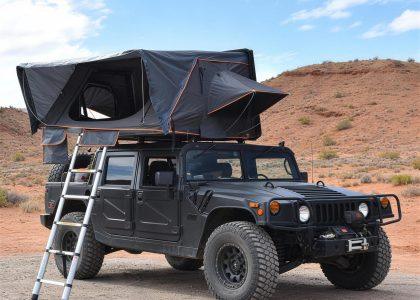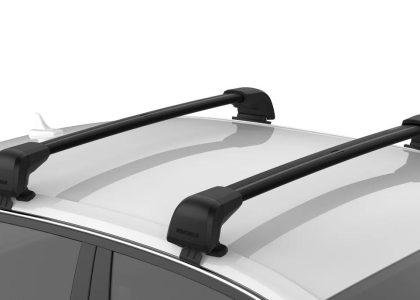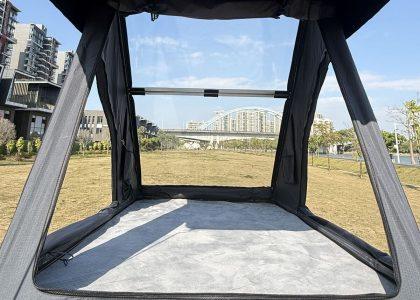
There is no single rooftop tent that is universally “best” for every small SUV. Vehicle roof capacities, roof designs, rack strength, and manufacturer fitment rules vary far too much to make blanket recommendations. Buying a rooftop tent based on the vehicle’s “small SUV” badge instead of its technical specifications is a mistake to avoid.
A small-SUV-friendly rooftop tent generally needs to combine a low packed weight with compact closed dimensions, but a low tent weight alone does not guarantee a safe fit. Among currently validated models, the 49 kg (approximately 108 lb) Dometic Front Runner Feather-Lite II and the 110 lb Thule Approach S are relatively light candidate options. The Thule Foothill 2 preserves roof width, while the 125 lb iKamper Skycamp 3.0 Mini provides a compact hard-shell alternative. However, none of these should be considered compatible until your exact vehicle and roof rack pass their required technical constraints.
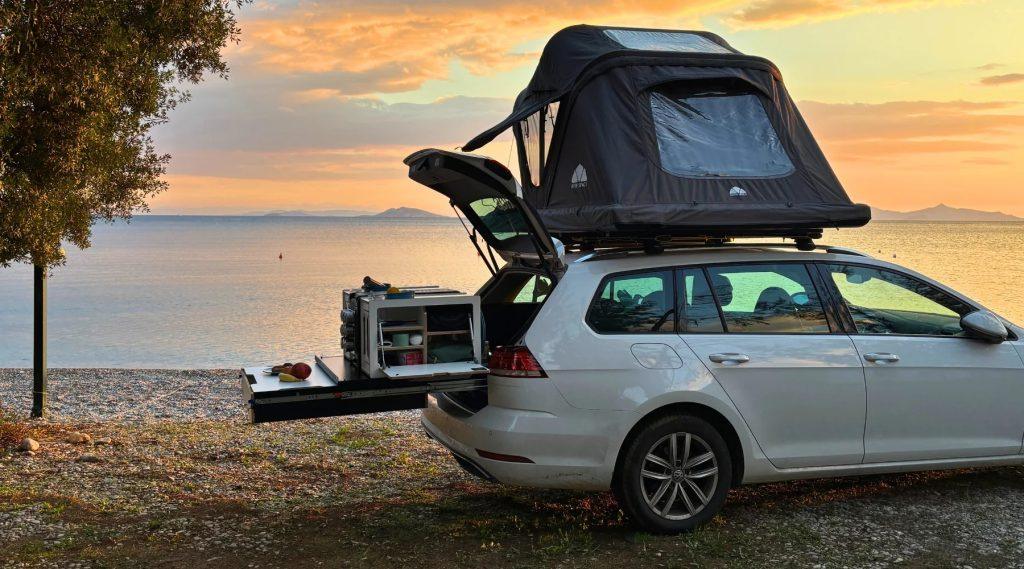
Start Here: Can Your Small SUV Carry a Rooftop Tent?
Instead of beginning with a list of tents, force every potential option through a strict four-gate compatibility check. Thule explicitly advises evaluating the vehicle roof capacity, roof design, and the rack configuration before proceeding.
| Check | Source to Consult | What Must Pass | Common Error |
| 1. Vehicle roof | Owner manual / automaker | Allowable roof load / RTT permission | Using generic “small SUV” load limits |
| 2. Roof architecture | Automaker / rack maker | Rail type / panoramic glass compatibility | Assuming a panoramic roof is automatically fine |
| 3. Rack system | Rack manufacturer | RTT-approved + adequate load rating | Assuming a stronger rack increases the vehicle’s limit |
| 4. Tent interface | Tent manufacturer | Tent weight + mounting requirements + bar spread | Looking only at the sleeping capacity |
Note: For further details on evaluating your crossbars, see What To Consider When Selecting Roof Racks For A Rooftop Tent.
Dynamic vs. Static Roof Load: Which Number Matters?
When verifying your limits, you must understand the difference between dynamic and static loads:
- Dynamic Load: The permissible weight capacity your vehicle’s roof can handle while driving.
- Static Load: The weight your roof system can support while the vehicle is parked and stationary.
Be cautious of universal multipliers. Many online resources claim that static capacity is always three to five times the dynamic capacity. This is not a universal engineering rule. As a guideline for Thule roof racks, Thule states static capacity is approximately three times dynamic capacity. This applies to their racks, not every vehicle roof.
Your Real Weight Limit Is the Lowest Applicable Limit
Your small SUV’s actual dynamic carrying capacity is restricted by the weakest link in your setup. The automaker’s roof-load limit and the roof-rack system’s load limit are separate constraints, and the lower of the two always governs the system.
Every applicable vehicle, rail, rack, mount, and tent requirement must pass. When calculating remaining roof capacity, first check how your automaker defines its published roof-load figure. Subtract rack and hardware weight only when the applicable documentation says those components count toward that limit.
Best Rooftop Tent Candidates for Small SUVs
Below is a verified matrix of compact and lightweight rooftop tents. These models are classified as candidates based on their published specifications, but they still require verification against your specific vehicle and rack.
| Model | Type | Published Weight | Published Closed Footprint / Profile | Mounting / Spacing Requirements | Small-SUV Strength | Critical Limitation |
| Dometic Front Runner Feather-Lite II | Soft-shell | 49 kg (108 lb) | 32 cm (12.6 in) closed profile | Check manufacturer | Lighter soft-shell candidate | Requires verified vehicle load capacity |
| Thule Approach S | Soft-shell | 110 lb | 43 × 48 × 11 in | Check manufacturer | Compact 2-person footprint | Requires a setup meeting Thule’s 165 lb (75 kg) minimum dynamic-capacity requirement and an approved rack configuration; Thule says not to use vehicle factory-installed crossbars. |
| Thule Foothill 2 | Soft-shell | 122 lb | 84 × 25 × 11 in | Verify both Thule’s minimum 28 in front-to-back rack-spacing rule and Foothill’s 24 in side-to-side mounting width; do not rely on the 24-in figure alone. | Preserves roof width (25 in) | Long closed footprint (84 in); heavier |
| iKamper Skycamp 3.0 Mini | Hard-shell | 125 lb | 57.5 × 54.75 in | 22–39 in | Compact fold-out footprint | Requires ≥125 lb roof/rack dynamic capacity |
Source Note: Product specifications must be verified against current official manufacturer documentation (e.g., Dometic Feather-Lite II official page, Thule Approach and Foothill 2 guidelines, iKamper Skycamp 3.0 Mini specifications).
Category Breakdown
- Best lightweight current candidate: Dometic Front Runner Feather-Lite II. At 49 kg (approx. 108 lb), it offers a lighter profile.
- Best compact premium soft-shell candidate: Thule Approach S. It provides a compact 43 × 48 inch closed footprint while weighing 110 lb. Requires meeting Thule’s 165 lb (75 kg) minimum dynamic-capacity requirement and avoiding factory-installed crossbars.
- Best candidate for preserving roof width: Thule Foothill 2. Its narrow 25-inch packed width leaves room for bikes or kayaks, but its 84-inch length and 122 lb weight mean your roof and rack load geometry still control the fit.
- Best compact hard-shell candidate (if capacity allows): iKamper Skycamp 3.0 Mini. It is compact and weighs 125 lb, but iKamper requires the rack/crossbars supporting the Skycamp Mini to have a dynamic rating of at least 125 lb; also verify the vehicle roof limit.
- Yakima-system option: SkyRise HD Small — currently listed by Yakima as a closeout model. Confirm availability before using it as a purchase candidate. This is an option only after ensuring your vehicle and rack have a minimum 165 lb load-carrying capacity, crossbar spread is between 26–40.5 inches, and factory crossbars are replaced, as Yakima prohibits factory bars for this installation.
Which Tent Type Makes More Sense on a Small SUV?
Shell type alone does not determine whether a tent suits a small SUV. Compare the exact model’s weight, closed footprint, height, and mounting requirements. For example, the Foothill 2 is unusually narrow when packed, while the Skycamp Mini uses a compact fold-out hard-shell footprint.
Check These 5 Fitment Details Before You Buy
- Exact model-year roof load: Do not rely on forum generalizations. Find your exact trim and model year in your manual.
- Rack approval/capacity: Ensure the aftermarket rack is officially rated for rooftop tent use.
- Combined roof-system weight: Account for the tent, the rack, and all mounting hardware.
- Bar spread and mount geometry: Verify that your crossbars fall within the tent manufacturer’s allowed distance (e.g., Yakima’s 26–40.5 in rule for side-opening).
- Roof architecture and hatch clearance: Check if a long tent will hit your rear liftgate. Additionally, if you have a panoramic or large glass roof, you must confirm vehicle-specific compatibility rather than making a generic assumption. Supported vs. unsupported rails also matter; Thule advises mounting tents only on supported raised rails and placing crossbars close to the supports.
Examples: Why Vehicle-Specific Numbers Matter
A compact SUV’s capacity cannot be averaged. Consider two real-world manufacturer specifications:
- 2026 Honda CR-V: The 2026 Honda CR-V manual states not to carry more than 165 lb (75 kg) of cargo on the Honda accessory roof rack.
- 2022 Toyota RAV4 (U.S.): Toyota’s 2022 owner manual lists a maximum of 176.4 lb (80 kg) of cargo on the roof luggage carrier. Treat this only as a model-year example; verify the manual for your own RAV4 before selecting a tent.
These figures show that different small SUVs—and different configurations of the same vehicle—yield different available budgets. Toyota likewise warns that roof cargo raises the vehicle’s center of gravity, which is why roof-load limits should be treated as handling limits as well as structural limits.
Source Note: Vehicle load limits are sourced directly from the 2026 Honda CR-V manual and the 2022 Toyota RAV4 (U.S.) owner manual. Always consult your specific model year’s manual.
Small-SUV RTT Mistakes to Avoid
- Starting with tent features: Shopping for mattresses or window designs before checking your vehicle’s payload limits.
- Relying on “SUV compatible” marketing: “Designed for small vehicles” does not establish compatibility with your specific RAV4, CR-V, or Crosstrek.
- Assuming a rack rating overrides a vehicle rating: A rack rated for 200 lb does not increase the structural roof limit set by the automaker.
- Assuming factory crossbars are approved: Yakima explicitly prohibits using factory crossbars for the SkyRise. Always verify.
Manufacturer Perspective: Designing an RTT for Smaller Vehicles
From an OEM manufacturer’s perspective, creating a rooftop tent for small SUVs starts with the target mass, closed dimensions, and the intended vehicle envelope. Everlead Outdoor is an OEM/ODM rooftop-tent manufacturer based in Dongguan, China.
Everlead’s R&D materials list custom dimensions, material selection, structural modifications and weight-reduction engineering among its OEM/ODM development capabilities. Their manufacturing workflow, which includes engineering development, aluminum fabrication, canvas sewing, and assembly, emphasizes that reducing a tent’s weight and footprint requires deliberate design trade-offs.
Commercial OEM & Consumer Next Steps:
If you are an individual buyer, the very first step is to check your exact owner’s manual and rack specifications before selecting any tent.
If you represent an outdoor brand or distributor developing a lightweight private-label RTT for compact SUVs, send Everlead your target weight, closed dimensions, vehicle class, and mounting requirements for an OEM/ODM feasibility discussion by reaching out via the Contact Everlead page.