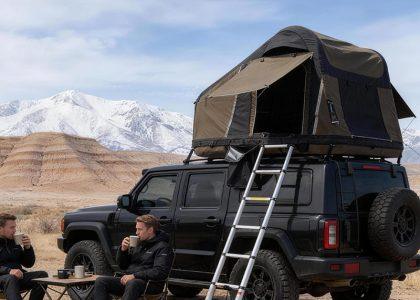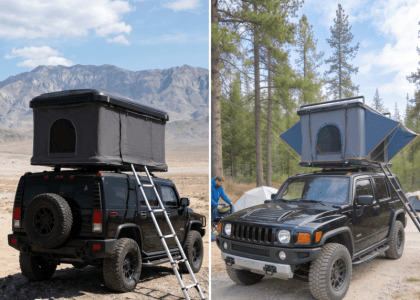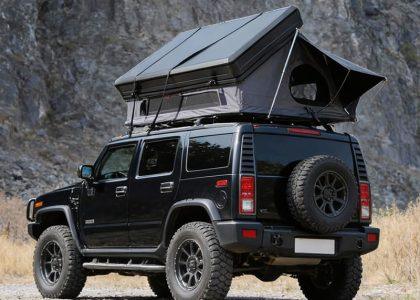
What Does “4-Person Rooftop Tent” Actually Mean?
A “4-person rooftop tent” is a capacity category, not a guarantee that four adults will sleep comfortably in every model. Current manufacturer specifications show substantial variation within this segment.
For example, Thule’s 4-person Approach L specifically describes comfort for two adults plus two children or three adults, while Roofnest sells a larger XXL model explicitly sized for 4+ full-size adults. Therefore, buyers should verify two independent variables before making a decision: does the sleeping platform actually fit the exact group, and can the vehicle and rack system safely carry the tent?
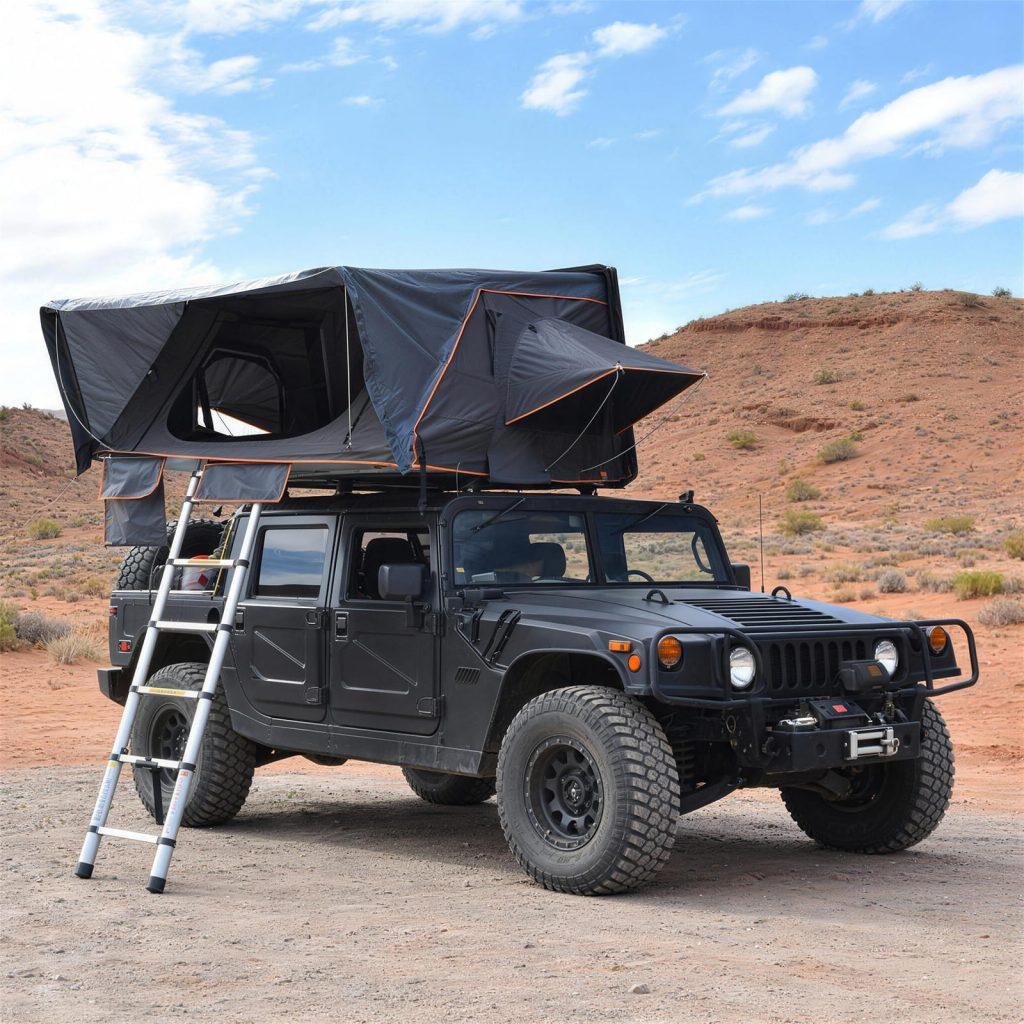
Do 4-Person Rooftop Tents Really Fit Four Adults?
Manufacturer definitions vary. Relying solely on the “4-person” tag is an incomplete approach to buying or sourcing a tent.
To determine true capacity, buyers must look past the category label and examine the manufacturer’s exact occupancy wording alongside the actual sleeping footprint. For instance, iKamper rates its Skycamp 4.0 Quad for 3–4 people. Conversely, the Roofnest Condor 2 XXL Air is positioned explicitly for 4+ full-size adults. Treating the “4-person” label as a universal rule will lead to fitment issues, especially for groups consisting entirely of adults.
Compare Real 4-Person RTT Sleeping Areas
The table below illustrates how different manufacturers define and dimension their 4-person offerings.
| Model | Manufacturer Capacity Wording | Sleeping Dimensions | Published Tent Weight | What the Buyer Should Notice |
| Thule Approach L | 4 person; 2 adults + 2 children or 3 adults comfortably | 95 × 67 in | 150 lb | Manufacturer specifically describes the capacity as 2 adults + 2 children or 3 adults comfortably. |
| iKamper Skycamp 4.0 Quad | 3–4 people | 84⅝ × 83⅛ in | 157 lb (tent + brackets) | Manufacturer rates the model for 3–4 people; verify whether its published sleeping dimensions suit your exact group. |
| Roofnest Condor 2 XL Air | 3–4 | 89 × 68 in | 170 lb | Manufacturer rates the model for 3–4 sleepers; compare the published sleeping dimensions with your actual occupant mix. |
| Roofnest Condor 2 XXL Air | 4+ full-size adults | 95 × 80 in | 205 lb | Manufacturer explicitly positions this model for 4+ full-size adults. At 205 lb published tent weight, vehicle and rack compatibility must be checked against the manufacturer’s requirements. |
| Everlead Side-Opening Family RTT | 3–4; 2 adults + 2 children or 3 adults | 210 × 210 cm | 76 kg | Manufacturer positions this configuration for 2 adults + 2 children or 3 adults. |
Calculated from published manufacturer sleeping dimensions: Thule Approach L (approx. 44.2 sq ft), iKamper Skycamp 4.0 Quad (approx. 48.9 sq ft), Roofnest Condor 2 XL Air (approx. 42.0 sq ft), Roofnest Condor 2 XXL Air (approx. 52.8 sq ft), Everlead Side-Opening RTT (approx. 47.5 sq ft).
Gate 1: Will the Tent Actually Fit Your Group?
A rooftop tent has two separate fit tests. Gate 1 is the People-Fit Gate. Just because a tent passes this gate does not mean it fits your vehicle. To ensure the sleeping arrangement fits your specific group, verify the following:
- Occupant Mix: How many adults versus how many children?
- Manufacturer Wording: Read the manufacturer’s specific occupancy breakdown (e.g., “2 adults + 2 children” vs. “4 adults”).
- Sleeping Footprint: Evaluate the actual mattress length and width.
- Gear Storage: If gear and clothing must be stored inside the tent, the usable sleeping space decreases.
- Platform Limits: Verify if everyone in your group must sleep on the raised platform simultaneously.
Gate 2: Can Your Vehicle and Rack Carry It?
Gate 2 is the Vehicle-Fit Gate. A tent can offer enough room for your family but completely fail your vehicle’s safety parameters. Check the following independently:
- Tent Travel Weight: iKamper publishes 157 lb for the Skycamp 4.0 Quad tent plus mounting brackets.
- Vehicle Dynamic Roof Limit: Verify the vehicle manufacturer’s permitted dynamic roof load and confirm that the complete installed rooftop-tent system remains within that limit.
- Roof-Rack Dynamic Rating: The lowest-rated rack-system component determines the rack-system maximum. iKamper’s current fitment guidance requires at least 185 lb of vehicle roof/rack dynamic capacity for this model.
- Crossbar Spacing: Different tents require different spacing. Thule Approach L requires a minimum bar spread of 31 inches; Roofnest Condor 2 XXL Air requires a minimum crossbar spread of 32 inches; iKamper Skycamp 4.0 Quad requires a range between 30–60 inches.
- Mounting Compatibility: Ensure your specific roof rails and crossbars are compatible with the tent’s required hardware.
- Static Capacity: Verify the system’s capacity when the vehicle is parked and the tent is fully occupied.
Dynamic vs Static Load: Don’t Mix the Two
- Dynamic Load: This applies when the vehicle is moving. The combined traveling roof load must stay strictly within the applicable vehicle and rack limitations.
- Static Load: This applies when the vehicle is parked and the tent is deployed and occupied. The parked system may allow a different load limit, but the correct static capacity must come directly from the relevant vehicle, rack, and tent manufacturers. (For instance, the Thule Approach L has a published static weight capacity of 660 lb).
The relevant limits must be verified across the vehicle, rack, and rooftop-tent system rather than inferred from a universal multiplier.
What Specifications Matter Besides Sleeping Capacity?
When validating a 4-person rooftop tent, use this specification checklist:
- Target Vehicle Category: Ensure the vehicle class matches the tent’s footprint.
- Maximum Acceptable Installed Tent Weight: Define the allowable rooftop-tent system weight using the vehicle manufacturer’s dynamic roof limit, the rack system’s dynamic rating, and the tent manufacturer’s fitment requirements.
- Required Crossbar Spread: Measure your rack to ensure it meets the tent’s minimum and maximum spread.
- Packed Footprint: Verify the packed dimensions and mounting position against the vehicle, rack, and tent manufacturer’s installation requirements.
- Mounting System: Check if your rack requires specific adapters.
Hard Shell or Fold-Out for Four People?
Tent architecture affects the packed footprint, deployed footprint, setup mechanism, and internal sleeping layout. However, actual performance and capacity are model-specific, not strictly defined by shell type.
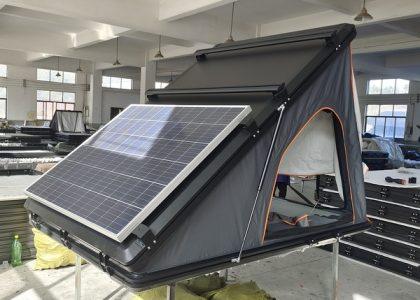
For example, Everlead’s side-opening family model uses a fold-out hard-shell architecture, with published open dimensions of 210 × 210 cm and closed dimensions of 220 × 133 cm. Do not assume shell type alone guarantees sleeping capacity or setup performance; compare exact model specifications.
How Outdoor Brands Should Specify a 4-Person RTT
If you are a B2B buyer or outdoor brand, do not send an RFQ that merely says, “4-person roof top tent.” Translate your needs into a proper product requirement by defining the following in your Tech Pack:
- User / Occupancy Requirement: Clearly state if the target is 2 adults + 2 children, 3 adults, or 4 full-size adults.
- Sleeping Platform: Specify minimum usable length, width, mattress dimensions, and internal headroom.
- Vehicle / Distribution Market: Define the target vehicle category, maximum acceptable tent travel weight, mounting system, required crossbar spread, and packed footprint.
- Product Format: Define if the project requires a fold-out, pop-up, side-opening, or other architecture.
- Performance Requirements: Specify water-resistance, material specifications, ventilation, mattress system, static-load requirements, and durability testing expectations.
Everlead Outdoor’s Family-Size RTT Approach
Everlead currently publishes two family-oriented product configurations that approach large-capacity sleeping using different geometries. This illustrates how the same broad 3–4-person capacity category can be implemented with different product geometries:
- Side-Opening Hard Shell RTT: Built with an ABS hard shell and a fold-out geometry, this model is explicitly positioned for 2 adults + 2 children or 3 adults. It features open dimensions of 210 × 210 × 110 cm, closed dimensions of 220 × 133 × 38 cm, and a net weight of 76 kg.
- Fiberglass Family Series (XL): This model utilizes a different architecture, providing an internal size of 220 × 160 cm, a 3–4 person positioning, and a net weight of 74 kg.
About Everlead Outdoor
Everlead Outdoor is an ISO 9001-certified OEM/ODM manufacturer of roof top tents and vehicle awnings based in Dongguan, China. Its product-development workflow includes Tech Pack review, prototyping and material verification before mass production, with 100% final-unit in-house inspection used as part of its quality-control process. Its current product range includes family-size rooftop-tent configurations, making its most relevant perspective here product development, specification and OEM integration.
If you are developing a private-label or OEM family rooftop tent, send your target occupancy, sleeping dimensions, target vehicle type, maximum product weight, preferred opening architecture, and material requirements as part of your Tech Pack. Submit your technical specifications to Everlead for a feasibility review, OEM discussion, and quotation.