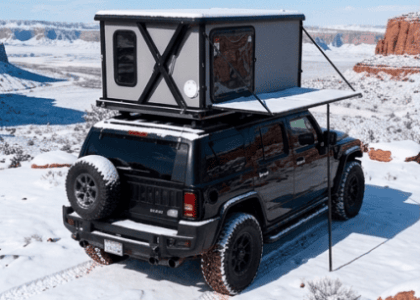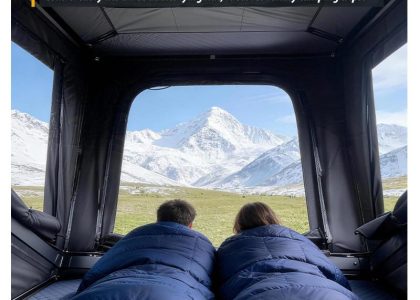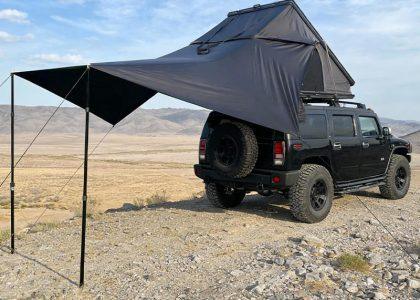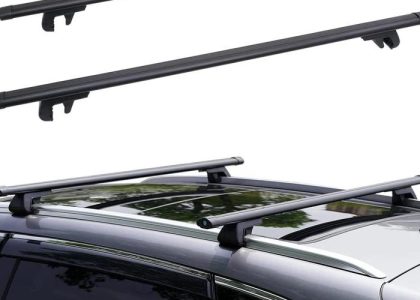
Every comparison article on this topic ends the same way: “there’s no clear winner — it depends on your needs.” After 2,000 words of setup time statistics and wildlife safety notes, you’re left exactly where you started.
This guide ends differently. The rooftop tent vs. ground tent decision isn’t a philosophical debate between two abstract products — it’s a practical choice between two camping lifestyles with genuinely different day-to-day implications. One question predicts the right answer more reliably than any spec comparison: is the vehicle carrying this tent your daily driver?
This guide covers what other comparisons skip — the base camp mobility problem, the honest setup speed data by tent type, the full 3-year cost calculation, and the hybrid family approach that overlanding forums have figured out but editorial guides have never documented. If you’ve read two or three comparisons already and still don’t have an answer, this is the one that gives you one.
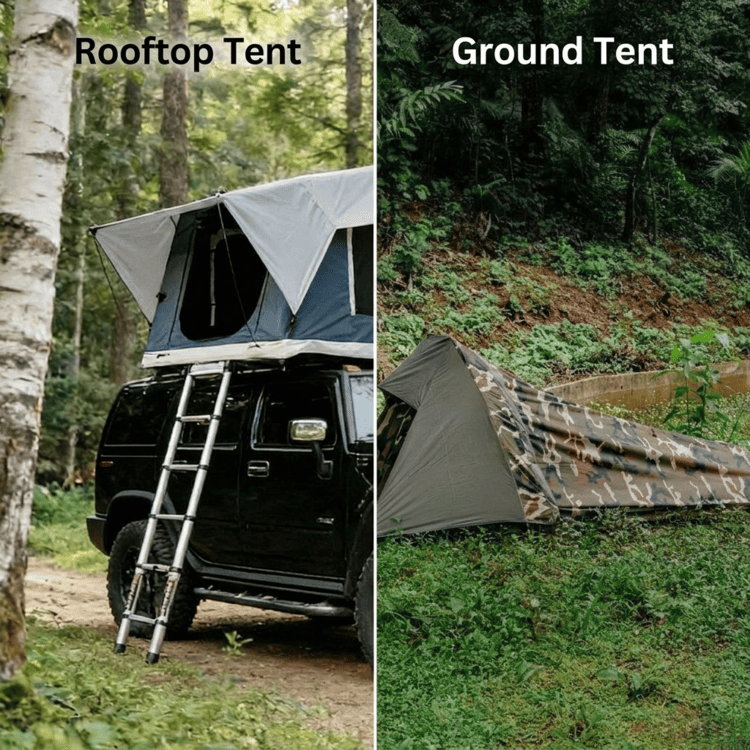
Quick Answer
Rooftop tents win on setup speed (hard shells), sleeping comfort, terrain flexibility, and weather protection. Ground tents win on cost, group capacity, base camp mobility, and pet/child accessibility. The single most predictive factor: if the vehicle is your daily driver, the RTT’s permanent trade-offs compound every day — making a ground tent the smarter default for most occasional campers.
Key Takeaways
- Daily driver status is the most predictive single variable — RTT trade-offs are acceptable for a dedicated camping rig, but compound into daily friction for a primary commuter vehicle.
- “RTTs deploy in 60 seconds” is true only for hard shell models — soft shell RTTs are often comparable in setup time to quality pop-up ground tents.
- Ground tents offer one irreplaceable advantage: you can leave them pitched at base camp and drive away for the day — RTTs travel with the vehicle, always.
- The total 3-year cost gap between a quality RTT setup and a premium ground tent setup is typically $2,500–$5,000+ — a gap that requires serious camping frequency to justify.
- For families, the practical answer is often a hybrid setup: RTT for adults, supplementary ground tent for children beneath or adjacent.
- Pets that can’t climb ladders are a genuine, commonly overlooked decisive factor — one that consistently pushes dog owners back to ground tents.
1. The One Question That Determines Most of the Answer
Before comparing setup speed, comfort, or cost, one variable predicts the right answer more reliably than everything else combined: is this vehicle your daily driver?
The RTT’s trade-offs — permanent fuel economy penalty, altered vehicle height affecting garage clearance, wind noise at highway speed, and changed handling dynamics from elevated center of gravity — are acceptable costs when the vehicle is a dedicated camping or overlanding rig that sits in the garage between trips. They become daily friction when that same vehicle is the one you take to work, school pickup, grocery runs, and weekend errands.
A ground tent owner packs the tent in a bag. It weighs nothing on the car, costs nothing in fuel, and adds nothing to the vehicle’s height or noise profile when not in use. That flexibility has real value that disappears entirely from the RTT calculus.
The Two-Path Framework
If the vehicle is a dedicated camping or overlanding rig → the RTT calculus applies fully. Evaluate setup speed, comfort, weather performance, and camping frequency with an open mind.
If the vehicle is a daily driver → the ground tent is the strong default. An RTT makes sense only if camping frequency is high enough (30+ nights/year) that the convenience premium is genuinely felt, and if the permanent vehicle modifications are acceptable trade-offs in daily life.
This framework doesn’t end the conversation — but it determines which half of the conversation matters most for your situation.
2. Setup Speed — The Honest Version
The “RTTs set up in 60 seconds” claim is repeated so often that it’s become a category-level assumption. It’s partially true and partially misleading — and the distinction matters when comparing against modern ground tents.
Setup Speed by Tent Type
| Tent Type | Structure Deployment | Bedding Setup | Total Time to Sleep | Pack-Down |
|---|---|---|---|---|
| Hard shell RTT | 30–90 sec | 0 sec (stored inside) | ~2–3 min | 2–3 min |
| Soft shell RTT | 4–8 min | 2–4 min | 6–12 min | 6–10 min |
| Quality pop-up ground tent (Gazelle T3, Nemo Wagontop) | 3–5 min | 3–5 min | 6–10 min | 5–8 min |
| Standard dome ground tent | 10–20 min | 3–5 min | 13–25 min | 10–15 min |
The honest picture: hard shell RTTs have a genuine, significant setup speed advantage — bedding stored inside the closed shell eliminates the nightly sleeping bag deployment entirely. Open the tent and you’re done. This is a real quality-of-life improvement for frequent movers who set up and pack down nightly.
Soft shell RTTs, however, are often comparable to or slower than modern quality pop-up ground tents. A Gazelle T3 Hub Tent deploys in 90 seconds. A soft shell RTT in the 4–8 minute range is not a meaningful improvement over that — and it’s considerably slower than the hard shell category it’s associated with in buyer perception.
The type distinction matters beyond setup speed alone. If you’re still deciding between a hard shell and soft shell RTT after confirming an RTT is right for you, our hard shell vs soft shell roof top tent comparison covers every meaningful difference — including which type genuinely delivers the speed advantage and which doesn’t.
3. The Base Camp Problem — The RTT Disadvantage Nobody Discusses
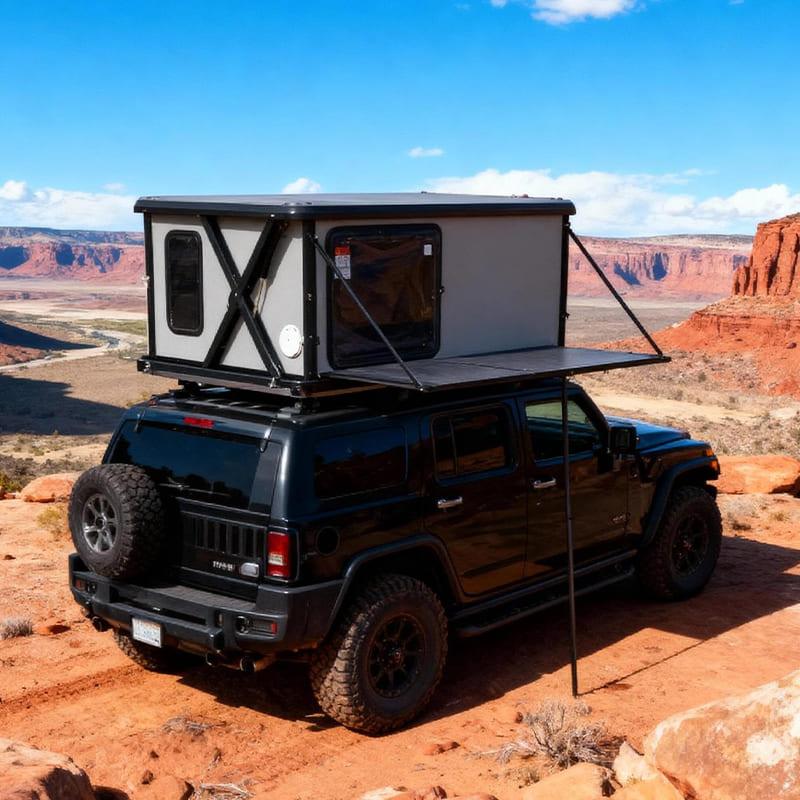
This is the most consequential practical difference in the comparison, and it’s consistently minimized or ignored in editorial guides. Forum communities have figured it out through experience. Buyers who discover it post-purchase consistently describe it as the thing they wish someone had explained clearly.
The problem: A rooftop tent is attached to the vehicle. When the vehicle moves, the tent moves with it. There is no configuration where the tent stays pitched at camp while you drive elsewhere.
For a solo traveler or couple who moves camp nightly — arrive, sleep, pack up, drive — this is not a problem. The tent is always in use when the vehicle is stationary, and the vehicle moves when camping is done.
For a family or group doing a multi-day base camp with day trips, this constraint changes how the camping trip functions:
The Base Camp Scenario Compared
Scenario: 4-night family base camp, with daily day trips to trails and town
| Rooftop Tent | Ground Tent | |
|---|---|---|
| Leaving for a day hike | Pack down the RTT (10–20 min) or leave vehicle at camp | Drive away; tent stays pitched |
| Returning to camp | Re-deploy tent (3–10 min depending on type) | Walk back to a standing shelter |
| Going to town for supplies | Same pack-down / re-deploy cycle | Drive freely; tent stays |
| Net extra time over 4 days | 3–5 additional hours of setup/pack-down | Zero |
| Camp security while away | Tent packs with vehicle | Ground tent left at site |
For families who take one vehicle to a base camp and make daily day trips — which describes the majority of recreational family camping — the RTT’s mobility constraint is a genuine daily friction that ground tents simply don’t have.
When this doesn’t matter: Solo or couple travelers who move camp nightly, or groups with multiple vehicles where one can stay at camp while another moves.
4. Comfort and Sleep Quality — A Fair Assessment
RTTs have a genuine sleep comfort advantage over typical camping setups — but “typical camping setup” is doing a lot of work in that sentence. The comparison depends significantly on what ground sleeping system you’re comparing against.
The RTT’s Real Advantages
Elevation from the ground: Eliminates the impact of rocks, roots, moisture, and cold ground conduction that no ground tent can match regardless of mattress quality. In wet conditions, this alone justifies significant cost premium for comfort-sensitive campers.
Included mattress: RTT mattresses run 2–3.5 inches of foam — meaningfully more than most backpacking sleeping pads. For casual campers who don’t invest in quality sleep systems, the RTT’s included mattress is a significant upgrade from what they’re comparing against.

Where the Advantage Narrows
Premium ground camping systems close the gap substantially:
- A quality 3-inch self-inflating sleeping pad ($150–$300) matches RTT mattress comfort closely
- A camping cot ($80–$200) eliminates ground contact and closely approximates the RTT’s elevated feel
- Purpose-built car camping mattresses (Exped, Therm-a-Rest) provide comparable or superior comfort to many included RTT mattresses
Temperature and Condensation
Summer heat: RTTs at elevation catch more breeze than ground tents — an advantage in still, hot conditions. Hard shell RTTs in direct sun can heat interior surfaces significantly — dark-colored shells in afternoon sun create noticeable heat retention.
Winter cold: RTTs are more exposed to ambient air on all sides, including underneath. Ground tents in cold weather benefit from ground insulation (even minimal) that RTTs don’t have. Without a quality sleeping bag and potentially a heater port, RTTs can be colder in winter than ground tents in comparable conditions.
Condensation: Both tent types generate condensation from occupant breath. Hard shell RTTs seal more completely — condensation collects on interior shell surfaces and requires wiping before closure. Ground tents with proper ventilation often manage condensation more naturally through fabric breathability.
5. Cost — The Full Picture Over 3 Years
Every comparison mentions that RTTs cost more than ground tents. None calculates what “more” actually means over a realistic ownership period. Here it is.
3-Year Total Cost Comparison
| Component | RTT — Budget | RTT — Mid-Range | RTT — Premium | Ground Tent — Budget | Ground Tent — Quality |
|---|---|---|---|---|---|
| Tent | $1,099 | $2,500 | $4,000 | $150 | $500 |
| Rack / crossbars | $350 | $600 | $900 | — | — |
| Sleeping system (pad/mattress) | $0 (included) | $0 (included) | $0 (included) | $80 | $250 |
| Ground footprint / tarp | — | — | — | $30 | $60 |
| Fuel penalty (3 yrs / 15k mi/yr) | $630 | $630 | $630 | $0 | $0 |
| Maintenance | $100 | $150 | $100 | $20 | $30 |
| 3-Year Total | ~$2,179 | ~$3,880 | ~$5,630 | ~$280 | ~$840 |
The cost gap is $1,900–$4,800 depending on tier comparison. This is not a trivial difference.
If the cost calculation has confirmed an RTT makes sense for your camping frequency, the next step is finding the right model. Our roof top tent buying guide walks through vehicle compatibility, tent type selection, and total system budgeting in full.
The Break-Even Analysis
At what camping frequency does the RTT’s convenience premium justify this gap?
Budget RTT vs. quality ground tent ($2,179 vs. $840 = $1,339 gap): If you value the RTT’s convenience at $15 per camping night (a modest premium for faster setup and better comfort), you need approximately 89 nights of camping to break even. Over 3 years, that’s roughly 30 nights per year — serious but achievable for dedicated campers.
Mid-range RTT vs. quality ground tent ($3,880 vs. $840 = $3,040 gap): At the same $15/night value, break-even requires approximately 203 nights — nearly 68 nights per year. This is a professional-level camping frequency that most buyers don’t honestly reach.
The honest conclusion: An RTT is financially defensible for buyers camping 30+ nights annually with a dedicated vehicle. Below that threshold, the cost per night of convenience premium becomes difficult to justify against a quality ground tent setup.
6. Weather, Safety, and Terrain Flexibility
This is where RTTs have legitimate, structural advantages that don’t depend on comparison context or camping frequency.
Weather Performance
Rain: RTTs are genuinely superior. Elevation eliminates flooding risk entirely — not reduced, eliminated. Hard shell RTTs actively shed water from a rigid sealed surface. Quality ground tents handle rain well with proper setup and a quality rainfly, but runoff, groundwater, and surface pooling remain real risks in sustained heavy rain that RTTs simply don’t face.
Wind: More nuanced. RTTs present a larger cross-section to wind and sit at greater elevation where wind is stronger — in sustained high-wind conditions (mountain ridgelines, open desert), a ground tent staked flat to the ground with profile minimized can actually be more stable than an elevated RTT. Hard shell RTTs have meaningful structural wind ratings. Soft shells in serious wind are not significantly more stable than well-staked dome tents.
Wildlife and Safety
Elevation provides genuine separation from ground-level wildlife — snakes, scorpions, insects, and most small mammals. In the US Southwest, Australia, or any environment where ground-dwelling hazards are a real concern, this advantage is meaningful rather than theoretical.
For larger wildlife (bears, coyotes), the calculation is more complex. Food storage practices and campsite selection matter far more than tent type for bear safety — an RTT offers no meaningful protection from a determined bear and should not be marketed as doing so.
Terrain Flexibility
This is the RTT’s clearest unconditional advantage. Any flat, level surface that supports the vehicle works as a campsite — gravel pullouts, dirt roads, beach parking, remote rocky areas. Ground tents require clear, level, soft enough terrain to stake effectively. In technical overlanding environments where designated campsites don’t exist and terrain is variable, this flexibility has high practical value.
7. Who Should Choose Each Option — Five Buyer Profiles
This is the verdict section every other guide avoids writing. Here it is, directly.
| Profile | Camping Pattern | Vehicle Type | Verdict | Reasoning |
|---|---|---|---|---|
| Daily driver, occasional camper | Under 20 nights/year | Primary commuter | Ground tent | Permanent RTT trade-offs don’t justify the cost at this frequency |
| Dedicated overlander, frequent mover | 30+ nights/year, moves camp nightly | Dedicated rig | RTT (hard shell) | This is the use case RTTs were designed for — speed and comfort compound over many nights |
| Family base camper | 2–5 nights per site, day trips | Daily driver or dedicated | Ground tent or hybrid | Base camp mobility constraint makes RTT frustrating for multi-day sites with day trips |
| Solo adventure traveler | Variable terrain, remote routes | 4WD dedicated rig | RTT | Terrain flexibility and solo setup ease justify the investment at remote sites |
| Pet owner (large dog) | Mixed camping styles | Any | Ground tent | Dogs that can’t climb ladders cannot easily use RTT camps — a daily management problem |
If the dedicated overlander or SUV owner profile fits your situation, see our best rooftop tent for SUV guide — it maps specific models to popular platforms with vehicle-by-vehicle weight calculations already completed.
The Verdict for Each Profile
Daily driver, occasional camper: The RTT’s convenience premium is real but costs $1,900–$4,800 more over three years for a vehicle already paying the fuel and handling trade-off daily. A quality ground tent at $500 plus a $200 sleeping pad delivers 85% of the camping experience for 15% of the cost.
Dedicated overlander: The RTT is the correct choice. Nightly setup and pack-down at 30–50 sites per year compounds the hard shell’s speed advantage into hours of recovered time annually. Terrain flexibility means never arriving at a remote location and discovering the ground isn’t suitable for pitching.
Family base camper: The RTT’s base camp constraint — pack down every time the vehicle moves — creates real daily friction for families making day trips from a fixed site. A large, quality cabin-style ground tent with a quality sleeping system is more functional for this pattern at lower cost.
Pet owner: A 65 lb dog cannot climb a vertical ladder. This is not a solvable problem — it’s a physical constraint. Either the dog is managed separately at ground level while owners sleep elevated (workable but inconvenient) or a ground tent accommodates everyone together. For dog owners, this single factor is often decisive.
8. The Hybrid Approach — When Both Is the Right Answer
No editorial guide discusses this, but overlanding forums have landed on it as the practical answer for families: use both.
The most common configuration: RTT as the primary adult sleeping platform + compact ground tent for children or additional adults beneath or adjacent.
How It Works in Practice
The RTT deploys as the “master bedroom” — adults sleep elevated with the comfort and setup speed advantages. A compact hub tent (Gazelle T3, Core 6-Person Instant Cabin, or similar) deploys on the ground nearby as the “kids’ room.” Children can access their tent independently, pets can sleep at ground level, and the vehicle remains mobile with only the RTT to pack down for driving.
Why This Works Better Than Either Alone
- Adults get RTT benefits (elevated sleeping, fast deployment, comfortable mattress)
- Children and pets are accommodated without ladder management
- Additional sleeping capacity without upgrading to a more expensive larger RTT
- Base camp flexibility is partially restored — if the vehicle needs to move, the ground tent stays as a base while adults pack the RTT
What to Pair
| RTT Type | Recommended Ground Tent Companion | Why It Works |
|---|---|---|
| Any 2-person RTT | Gazelle T3 Hub Tent (3-person) | Deploys in 90 seconds; stands independently without stakes |
| Hard shell RTT | Core 6-Person Instant Cabin | Full standing room; deploys in 2 minutes; families of 4 accommodated |
| Fold-out hard shell | Nemo Wagontop 4P | Large floor area; excellent weather protection; complements RTT premium |
Additional cost: $200–$600 for a quality companion ground tent — meaningful but far less than upgrading to a larger RTT.
Final Word
The rooftop tent vs. ground tent decision has a clearer answer than most guides are willing to give.
If you camp on a dedicated overlanding rig at 30+ nights per year and move camp frequently — a hard shell RTT is the right choice. The setup speed advantage compounds over many nights, the terrain flexibility is genuinely valuable in remote environments, and the vehicle trade-offs are irrelevant when the vehicle isn’t your daily transportation.
If you’re a daily driver with occasional camping trips under 20 nights per year, base camping with family and day trips, or camping with a large dog — a quality ground tent setup delivers 85% of the camping experience for a fraction of the cost and none of the permanent vehicle trade-offs.
For families who want both: the hybrid approach (RTT for adults, ground tent for children) is the answer that forum communities discovered through experience and that no buying guide has documented — until now.
For everything from tent type selection to installation and where to camp legally, the roof top tent guide covers the complete decision from first principles — the right starting point once you’ve confirmed an RTT suits your lifestyle.
Frequently Asked Questions
Can I use a rooftop tent if my vehicle is my daily driver?
Yes, but with significant daily trade-offs: 5–17% fuel economy penalty permanently, potential garage clearance issues, increased wind noise at highway speeds, and altered handling from elevated center of gravity. For occasional campers (under 20 nights/year), these daily costs rarely justify the RTT’s expense and inconvenience. For campers at 30+ nights/year with high camping frequency, the math improves.
Is a rooftop tent worth it for occasional camping (10–15 nights per year)?
For most buyers at this frequency: no. The 3-year total cost premium of $1,900–$4,800 over a quality ground tent setup, combined with the permanent daily-driver trade-offs, makes the cost-per-night value difficult to justify. An RTT makes financial and practical sense for frequent users — typically 25–30+ nights per year on a dedicated vehicle.
Can I leave my ground tent set up while I drive away from camp?
Yes — this is one of the ground tent’s most significant practical advantages. A ground tent pitched at a base camp stays pitched while you drive to a trailhead, town, or day-use area. RTTs travel with the vehicle; leaving camp requires either packing the tent down or leaving the vehicle behind. For multi-day base camping with day trips, this distinction significantly affects how the camping trip functions.
Are rooftop tents actually faster to set up than good ground tents?
Hard shell RTTs: yes, genuinely — 30–90 seconds including built-in bedding access. Soft shell RTTs: only marginally, and sometimes not at all. Quality modern pop-up ground tents (Gazelle T3, Core Instant Cabin) deploy in 60–180 seconds — comparable to soft shell RTTs and sometimes faster. The “RTTs are always faster” claim applies specifically to hard shells, not the category broadly.
What happens with my dog and a rooftop tent?
A dog that can’t climb a ladder — typically any dog over 40–50 lbs or with mobility limitations — cannot independently access or exit an RTT sleeping area. You’ll need to lift the dog up and down each time, or manage the dog at ground level separately while sleeping elevated. For large dog owners who camp with their pets, this constraint frequently makes ground tents the more practical choice.
Is a rooftop tent safer than a ground tent in bear country?
Elevation provides separation from ground-level wildlife, which is a genuine advantage. However, bears that are food-motivated will investigate a scent source regardless of its elevation — an RTT does not make you bear-safe, and should not replace proper food storage and campsite selection practices. For snakes, scorpions, and smaller ground-dwelling animals, RTT elevation is a meaningful practical advantage.
Can a rooftop tent and ground tent be used together for family camping?
Yes — and for families with children or pets, this hybrid approach is often the most practical solution. An RTT serves as the adult sleeping platform; a compact hub tent or instant cabin tent deploys at ground level for children and pets. Adults get RTT benefits (elevated sleeping, fast setup, comfortable mattress) while children and dogs are accommodated at ground level without ladder management.
How much more does a rooftop tent really cost than a ground tent over 3 years?
A budget RTT setup (tent + rack + 3-year fuel penalty) costs approximately $2,200 over three years. A quality ground tent setup costs approximately $840. The gap is roughly $1,400 at the budget comparison. At mid-range RTT vs. quality ground tent: approximately $3,900 vs. $840 — a $3,060 gap. These figures assume 15,000 miles/year of driving and a 10% fuel economy penalty from the mounted tent.