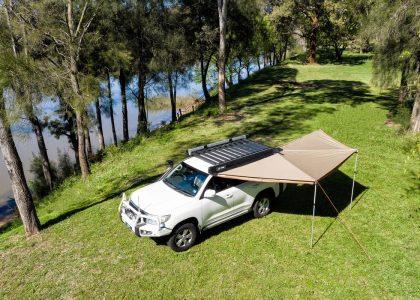
Most online guides will state the obvious: a 270° awning offers more shade than a standard pull-out. While true, this superficial comparison ignores the critical structural dynamics that dictate durability, usability, and safety.
What they don’t tell you is how the massive torque of a freestanding 270° system can twist a sub-par roof rack, the specific point-load stresses on hinges, or why a simple pull-out might be mechanically superior for certain applications.
This comprehensive analysis moves beyond “shade area” to compare the Structural Engineering, Installation Realities, and Weather Management of the three dominant awning styles: Straight Pull-Out, 180°, and 270°.
1. The Engineering Core: Hinge & Arm Mechanics
The fundamental difference between these awnings lies not just in their shape, but in the mechanical principles they use to fight gravity and wind.
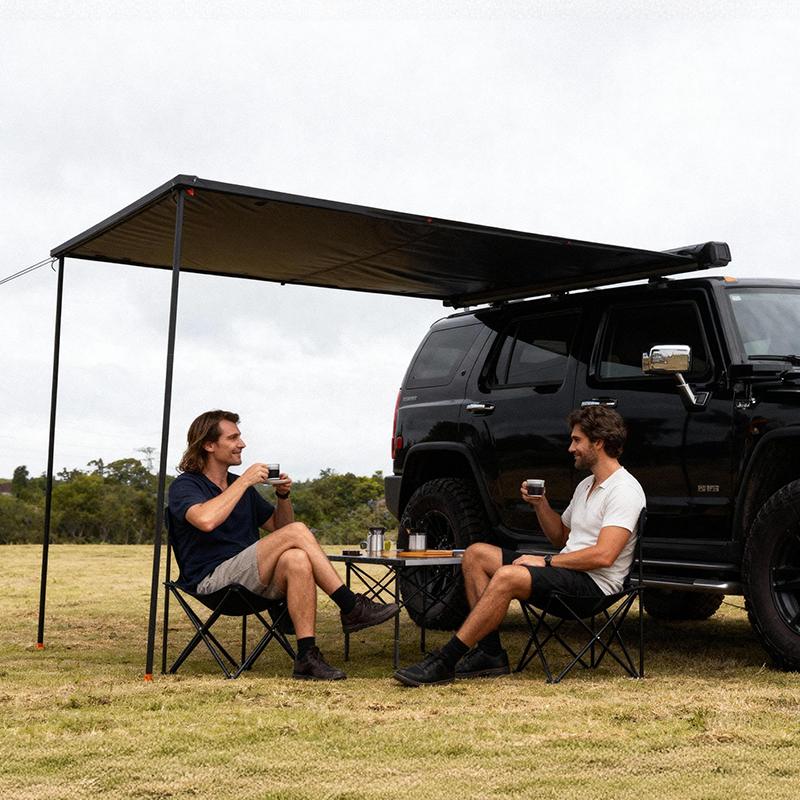
Straight Pull-Out (The Static Frame)
This is the classic, rectangular awning that extends straight from the side of the vehicle (typically 2.0m or 2.5m wide).
- Structure: It operates on a simple, static frame principle. The fabric is supported by two horizontal poles (rafters) and two vertical legs that must be deployed every time.
- Stress Distribution: The load is distributed relatively evenly across the front bar, the legs, and the vehicle mounting plate.
- The Hidden Benefit: Because it relies on ground legs for support, the hinge on a pull-out awning is rarely under significant stress. It is mechanically simple, forgiving of abuse, and highly durable because it doesn’t try to defy gravity.
180° & 270° Freestanding (The Cantilever System)
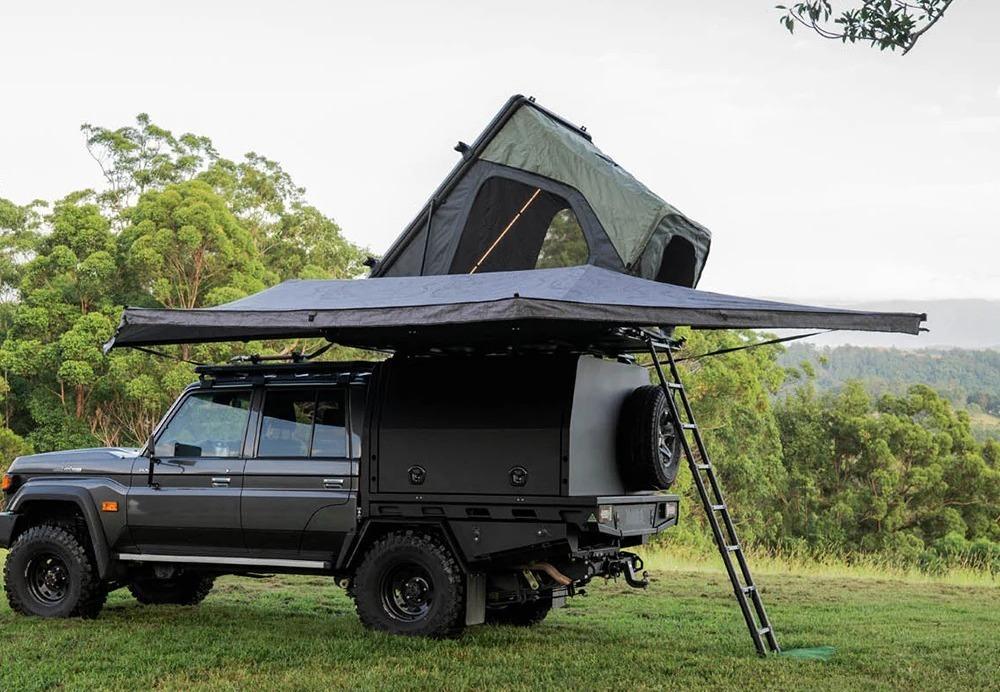
These awnings fan out from a central point, with the 180° covering the side and the 270° wrapping around the rear. The modern trend is for these to be “Freestanding,” meaning they can support themselves without immediate use of poles.
- Structure: They operate on a Cantilever Principle. The entire weight of the massive canvas area and the aluminum arms is held horizontally in mid-air by a single rear hinge.
- The “Truss” Factor: To achieve this freestanding capability without sagging, premium manufacturers (like Everlead) utilize Truss-Designed Arms. These are engineered aluminum structures—often boxed or triangularly braced with internal cutouts—to maximize strength while minimizing weight. Cheap clones use simple flat aluminum tubes that flex wildly and will eventually snap under dynamic load.
- The Hinge Material: This is the non-negotiable core component. A true freestanding awning must use a Forged Aluminum Alloy or Stainless Steel hinge with brass or polymer bushings. Plastic or cast metal hinges found on budget 270s cannot withstand the immense leverage torque and will shear off.
2. Installation Realities: Rack Stress & Mounting
The impact of an awning on the vehicle’s roof rack is perhaps the most critical topic ignored by consumer-focused buying guides.
Point Loading (The Rack Killer)
- Pull-Out: It is lightweight (~10kg) and its weight is spread along its entire 2m or 2.5m length. It mounts easily with two simple L-brackets onto almost any crossbar or roof basket. It is low stress.
- 270° & 180°: These are heavy units (25kg – 35kg+), but weight isn’t the main issue—leverage is. When deployed, the entire weight hangs off the rear corner, creating a massive fulcrum point.
- The Gap Requirement: To manage this leverage, the mounting brackets must be spaced widely apart. A 270° awning typically requires a bracket spacing of over 1000mm to distribute the torque load effectively along the rack’s rail.
- The “Clamp-On” Risk: Installing a heavy 270° awning on standard “clamp-on” style crossbars (common on factory roof rails) is dangerous. The twisting force (torque) generated during deployment or by wind can rotate the crossbar on the rail, potentially denting the vehicle roof or causing failure. These systems demand a rigid Platform Rack or through-bolted heavy-duty crossbars.
Tailgate Interference
- 180° Advantage: The 180° awning is the specialist solution for Vans (Sprinters, Transits) or SUVs with large, vertically opening tailgates. Its arms spread forward and backward along the side, ensuring the rear of the vehicle remains completely clear for door operation.
- 270° Warning: The signature rear-swinging arm of a 270° awning cuts directly across the back of the vehicle. If you have a high-lift tailgate (like on a Land Cruiser 200 Series or a van), the awning arm may block the trunk from opening fully. You must measure carefully to ensure your rack is high enough for the tailgate to clear the awning arm underneath.
3. Weather Management: Wind vs. Rain
In the showroom, every awning looks great. In the wild, nature tests the geometry of your gear.
Wind Resistance (The “Parachute” Effect)
- Winner: Straight Pull-Out.
With its legs firmly pegged and guy ropes set at 45-degree angles, a straight pull-out awning forms a stable, aerodynamic wedge. It cuts through wind effectively. - The Freestanding Reality:
A 270° awning acts as a massive sail. The leverage that makes it “freestanding” works against it in a gust.- The Rule: If wind speeds exceed 15–20 mph (approx. 25-30 km/h), you must deploy legs. Many “freestanding” hinges have snapped because owners overestimated the metal’s ability to fight a storm. Even the strongest 270° awning becomes a kite in high wind.
Rain Run-Off (The Pooling Problem)
- The 270° Weakness:
Because of their shape, 270° awnings feature large, triangular sections of fabric between the arms. Without proper tension, these sections are prone to “Pooling” (water gathering in the center, stretching the fabric and potentially bending the arms under weight).- The Fix: Premium models include integrated “tie-down points” in the middle of the canvas panels, allowing you to pull the fabric down to create a drainage valley.
- The Pull-Out Advantage:
Managing rain on a straight awning is effortless. Simply lower one leg by 6 inches to create a steep pitch. Gravity does the rest, and water sheds instantly.
4. Expandability: Walls & Rooms
For many overlanders, the awning is just the roof; the walls make it a home.
Straight Pull-Out
- Annexes: Expanding a pull-out is simple and affordable. Most brands offer a standard “Awning Room” that slides into the sail track and clips to the poles. It creates a fully sealed, mosquito-proof box in minutes. It is the best option for sleeping extra guests.
270° & 180°
- The Complexity: Adding walls to a batwing-style awning is a geometric puzzle. It involves multiple zippers, large velcro panels, and significantly more canvas.
- The Trade-off: A full wall kit for a 270° awning is often bulky, expensive (sometimes costing as much as the awning itself), and can take 15–20 minutes to set up. While it offers a massive enclosed area, it negates the “fast setup” advantage of the awning itself.
5. Detailed Specification Comparison
| Feature | Straight Pull-Out | 180° Freestanding | 270° Freestanding |
| Shade Area | ~5 sqm (Side Only) | ~8–11 sqm (Side Only) | ~10–15 sqm (Side + Rear) |
| Setup Time | 3–5 Minutes | 30 Seconds | 30 Seconds |
| Hinge Stress | Low | High | Extreme |
| Rain Management | Excellent (Easy pitch) | Good | Moderate (Requires tensioning) |
| Wall/Annex Setup | Fast (One piece) | Slow (Multiple panels) | Slow (Multiple panels) |
| Mounting Req. | 2 Standard Brackets | 2–3 Heavy Duty Brackets | 3 Heavy Duty Brackets |
| Rear Kitchen Shade | No | No | Yes (100%) |
| Ideal for | Budget / Modular Builds | Vans / Lift-Gate SUVs | Pickup Trucks / Utes |
6. Conclusion: Which Geometry Fits Your Mission?
The “best” awning is not the biggest one; it is the one that fits your vehicle’s structure and your camping style.
- Select the Straight Pull-Out If: You prioritize simplicity, storm durability, and weight savings. It remains the gold standard for smaller SUVs (Subaru, RAV4) and budget-conscious builds.
- Select the 180° If: You drive a Van (Sprinter/Transit) or a Wagon and need maximum side shade without the interference of a rear-swinging arm blocking your doors.
- Select the 270° If: You are a Solo/Duo Traveler living out of a pickup truck with a tailgate kitchen. The ability to swing the awning open in 30 seconds and instantly cover your cooking area is worth the extra weight and investment.
B2B Engineering Note: The Everlead Difference
At Everlead Outdoor, we have engineered solutions to address the structural weaknesses identified in this guide. As a premier OEM/ODM Manufacturer, our awning systems are built for brands that demand low return rates and high customer satisfaction:
- The “Titan” Hinge: We utilize a proprietary Forged Aluminum Hinge with a brass bushing system, lab-tested to withstand high torque loads without shearing, ensuring true freestanding performance.
- Anti-Pooling Design: Our canvas patterns feature optimized tension lines and integrated central tie-down points to ensure water runoff, solving the #1 consumer complaint regarding 270° awnings.
- Reinforced Mounting: We provide oversized, 4mm stainless steel L-brackets designed to distribute torque load across a wider section of the roof rack, protecting your customer’s vehicle.
Build your brand reputation on structure, not just shade. Partner with Everlead Outdoor for your next awning line.