You’ve read the comparisons. They all end the same way: “hard shells are faster to set up, soft shells offer more space — it depends on your needs.” That conclusion is accurate and almost completely useless. You already know it depends. What you need is help figuring out which scenario you’re actually in.
This guide does three things differently from everything else you’ve read on this topic. First, it resolves the aerodynamics controversy — there is a genuine factual dispute between manufacturer claims and real-world testing data that no other article addresses honestly. Second, it treats the hybrid category as a serious third option rather than a marketing footnote. Third, it ends with a clear verdict for five specific buyer profiles — not a hedge.
If you’re trying to decide between a hard shell and a soft shell before spending $1,500–$5,000, this is the article that actually makes the decision easier.
Quick Answer
Hard shells win on setup speed (30–90 seconds), aerodynamics at highway speeds, all-weather durability, and long-term maintenance cost. Soft shells win on interior space, mattress thickness, and purchase price. Hybrids bridge both. The single best predictor of which type suits you: how often you move camp.
For a complete overview of roof top tents, including hard shell vs soft shell fundamentals and more, see our roof top tent guide.
Key Takeaways
- Hard shells deploy in 30–90 seconds; true total setup time including bedding narrows this gap — but hard shells still win meaningfully for frequent movers.
- The aerodynamics advantage of hard shells is real but speed-dependent — negligible at city speeds, significant at sustained highway speeds above 60 mph.
- Soft shells offer more interior space at every price point, but the mattress quality gap is closing in premium models.
- ABS vs. aluminum within the hard shell category is a meaningful sub-decision most buyers overlook — and it affects weight, durability, thermal performance, and cargo capability.
- Hybrids are a legitimate third category — purpose-built for buyers who need hard shell speed AND soft shell space.
- Long-term maintenance costs favor hard shells: canvas recoating, zipper replacement, and pole repair are soft shell costs with no hard shell equivalent.
1. How They Actually Work — Structural Differences That Drive Everything Else
Most comparisons treat hard shell vs. soft shell as a simple binary. In practice, the structural approach of each type creates a cascade of downstream consequences — for interior space, packed height, weight, weather performance, and price. Understanding the mechanism explains the trade-offs more clearly than any spec sheet.
Hard Shell: How the Deployment Works
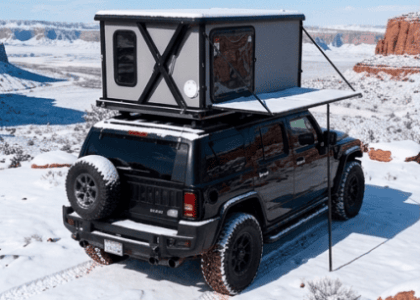
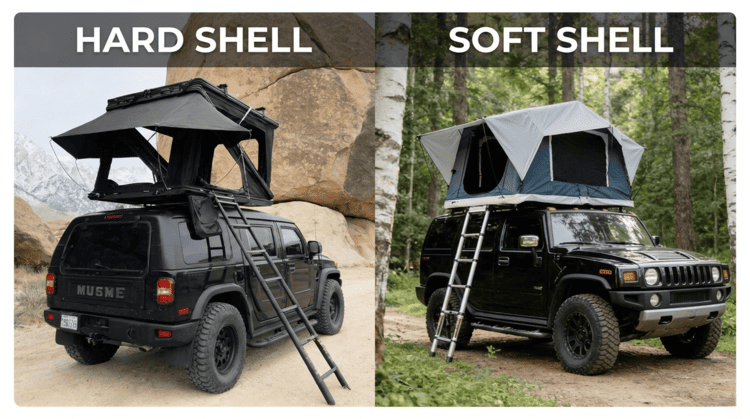
A hard shell RTT uses a rigid outer casing — typically hinged at the rear — that lifts via gas struts when unlatched. The tent fabric is pre-attached to the shell interior and extends automatically as the shell opens. The result is a sleeping platform that’s ready in under 90 seconds with no manual fabric tensioning or pole insertion.
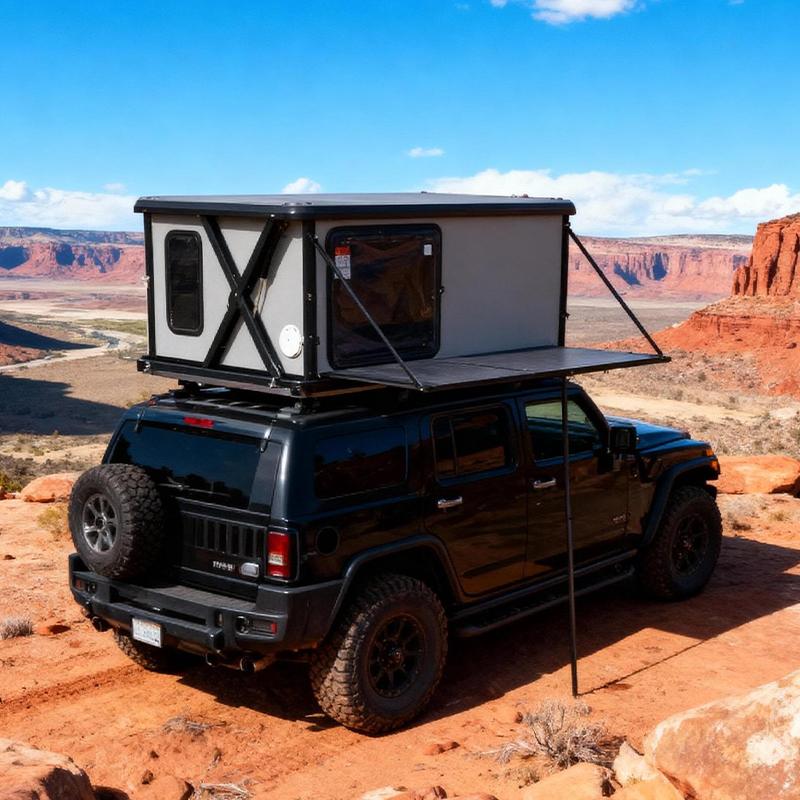
Hard shell material types — and why they matter:
| Material | Weight | Thermal Insulation | Cargo Rail Support | UV Durability | Price Premium |
|---|---|---|---|---|---|
| ABS Plastic | Lightest | Good (natural insulator) | Rarely | Can yellow/become brittle | Base price |
| Fiberglass | Moderate | Moderate | Sometimes | Better than ABS | +$200–$500 |
| Aluminum | Heaviest | Poor (conducts heat/cold) | Yes (T-slot rails) | Excellent (anodized) | +$400–$1,000+ |
The material choice inside the hard shell category is one of the most overlooked sub-decisions in RTT purchasing. An aluminum hard shell is a fundamentally different product from an ABS hard shell — not just cosmetically, but in weight, thermal behavior, and long-term capability.
Soft Shell: How the Deployment Works
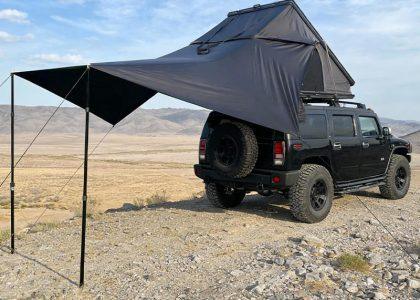
A soft shell RTT folds out from a compressed stack — fabric walls, poles, and rainfly are all integrated and unfold in sequence. The sleeping area extends beyond the tent’s footprint on the roof, typically opening to the side or rear. Setup involves unfolding the structure, extending support poles, and securing the rainfly — a 4–10 minute process depending on the model.
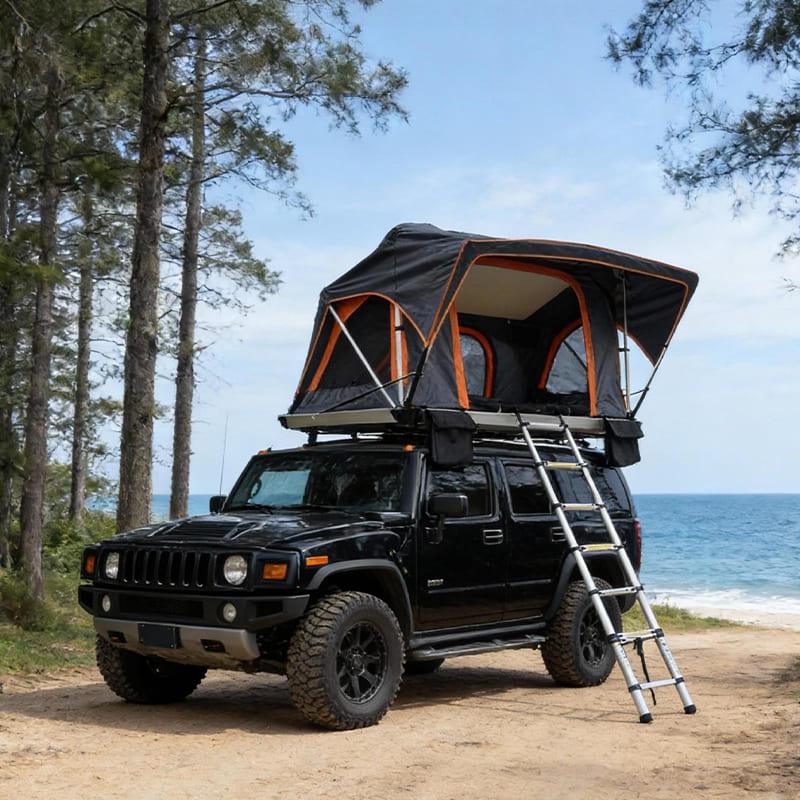
Soft shell fabric standards:
- 280–320g/m² canvas: Budget to entry-level. Functional waterproofing (1,500–2,000mm HH), degrades faster under UV and abrasion.
- 320–600g/m² canvas: Mid-range to premium. Significantly longer service life, better dimensional stability in rain and heat, higher hydrostatic head (3,000–5,000mm).
Canvas weight is the single most reliable proxy for soft shell quality that most buyers never check. It tells you more about long-term performance than brand name alone.
2. Setup Speed — The Complete Picture Most Comparisons Miss
The standard setup time comparison — “hard shells open in 60 seconds, soft shells take 5 minutes” — is accurate but incomplete. It measures structural deployment, not the time from arriving at camp to actually being ready to sleep. That’s a different and more useful metric.
True Total Setup Time
| Task | Hard Shell | Soft Shell |
|---|---|---|
| Unlatch / unzip and open structure | 30–90 sec | 4–8 min |
| Extend and position ladder | 30 sec | 30–60 sec |
| Retrieve bedding (pillows, sleeping bags) | 0 sec* | 2–4 min |
| Interior organization | 1 min | 2–3 min |
| Total time to sleep | ~2–3 min | ~8–15 min |
*Hard shell tents allow bedding to be stored inside the closed shell. You open the tent and your sleeping bag, pillows, and any interior items are exactly where you left them from the night before. This is a genuine nightly quality-of-life advantage that rarely appears in standard comparisons.
Soft shell owners develop routines around this — storing pillows in a bag clipped to the ladder, keeping sleeping bags inside stuff sacks strapped to the rack — but none of these fully replicate the frictionlessness of opening a hard shell that’s already made up.
When the Speed Difference Actually Matters
At 10 nights per year, the extra 10–12 minutes per night of soft shell setup and pack-down adds up to roughly 3.5 hours annually. Spread across a decade of camping, that’s a manageable trade-off for the cost and space advantages.
At 50+ nights per year — the serious overlander pattern — the same math produces 25+ hours annually. At that usage frequency, setup speed has a real quality-of-life impact, and the hard shell’s price premium becomes easier to justify.
3. The Aerodynamics Controversy — Resolving a Genuine Factual Dispute
This is the comparison factor with the most conflicting information in the market — and the one where buyers most deserve a clear, reasoned answer.
The conventional position: hard shells are significantly more aerodynamic than soft shells, producing meaningfully better fuel economy. Several manufacturers directly contradict this, claiming the real-world difference is minimal and shouldn’t drive the decision. Both positions contain truth. Neither is complete.
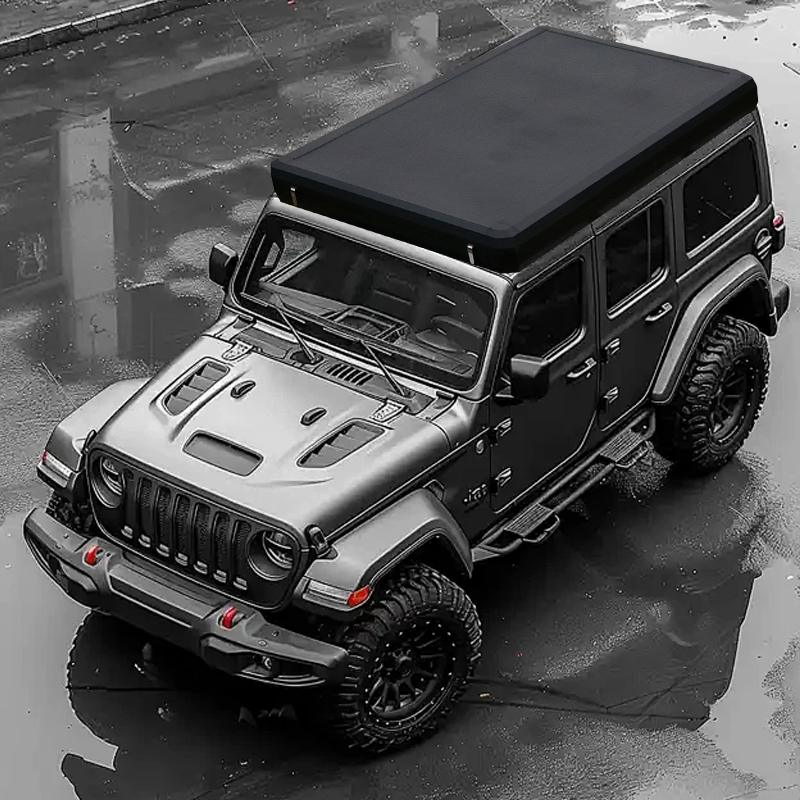
Why the Claims Conflict
The discrepancy comes from comparing different products within each category rather than equivalent ones.
Packed height is the primary aerodynamic variable — not the tent type label. A low-profile wedge hard shell packed at 7–9 inches with a tapered leading edge behaves very differently from a standard clamshell hard shell at 12–14 inches. A soft shell with a tight PVC cover at 14 inches creates different drag than a bulky soft shell at 20+ inches with a rounded profile.
When manufacturers claim “no meaningful aerodynamic difference,” they’re typically comparing a tall hard shell to a well-managed soft shell. When aerodynamics advocates cite large fuel economy gaps, they’re often comparing a wedge hard shell to a poorly packed, uncovered soft shell. Both are valid comparisons of real products. Neither is a fair category-level comparison.
The Physics of Speed Dependency
Aerodynamic drag scales with the square of velocity. This has a practical implication most guides miss entirely:
| Speed | Hard Shell Fuel Penalty | Soft Shell Fuel Penalty | Difference |
|---|---|---|---|
| 35 mph (city) | 1–3% | 3–5% | ~2% — negligible |
| 55 mph (highway) | 3–6% | 7–10% | ~4% — noticeable |
| 65 mph (highway) | 5–8% | 10–14% | ~6% — meaningful |
| 75 mph (fast highway) | 7–10% | 13–17% | ~7% — significant |
Figures represent ranges across tent types within each category. Low-profile hard shells perform at the lower end; standard clamshells toward the higher end.
The practical verdict: If your camping involves sustained highway driving at 65+ mph — long road trips, cross-country overlanding — the aerodynamic difference between a low-profile hard shell and a soft shell is real and compounds meaningfully over time. If you primarily drive at city and rural speeds to reach camp, the difference is largely theoretical.
This is not a reason to choose a hard shell automatically. It is a reason to factor your typical driving pattern into the decision alongside setup speed and space.
4. Interior Space and Sleeping Comfort — Where Soft Shells Still Win
On interior space, the soft shell advantage is structural and largely unavoidable. A hard shell’s sleeping area is constrained by its packed footprint — the shell opens to roughly the same dimensions it occupies on the roof. A soft shell extends outward when deployed, creating a sleeping area significantly larger than its packed footprint.
Sleeping Dimensions Comparison
| Tent Category | Packed Footprint | Deployed Sleeping Area | Headroom |
|---|---|---|---|
| Hard shell (2-person) | 48″ × 90″ | 48″ × 90″ | 36–42 inches |
| Soft shell (2-person) | 48″ × 56″ | 56″ × 96″+ | 42–52 inches |
| Hybrid fold-out (2-person) | 48″ × 90″ | 56″ × 108″+ | 44–54 inches |
For couples where at least one person is over 6 feet tall, or for anyone who moves around in their sleep, the extra width and length of a soft shell is a meaningful nightly difference — not a theoretical spec sheet advantage.
Mattress Quality by Category
Mattress thickness is constrained by the tent’s packed geometry. Hard shells must accommodate the mattress inside the closed shell, which creates a practical upper limit on foam thickness.
- Hard shell mattresses: Typically 2–2.5 inches. Memory foam is common at premium price points.
- Soft shell mattresses: Typically 2.5–3.5 inches. More room for high-density foam at mid-range prices.
- Hybrid mattresses: Typically 2.5–3 inches. Better than standard hard shells, comparable to mid-range soft shells.
The gap is narrowing at the premium end — iKamper’s Skycamp 3.0 uses a 2.5-inch memory foam mattress that performs above what the thickness number suggests. But at equivalent price points, soft shells generally deliver a thicker sleeping surface.
The annex factor: Soft shells support annex room attachments that create ground-level sleeping or living space beneath the tent. For families with one child, this is often the deciding factor — parents sleep in the main tent, child sleeps in the annex. Hard shells rarely support annexes in any meaningful configuration.
5. ABS vs. Aluminum — The Sub-Decision Most Hard Shell Buyers Miss
If you’ve decided a hard shell is right for you, the next decision is the one most buyers skip entirely: what is the outer shell made of? ABS plastic and aluminum are not interchangeable materials — they produce meaningfully different products.
Head-to-Head Material Comparison
| Factor | ABS / Fiberglass | Aluminum |
|---|---|---|
| Weight | Lighter (20–40 lbs lighter at same size) | Heavier — impacts vehicle load budget |
| Thermal insulation | Better — plastic is a natural insulator | Poor — conducts heat and cold directly |
| Cargo rail support | Rarely available | T-slot rails common — supports on-tent gear |
| UV durability | Can yellow, fade, become brittle over 8–10 years | Anodized finish is essentially permanent |
| Repairability | Difficult — cracked ABS is hard to fix | Dented aluminum can often be reshaped |
| Price | Lower | $400–$1,000+ premium at equivalent tent size |
Choose aluminum if: You camp in extreme temperatures where thermal conduction matters, you want to mount gear on the tent exterior (bike racks, gear boxes, solar panels), or you’re buying for a 10+ year horizon where long-term material integrity justifies the premium.
Choose ABS if: Weight is a constraint (tight vehicle load budget), you camp primarily in moderate temperatures, or you want to maximize tent quality per dollar spent.
One underappreciated aluminum advantage: T-slot roof rails. Many aluminum hard shells include integrated crossbars on the outer shell that allow you to mount gear directly on top of the closed tent while driving. This effectively turns the tent roof into a secondary gear platform — a capability ABS shells rarely offer.
6. All-Weather Performance and Long-Term Durability
Weather performance is one of the most common reasons buyers lean toward hard shells — and the durability claim is largely justified, but the reasoning matters.
All-Weather Comparison
Rain: A properly sealed hard shell has a significant structural advantage in heavy rain — there are no seams running across the sleeping area to leak, and the rigid shell sheds water before it contacts the tent fabric. Soft shells rely on rainfly coverage and seam sealing. A quality soft shell (3,000mm+ HH, sealed seams, full-coverage fly) performs well in moderate to heavy rain — but a compromised seam or aging DWR coating creates leak risk that hard shells don’t face.
Wind: Hard shells have measurable wind rating advantages. Most quality hard shells are rated to 60–90 mph structural wind resistance. Soft shells in sustained wind flex, rattle, and in extreme conditions can have poles stressed beyond their design limits. For camping in consistently exposed or high-wind environments — mountain ridgelines, coastal headlands, desert plateaus — a hard shell is the more reliable choice.
Cold weather: This is where the aluminum hard shell has a specific disadvantage. Aluminum conducts heat efficiently, meaning an aluminum shell in cold temperatures creates a cold outer surface that promotes condensation on the interior. ABS hard shells and soft shells with insulated liners handle cold weather more comfortably. Serious cold-weather campers should look at ABS hard shells or soft shells with thermal liners rather than defaulting to aluminum.
Long-Term Maintenance Reality
| Component | Hard Shell Cost (5 years) | Soft Shell Cost (5 years) |
|---|---|---|
| DWR waterproof recoating | None | $30–$80 every 3–4 years |
| Zipper replacement | Minimal (fewer zippers) | $50–$150 depending on extent |
| Pole repair / replacement | None | $40–$120 for stress fractures |
| Hinge and latch service | $20–$50 (lubrication, adjustment) | Minimal |
| Canvas / fabric repair | None | $30–$100 for tears or seam failure |
| 5-Year Maintenance Total | ~$20–$50 | ~$150–$450 |
The maintenance cost gap is real but manageable — $150–$400 over five years is not a decisive financial argument on a $2,000–$4,000 investment. It becomes more relevant at 8–10 year ownership horizons, where soft shell canvas degradation accelerates and hard shell structural components remain largely unchanged.
7. The Hybrid Category — A Serious Third Option
The hybrid roof top tent category is growing faster than either traditional type, and it’s being underserved by buying guides that treat it as a footnote or a marketing compromise. It isn’t. For a specific buyer profile, a hybrid is the correct answer — not a middle ground between two better options.

What a Hybrid Actually Is
A hybrid RTT uses a hard outer shell (typically aluminum or ABS) that opens to reveal a fold-out fabric interior extending significantly beyond the shell’s footprint. The result: hard shell deployment speed (2–3 minutes, faster than soft shells but slower than pure hard shells) with a sleeping area closer to a soft shell in size.
The three main hybrid configurations:
| Type | How It Works | Best For |
|---|---|---|
| Fold-out hard shell | Rigid base opens to fold-out fabric extension | Couples who move camp frequently but want space |
| Pop-up with fabric sides | Rigid top panel pops up; fabric walls deploy around it | Speed-focused buyers who want more headroom |
| Inflatable | Air beams replace poles; rigid base optional | Weight-sensitive vehicles, ultralight builds |
The Hybrid Buyer Profile
Hybrids serve a specific profile that neither traditional type addresses well: the couple or small family who moves camp every 1–2 days and needs 60+ inches of sleeping width. A standard hard shell gives them the speed but not the space. A soft shell gives them the space but not the speed. A hybrid gives them 80% of both.
The trade-offs to understand before choosing a hybrid:
- Heavier than equivalent soft shells (hybrid mechanism adds weight)
- More expensive than equivalent hard shells at the same quality tier
- Fewer model options — the category is newer and smaller
- Pack-down requires more steps than a pure hard shell
Current price range: $2,500–$4,500 for quality hybrid models. The iKamper Skycamp 3.0 (a fold-out hard shell) is the category reference point — it established the format and remains the market leader.
8. The Decision Matrix — A Clear Verdict for Every Buyer Profile
This is the section every “hard shell vs soft shell” article should contain and almost none do. Here is a direct recommendation for five specific buyer profiles — with reasoning, not hedging.
| Buyer Profile | Camping Pattern | Recommended Type | Key Reasoning | Starting Price |
|---|---|---|---|---|
| Daily driver / road tripper | Moves camp every 1–2 days, significant highway driving | Hard shell | Setup speed compounds; fuel savings at highway speeds matter over time | $2,000+ |
| Base camper, couple | 3–7 nights per site, moderate camping frequency | Soft shell | Space and mattress quality matter more than speed; maintenance costs acceptable | $900+ |
| Family with children | Mix of base camping and occasional moves | Hybrid or soft shell with annex | Space for 3+ people; annex room critical for family configuration | $2,500+ |
| Four-season / winter overlander | Year-round use including sub-freezing temperatures | Hard shell (ABS preferred) | Structural wind rating, sealed shell, weather reliability; avoid aluminum for cold climates | $2,500+ |
| Budget-first / occasional use | 10–15 nights/year, primarily stationary camping | Soft shell entry-level | Cost efficiency is primary; usage frequency doesn’t justify hard shell premium | $900–$1,400 |
The one-question shortcut: If you had to pick a single diagnostic question, it’s this: Do you move camp more than twice per week on average during your camping season? If yes, hard shell or hybrid. If no, soft shell or hybrid depending on space needs and budget.
Not sure which specific model fits your profile? Check our updated best roof top tent picks for 2026, featuring top hard shell, soft shell, and hybrid options.
Final Word
The hard shell vs. soft shell debate has a clear answer — it just isn’t the same answer for everyone.
If you move camp frequently, drive significant highway miles, and want the lowest-friction camping experience over years of regular use: buy a hard shell. The setup speed, aerodynamic advantage at speed, and near-zero maintenance cost justify the price premium for this pattern.
If you base camp, prioritize sleeping space and mattress comfort, or are entering RTT camping without a large upfront budget: buy a quality soft shell. The interior space advantage is structural and real, and the maintenance requirements are manageable for occasional to moderate use.
If you move camp regularly but need more space than a hard shell provides: the hybrid category exists precisely for you.
If you’re still weighing your options, our main roof top tent guide covers compatibility, installation, and long-term ownership in more depth.
What the decision doesn’t require is months of research paralysis. Map your camping pattern to the buyer profiles in Section 8, verify your vehicle’s dynamic load rating, and the right tent type will be obvious.
Frequently Asked Questions
Is the fuel economy difference between hard shell and soft shell actually significant?
At city speeds, no — the difference is 1–3% and practically invisible in day-to-day fuel costs. At sustained highway speeds (65–75 mph), yes — soft shells create 5–8% more drag than low-profile hard shells, which translates to a meaningful cost difference on long road trips. Your driving pattern determines whether this is a real factor or a theoretical one.
Can a soft shell roof top tent survive a heavy storm as well as a hard shell?
A quality soft shell with 3,000mm+ hydrostatic head, sealed seams, and a full-coverage rainfly handles moderate to heavy rain well. In extreme conditions — sustained winds above 50 mph, heavy snow load, or multi-day severe weather — a hard shell’s rigid structure and factory-sealed perimeter provides a meaningful safety margin that a fabric tent cannot match.
What is a hybrid roof top tent and is it worth considering?
A hybrid uses a rigid outer shell that opens to reveal a fold-out fabric interior, delivering sleeping area larger than the shell footprint with faster deployment than a traditional soft shell. It’s worth considering if you move camp every 1–2 days and need 60+ inches of sleeping width — a combination that neither traditional type handles well. Expect to pay $2,500–$4,500 for quality options.
Does a hard shell or soft shell last longer with regular use?
Hard shells generally outlast soft shells at equivalent quality tiers. ABS hard shells can show UV degradation after 8–10 years; aluminum hard shells are effectively indefinitely durable structurally. Soft shell canvas requires recoating every 3–5 years and typically shows meaningful fabric degradation at the 7–10 year mark with regular use. Budget an additional $150–$450 in maintenance costs for a soft shell over a 5-year ownership period.
Which type is better for vehicles with a low roof load rating?
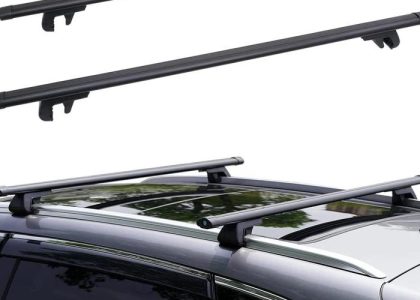
ABS hard shells are typically the best choice for weight-constrained vehicles — they offer hard shell speed at lower weights than aluminum equivalents. Some quality ABS hard shells for 2 people weigh 85–100 lbs, within reach of vehicles with 150–165 lb dynamic load ratings when paired with a lightweight crossbar rack. Inflatables are the lightest option of all at 50–90 lbs.
Can I leave bedding inside a soft shell roof top tent when I close it?
Most soft shell designs allow some items to remain inside when closed — but the compression of the folding mechanism limits what fits and how well it’s protected. Pillows typically survive fine; bulky sleeping bags can create uneven pressure on poles and fabric. Hard shells allow the full sleep setup to remain inside the closed shell undisturbed, which is one of their most practical daily-use advantages.
Which is easier to install and remove from the vehicle?
Both types use the same mounting interface — T-bolts in crossbar or rack channels — so the installation process is comparable. The meaningful difference is in removal frequency: hard shells are heavier (often 120–170 lbs) and typically require two people to dismount safely. Soft shells at 60–110 lbs are often manageable for one person with a step stool. If you plan to remove the tent regularly between trips, soft shells have a practical handling advantage.
Is ABS or aluminum better for a hard shell roof top tent?
Neither is universally better — they serve different priorities. Aluminum is better for longevity, cargo rail capability, and resale value. ABS is better for weight, thermal comfort in cold weather, and cost efficiency. For most buyers who camp in variable conditions and want a tent that lasts 10+ years, aluminum is worth the premium. For buyers on a vehicle with a tight load budget or camping primarily in cold climates, ABS performs better per dollar.