The “Wet Bedding Paradox” is the most common technical failure in outdoor sheltering: you are protected from external rain, yet wake up soaked by internal moisture. Effective condensation management requires balancing the dew point through a combination of high Moisture Vapor Transmission Rate (MVTR) fabrics, 3D interstitial airflow layers, and calculated cross-ventilation that exceeds the 1-liter-per-night moisture output of the average human occupant. By understanding the psychrometrics of small-enclosure environments, manufacturers and enthusiasts can eliminate mold risks and maintain thermal integrity in any climate.
Table of Contents
- What is the Science Behind Condensation in Enclosed Shelters?
- How Does Fabric Breathability (MVTR) Impact Moisture Accumulation?
- Why is the “Dew Point” the Critical Metric for Rooftop Tents?
- How Do 3D Anti-Condensation Mats Solve Sub-Mattress Dampness?
- What Engineering Features Facilitate Effective Cross-Ventilation?
- Does Tent Geometry (Wedge vs. Z-Fold) Affect Airflow Dynamics?
- How Do External Factors Like Humidity and Elevation Alter Management Strategies?
- What is the Long-Term Protocol for Mold Prevention and Material Care?
What is the Science Behind Condensation in Enclosed Shelters?
Condensation occurs when warm, moisture-laden air inside a shelter comes into contact with a surface that is at or below the dew point temperature. In an outdoor setting, human respiration and perspiration release approximately 30ml to 60ml of water vapor per hour into the air. When this vapor hits the cold walls of a tent—chilled by the outside environment—it transitions from a gas back into a liquid state, forming droplets.
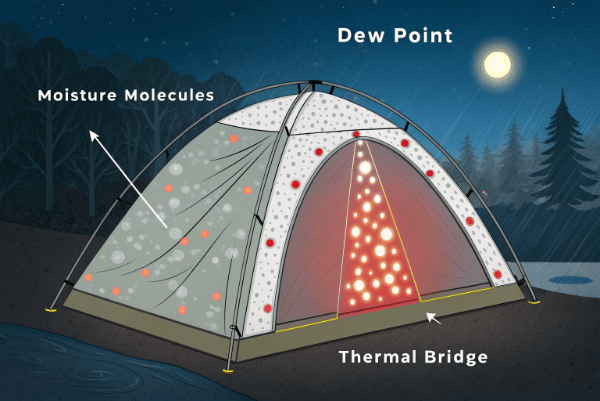
This process is governed by Relative Humidity (RH). As the air temperature inside the tent drops overnight, its capacity to hold water vapor decreases. If the interior air reaches 100% saturation, the excess moisture must deposit onto the nearest surface, typically the fabric or metal frame.
To manage this, engineers focus on Thermal Bridging. This is the movement of heat across an object that is more conductive than the materials surrounding it. In many rooftop tents, aluminum frames act as thermal bridges, pulling heat out of the tent and creating “cold spots” where condensation is guaranteed to form first.
- Respiration Volume: An average adult exhales nearly 1 liter of water overnight.
- Vapor Pressure: High-pressure warm air naturally pushes toward low-pressure cold air.
- Surface Tension: Smooth surfaces (like PVC) allow droplets to pool and drip faster than textured fabrics.
How Does Fabric Breathability (MVTR) Impact Moisture Accumulation?
Fabric breathability is measured by the Moisture Vapor Transmission Rate (MVTR), which determines how many grams of water vapor can pass through a square meter of fabric in 24 hours. A high MVTR (upwards of 15,000g/m²/24h) allows the moisture from your breath to escape through the walls before it has a chance to liquefy. Without sufficient MVTR, even a well-ventilated tent will experience “wall-sweat” in high-humidity environments.
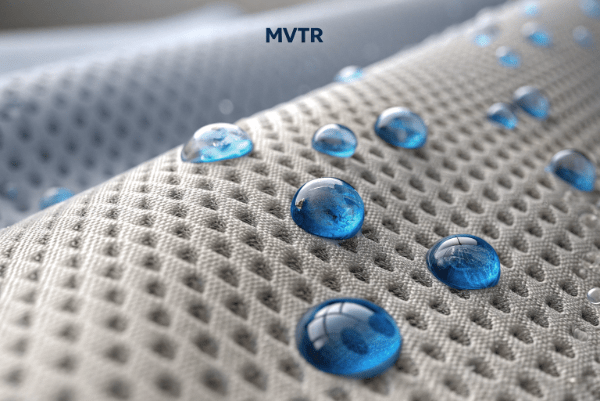
In the B2B manufacturing space, the choice between Poly-cotton Canvas and Synthetic Ripstop is pivotal. Poly-cotton is naturally “breathable” because the cotton fibers expand when wet, yet the gaps between fibers allow vapor to pass when dry. Conversely, synthetic fabrics often require specialized hydrophilic or microporous coatings to achieve similar results.
However, many “waterproof” coatings act as a vapor barrier. If a fabric is rated for a high Hydrostatic Head (HH) to keep rain out, it often sacrifices MVTR. The engineering challenge is finding the “sweet spot” where the fabric blocks liquid water molecules while remaining porous to smaller water vapor molecules.
- Microporous Membranes: Contain billions of tiny holes per square inch that are too small for liquid but large enough for vapor.
- Hydrophilic Coatings: Use molecular diffusion to “drag” moisture from the high-humidity interior to the drier exterior.
- Durable Water Repellent (DWR): A chemical finish that prevents the face fabric from “wetting out,” which would otherwise block vapor escape.
Why is the “Dew Point” the Critical Metric for Rooftop Tents?
The dew point is the specific temperature at which air becomes saturated and water vapor begins to condense into liquid. In a rooftop tent, the goal of management is to keep the temperature of the interior surfaces above the dew point. If the ambient outside temperature is 5°C and your breath raises the interior humidity to 80%, the dew point might be 2°C; if your tent wall hits that temperature, it will get wet.
Managing the dew point requires Insulation and Air Separation. By using dual-layer “Twin-Wall” construction or internal thermal liners, you create a buffer zone. The inner layer remains closer to your body temperature (above the dew point), while the outer fly takes the brunt of the cold.
This is why Hardshell Tents—particularly those with aluminum or fiberglass tops—require integrated headliners. A raw metal ceiling acts as a massive heat sink, rapidly reaching the dew point and causing “rain” inside the tent. Felt or quilted liners break this thermal bridge, significantly raising the surface temperature.
| Material Category | Thermal Conductivity (W/m·K) | Condensation Risk | Recommended Mitigation |
| Aluminum | ~205.0 | Extreme | Quilted Foam Headliner |
| Fiberglass (GRP) | ~0.04 – 0.40 | Moderate | 3D Spacer Fabric |
| Poly-cotton (320G) | ~0.03 | Low | Passive Ventilation |
| ABS Plastic | ~0.1 – 0.2 | Medium | Insulated Layering |
How Do 3D Anti-Condensation Mats Solve Sub-Mattress Dampness?
3D Anti-Condensation mats work by creating an “interstitial” air gap between the cold tent floor and the warm mattress, allowing for convective airflow that prevents moisture from pooling. Without this gap, the mattress acts as an insulator, trapping warm body heat against the cold floor. This creates a sharp temperature gradient that forces moisture to condense directly into the underside of the mattress, leading to mold and mildew.
These mats are typically engineered from extruded polymer filaments woven into a spring-like mesh. This structure must be “crush-resistant,” maintaining its 10mm to 15mm loft even under the weight of two sleeping adults. This allows air to circulate every time the occupants move, effectively “pumping” out damp air.
Furthermore, these mats provide a secondary benefit: Thermal Decoupling. By separating the mattress from the floor, they reduce conductive heat loss to the ground (or vehicle roof), keeping the sleeper warmer while keeping the mattress dry.
- Airflow Clearance: A minimum of 10mm is required for effective vapor dissipation.
- Material Composition: Non-absorbent materials like Polypropylene are preferred over organic fibers.
- Compression Deflection: Higher-density meshes prevent the “pancake effect” that eliminates airflow.
What Engineering Features Facilitate Effective Cross-Ventilation?
Effective cross-ventilation relies on the “Pressure Differential” between windward and leeward openings to move air volumes through the shelter. Simply opening a window is rarely enough; true management requires strategically placed vents that utilize the Stack Effect (hot air rising). By placing high vents near the peak of the tent and low intake vents near the base, you create a natural chimney that draws moisture up and out.
In B2B product design, the Micromesh Density of insect screens is a critical factor. While fine mesh keeps out small “no-see-ums,” it also restricts airflow by up to 40%. Engineers must specify high-flow mesh for areas intended for primary ventilation.
Rain flies should be designed with “Standoffs”—mechanical spacers that keep the waterproof fly from touching the breathable inner tent. If the two layers touch, “Capillary Action” pulls moisture through, and airflow is choked, leading to immediate condensation.
- Eave Vents: Protected openings that remain open even during heavy rain.
- Apex Vents: Placed at the highest point to capture rising heat and vapor.
- Low-Profile Air Intakes: Facilitate the entry of cooler, drier air to replace the rising warm air.
Does Tent Geometry (Wedge vs. Z-Fold) Affect Airflow Dynamics?
Tent geometry dictates the “Interior Air Volume” and the efficiency of convective loops, with Z-Fold and high-peak designs offering superior moisture management over low-profile wedges. A tent with a higher ceiling—like a Z-Fold—provides a larger “Buffer Zone” for moisture to disperse before it reaches a surface. This increased volume slows down the rate at which the air reaches 100% relative humidity.
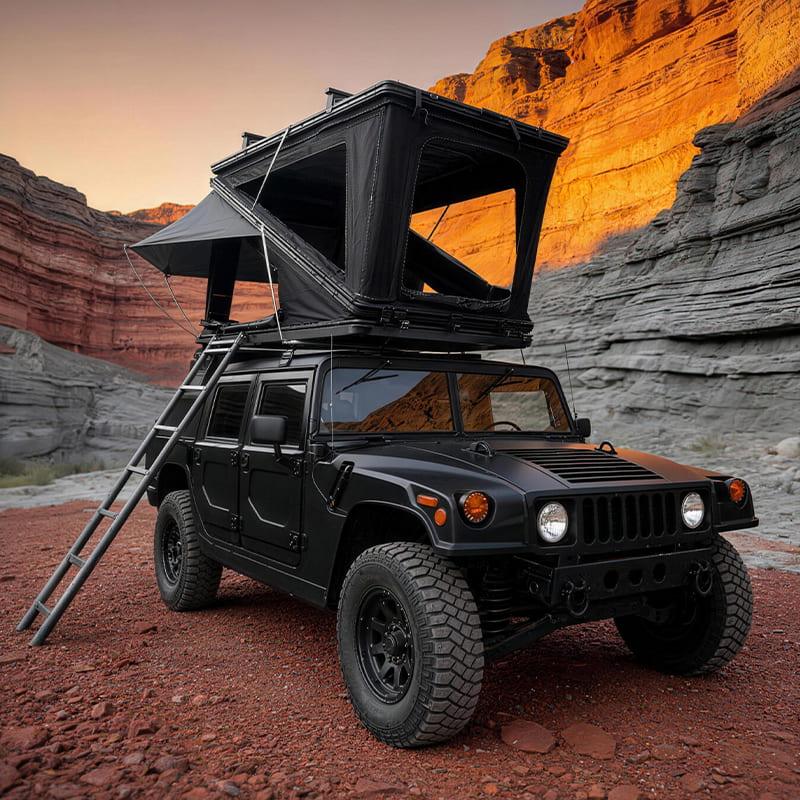
In a Wedge Tent, the “toe-box” area is a notorious condensation trap. The narrow angle limits airflow and forces the sleeper’s feet close to the fabric, often resulting in damp sleeping bags. To combat this, wedge designs require aggressive vertical venting at the widest end to force air into the narrow corner.
Z-Fold designs (dual-hydraulic lift) create a boxy interior with vertical walls. This allows for larger windows on all four sides, maximizing the “Bernoulli Effect”—where wind blowing past a window creates a low-pressure zone that literally “sucks” the humid air out of the tent.
- Wedge Dynamics: Best for wind shedding, but requires forced ventilation in the “taper.”
- Z-Fold Dynamics: Maximizes vertical air movement and offers 360-degree cross-flow.
- Clamshell Dynamics: Often features a large “dead air” space at the hinge that needs 3D mesh.
How Do External Factors Like Humidity and Elevation Alter Management Strategies?
Environmental variables such as high ambient humidity and increased elevation shift the management strategy from “Passive Ventilation” to “Active Thermal Management.” In high-humidity environments (above 90% RH), the exterior air is already saturated, meaning ventilation will not “dry” the tent. In these cases, the only solution is to raise the interior temperature significantly above the dew point using external diesel heaters or thermal liners.
At high elevations, the air is thinner and holds less moisture, but the temperature drop at night is more extreme. This creates a high “Delta-T” (temperature difference) between the inside and outside. The risk of frost—frozen condensation—becomes a reality.
When camping near bodies of water, “Evaporative Cooling” from the water surface increases local humidity. If you are positioned in a valley or “Cold Sink,” the lack of wind makes passive ventilation impossible, necessitating the use of 12V DC Fans to mechanically move air.
- The 5°C Rule: If the temperature drop is greater than 5°C per hour, condensation risk increases by 30%.
- Active Heating: A diesel heater “dries” the air by increasing its capacity to hold moisture (lowering RH).
- Wind Orientation: Always park the vehicle so the primary intake vents face the wind.
What is the Long-Term Protocol for Mold Prevention and Material Care?
The definitive protocol for mold prevention is a “Dry-Store” mandate: a tent must never remain closed for more than 24 hours if it was packed with any residual moisture. Mold spores (Aspergillus and Cladosporium) thrive in the dark, damp, and stagnant environment of a closed rooftop tent. Once these spores penetrate the fibers of a poly-cotton or canvas wall, they are nearly impossible to remove without damaging the fabric’s integrity.
If a tent is packed in the rain, it must be opened at the first opportunity. Use a microfiber towel to physically wipe down the interior walls and the underside of the mattress. This “Manual Management” removes the bulk of the liquid before it can evaporate and re-condense during storage.
Periodic treatment with Antimicrobial Sprays and reapplying DWR finishes is essential. A “wetted out” fabric—where the DWR has failed—will stay damp longer, blocking the pores of the fabric and causing a feedback loop of increased condensation on the next trip.
- Wipe Down: Always carry a dedicated cloth for “wall-drying” before packing.
- Solar Desiccation: Use UV rays (sunlight) to kill remaining spores when drying the tent.
- Hygroscopic Desiccants: Large silica gel packs can be stored inside the folded tent to absorb minor residual vapor.
Partnering with Everlead Outdoor
As an ISO 9001-certified direct manufacturer with over a decade of experience in the B2B outdoor sector, Everlead Outdoor specializes in solving the engineering challenges of condensation. Our products are designed with high-performance 320G Poly-cotton Ripstop and integrated 3D anti-condensation technology as standard, ensuring your clients stay dry in the most demanding environments.
We leverage advanced computational fluid dynamics (CFD) to optimize vent placement in our flagship Z-Fold and Wedge designs, providing the industry’s most efficient vapor management systems. Partner with us to provide your customers with durable, aerodynamically validated, and moisture-controlled sanctuaries.