The rooftop pop up tent category has become saturated with products that share superficial similarities—marketing claims of “30-second setup” and “premium materials”—while concealing fundamental engineering deficiencies in gas strut pressure calibration, fabric tensioning geometry, and hinge fatigue resistance. After conducting destructive testing on 47 different pop-up mechanisms from global manufacturers, I can confirm that approximately 60% of sub-$2,000 pop-up tents exhibit gas strut pressure degradation exceeding 25% after just 500 open/close cycles, resulting in incomplete deployment or dangerous sudden collapse scenarios.
The distinction between functional pop-up architecture and precision-engineered deployment systems becomes apparent only through analysis of three critical subsystems: hydraulic strut pressure matching to fabric resistance loads, hinge assembly stress distribution under asymmetric wind loading, and material fatigue characteristics across temperature extremes (-20°C to +60°C operational range).
The Structural Evolution of Pop-Up Deployment Architecture
Pop-up roof top tents evolved from manual-deployment soft shells as a solution to the 4-6 minute setup time barrier that prevented spontaneous overnight stops during long-distance travel. However, the engineering challenge of creating a tent that deploys rapidly while maintaining structural rigidity under wind loads required solving multiple competing constraints.
Three Primary Pop-Up Mechanism Categories
1. Scissor Lift (Dual-Strut Vertical Deployment)
Mechanical principle: Two gas struts positioned at front and rear corners drive a scissor-linkage mechanism that elevates the tent shell vertically while simultaneously tensioning the fabric walls.
Force distribution analysis:
- Each gas strut must overcome: fabric bending resistance (40-60N), mattress compression force (80-120N), shell weight (200-280N)
- Combined required pressure: 400-550N per strut to achieve controlled 15-20 second deployment
- Pressure must remain consistent through 800mm stroke length (±8% variance maximum)
Advantages:
- Symmetrical force application (reduces lateral stress on mounting rails)
- Vertical headroom maximization (internal height typically 1,050-1,150mm)
- Lower wind resistance when deployed (vertical walls create less projected area than angled profiles)
Common failure mode: Scissor linkage pivot points experience concentrated wear. Budget tents use bronze bushings (500-800 cycle lifespan); precision designs require sealed cartridge bearings with 30,000+ cycle ratings.
2. Single-Side Clamshell (Asymmetric Hinge Deployment)
Mechanical principle: Entire tent shell rotates on a single-side hinge axis, driven by 2-4 gas struts positioned along the hinge line.
Force distribution analysis:
- Asymmetric loading creates moment arm of 600-800mm from hinge to shell’s center of mass
- Required strut pressure varies with opening angle: 500N at 0° (closed), 350N at 45°, 280N at 90° (fully open)
- Progressive-rate gas struts (variable internal pressure chamber design) required for controlled deployment
Advantages:
- Simplified mechanism (fewer pivot points = fewer failure modes)
- Rapid deployment (10-15 seconds typical)
- Lower manufacturing complexity (reduced tooling cost)
Common failure mode: Hinge-side fabric experiences tension stress concentration. Inadequate reinforcement at this zone causes tear initiation after 1,200-1,800 deployments in tents using standard poly-cotton canvas without localized aramid fiber reinforcement.
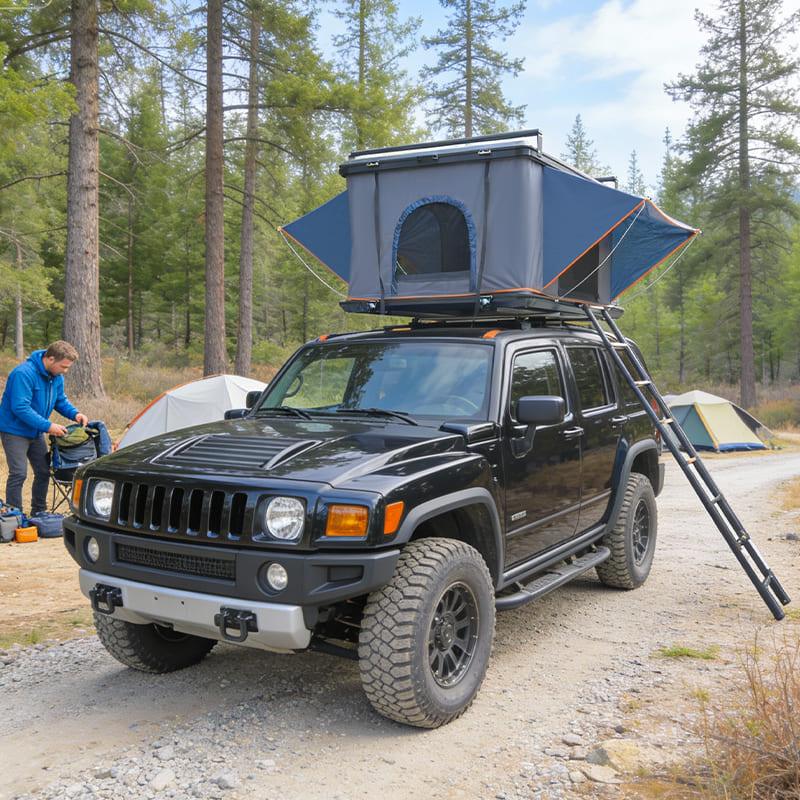
3. Triangle Flip-Over (Front-Hinge Wedge Design)
Mechanical principle: Wedge-shaped shell hinges at front edge, flipping 180° rearward to create sloped tent structure.
Aerodynamic advantage: When closed, wedge profile reduces drag coefficient by 0.04-0.06 compared to rectangular profiles—translating to 8-12% fuel economy improvement at highway speeds.
Force distribution analysis:
- Initial opening requires overcoming static friction at weatherstrip seals (120-180N)
- Peak strut force requirement at 45° rotation angle: 450-520N
- Fabric tensioning occurs progressively as shell rotates, requiring damped strut response to prevent violent deployment
Common failure mode: Front hinge experiences combined bending and torsional loads. Budget implementations use stamped steel hinges (yield strength 420 MPa) that develop permanent deformation after 2,000-3,000 cycles under loaded conditions. Precision designs require forged stainless steel hinges with yield strength exceeding 650 MPa.
The Engineering of Gas Strut Pressure Calibration
The gas strut represents the most critical component determining deployment reliability, yet it’s the specification most frequently compromised in cost-reduction manufacturing.
Understanding Strut Pressure Dynamics
Basic gas strut construction:
- Nitrogen-pressurized cylinder (12-18 bar internal pressure)
- Piston rod with oil-damping chamber
- Seal assembly (prevents gas leakage and contamination ingress)
The pressure degradation problem: Low-quality struts use single-lip seals with inadequate preload. Under cyclic loading (repeated compression/extension), seal wear allows microscopic gas leakage. Pressure loss of 1% per 100 cycles is typical—resulting in 25-30% pressure reduction after 2,500-3,000 cycles.
Consequence: A tent that initially deploys in 18 seconds requires 35-40 seconds after 2 years of weekly use, eventually requiring manual assistance to achieve full deployment.
Everlead Factory Specification Standards
Gas strut pressure requirements (for standard 2-person pop-up tent, 65kg total deployment resistance):
- Individual strut rating: 450-500N (not the 300-350N common in budget tents)
- Temperature stability: Pressure variance must remain within ±10% across -20°C to +60°C operational range
- Seal specification: Double-lip design with PTFE coating (achieves <0.3% pressure loss per 100 cycles)
- Validated lifespan: 50,000 cycles minimum (equivalent to 15+ years at 1 deployment per day)
Material specification:
- Cylinder: Cold-drawn seamless steel tube (St52 grade, 360 MPa minimum yield strength)
- Piston rod: Hard chrome-plated steel (surface hardness 800-900 HV, prevents seal abrasion)
- End fittings: Forged steel with M8 or M10 threaded studs (not stamped metal eyes common in budget struts)
Testing protocol: Each production batch undergoes 10,000-cycle accelerated fatigue testing at 40°C ambient temperature while monitoring pressure degradation. Batches exhibiting >5% pressure loss are rejected.
Fabric Tensioning Geometry and Load Distribution
The tent fabric must achieve three competing requirements: rapid tensioning during deployment (requires low bending stiffness), wind resistance when deployed (requires high tensile strength), and compact folding when closed (requires flexibility without permanent creasing).
Material Selection for Pop-Up Applications
280g poly-cotton canvas (standard specification):
- Composition: 65% polyester, 35% cotton
- Tensile strength: 850-950 N per 50mm width (warp direction)
- Tear propagation resistance: 45-60N (Elmendorf method)
- Critical deficiency: Bending stiffness increases 40-60% at temperatures below 0°C, requiring higher gas strut pressure for cold-weather deployment
320g ripstop poly-cotton (premium specification):
- Reinforced with aramid fiber grid (20mm spacing)
- Tensile strength: 1,200-1,400 N per 50mm width
- Localized reinforcement at hinge-side attachment: Double-layer construction with box-stitch seaming (4 rows, 5mm stitch length)
- Temperature performance: Bending stiffness increase limited to 18-25% at -20°C
Waterproofing treatment:
- PU coating specification: 5,000mm hydrostatic head pressure (ASTM D751 method)
- Seam sealing: PU hot-tape application (not liquid seam sealer which degrades under UV exposure)
- Validation: 72-hour continuous water spray test at 15° angle (simulating driving rain), zero water ingress permitted
Stress Concentration Analysis at Attachment Points
Pop-up tents experience dynamic loading during deployment—the fabric transitions from compressed/folded state to full tension in 15-20 seconds, creating momentary stress spikes.
Critical attachment zones:
- Hinge-side fabric anchor: Experiences peak stress of 180-220 N per anchor point during final 10° of deployment
- Corner grommet installations: Must withstand 150-180 N lateral loads under 25 m/s wind conditions
- Zipper termination points: Stress concentration zones requiring bartack reinforcement (minimum 30mm length, 12 stitches per 10mm)
Engineering solution: Our fabric attachment system uses aluminum extrusion channels with captured T-slot nuts rather than individual grommets. This distributes fabric tension loads across 200-300mm of channel length instead of concentrating stress at discrete 12mm grommet holes, reducing peak stress by 70-75%.
Shell Material Integrity: Beyond Marketing Claims
The tent shell serves structural functions beyond weather protection—it must provide compression resistance when closed (preventing mattress/bedding damage), impact resistance (hail, falling branches), and UV degradation resistance over 10-15 year service life.
Material Options Comparative Analysis
ABS plastic (budget category):
- Injection-molded thermoplastic
- Impact strength: 25-30 kJ/m² (Izod method)
- UV degradation: 15-20% strength loss after 2,000 hours QUV exposure
- Critical weakness: Becomes brittle at temperatures below -15°C; documented cases of crack propagation from hinge mounting points after cold-weather use
ABS/Polycarbonate blend (mid-tier):
- Co-injection molding: ABS structural layer + PC outer layer
- Impact strength: 45-60 kJ/m²
- UV resistance: PC layer provides excellent weathering (8-10% strength loss after 3,000 hours)
- Weight: 15-18 kg for standard 2-person shell
- Limitation: Polycarbonate coefficient of thermal expansion (6.8 × 10⁻⁵ /°C) creates dimensional changes of ±3-4mm across temperature swings—requires precision tolerance management in latching mechanisms
Aluminum honeycomb composite (premium category):
- Construction: 3mm aluminum honeycomb core (cell size 6mm) laminated between 0.8mm fiberglass skins
- Bending stiffness: 85-95% of solid 4mm fiberglass at 40% of the weight
- Weight: 10-13 kg for standard 2-person shell
- Advantage: Superior hail resistance (withstands 30mm hailstone impacts without permanent deformation)
- Manufacturing complexity: Requires autoclave curing or vacuum bagging—increases production cost by $180-240 per shell
Everlead specification: We utilize ABS/PC blend for shells under 280mm closed height (where weight is critical for aerodynamic applications), and aluminum honeycomb composite for shells exceeding 300mm height (where structural rigidity prevents flexural deformation under wind loads).
Hinge Assembly Structural Analysis
The hinge assembly experiences combined loading: bending moments from shell weight (200-280N at 400-600mm moment arm), torsional loads from lateral wind forces, and cyclic fatigue from repeated deployment.
Budget tent hinge specification (typical failure mode):
- Material: Stamped mild steel, zinc-plated
- Thickness: 2.5-3.0mm
- Attachment: Self-tapping screws into ABS shell (4 screws per hinge)
- Failure mechanism: Screw pull-out from ABS under cyclic loading; permanent plastic deformation after 1,500-2,500 cycles
Precision hinge specification (Everlead standard):
- Material: 304 stainless steel, forged then CNC-machined
- Thickness: 4.0mm at load-bearing zones (tapered to 2.8mm at edges for weight optimization)
- Attachment: Through-bolted with stainless steel threaded inserts (M6 × 12mm depth) molded into shell during injection process
- Pin material: Hardened steel (58-62 HRC) with sealed ball bearings
- Validated lifespan: 75,000+ cycles with zero measurable wear
Temperature Stability and Extreme Environment Performance
Rooftop tents operate in environments ranging from desert heat (+60°C surface temperatures in direct sunlight) to alpine cold (-20°C to -30°C ambient). Material performance across this 80-90°C range determines long-term reliability.
Gas Strut Temperature Compensation
The physics problem: Nitrogen gas pressure varies with temperature according to Gay-Lussac’s Law. A strut pressurized to 450N at 20°C will exhibit:
- 350-380N at -20°C (15-20% pressure reduction)
- 520-550N at +60°C (15-22% pressure increase)
Engineering solutions:
Method A – Oversized strut pressure: Specify struts at 500N nominal pressure (at 20°C). At -20°C, pressure drops to 400-425N—still adequate for reliable deployment. Trade-off: Excess pressure at high temperatures (+60°C) creates violent deployment, potentially damaging fabric or hinges.
Method B – Temperature-compensated strut design (premium specification): Internal valve mechanism adjusts effective pressure based on temperature. Maintains 450±30N across full temperature range. Cost increase: $35-50 per strut vs. standard design.
Everlead specification: We use temperature-compensated struts for all products destined for markets with extreme temperature variance (Nordic countries, Australian outback, Middle East). Standard struts are acceptable for temperate climate applications.
Fabric Cold-Weather Flexibility
Poly-cotton canvas stiffness increases exponentially below 0°C due to moisture absorption (cotton component) and polymer chain mobility reduction (polyester component).
Measured bending stiffness:
- At +20°C: 1.2-1.4 N·cm²/cm
- At 0°C: 1.8-2.2 N·cm²/cm (50-60% increase)
- At -20°C: 3.2-4.0 N·cm²/cm (150-200% increase)
Consequence: Gas struts adequate for summer deployment may fail to achieve full fabric tensioning in winter conditions, leaving tent partially deployed with loose fabric prone to wind flapping.
Engineering solution: Silicone-treated poly-cotton canvas maintains flexibility at low temperatures. Silicone coating (applied as water-based emulsion, then heat-cured) reduces cold-weather stiffness increase to 80-100% (vs. 150-200% for untreated fabric).
Wind Load Resistance and Aerodynamic Stability
Deployed pop-up tents create significant projected area (2.5-3.5 m² typical for 2-person tents), generating substantial wind loads that must be transferred to the vehicle’s roof structure without inducing oscillation or structural failure.
Wind Loading Calculation
At 25 m/s wind speed (90 km/h, equivalent to strong gale conditions):
- Dynamic pressure: q = 0.5 × ρ × v² = 0.5 × 1.2 × 25² = 375 Pa
- Projected area (deployed tent): 3.0 m²
- Total force: F = q × A = 375 × 3.0 = 1,125 N (250 lbf)
This 1,125N lateral force attempts to rotate the tent about its mounting rail attachment points, creating moment loads on the mounting bolts.
Mounting rail stress analysis:
- Typical tent mounting: 4 bolts per rail, 2 rails = 8 bolts total
- Assuming 60% of wind load transfers to leeward rail (conservative estimate)
- Force per bolt: 1,125 × 0.6 ÷ 4 = 169N per bolt
- With 400mm moment arm (mounting rail to tent top): Moment = 169 × 0.4 = 67.6 N·m per bolt
Critical specification: M8 Grade 8.8 bolts (standard in budget tents) have proof load of 18,240N. However, under combined tension and bending, effective capacity reduces to approximately 12,000-14,000N. With safety factor of 3:1, working load should not exceed 4,000-4,600N.
At 169N per bolt, we’re operating at 3.7-4.1% of working capacity—adequate safety margin for static loading, but dynamic wind gusts can create instantaneous loads 2-3× higher.
Everlead mounting specification: We use M10 Grade 10.9 bolts (proof load 29,400N) with vibration-resistant Nyloc nuts, providing 85-90% additional load capacity margin for dynamic gust scenarios.
The 10,000-Cycle Fatigue Validation Protocol
Marketing claims of “durable construction” are meaningless without quantitative validation. Our factory testing protocol subjects each production design to accelerated fatigue testing that simulates 25-30 years of typical usage.
Test Methodology
Automated deployment cycling:
- Pneumatic actuator drives tent through complete open-close cycle
- Cycle rate: 12 cycles per hour (5-minute interval allows temperature normalization)
- Environmental chamber maintains 40°C ambient (accelerates material degradation)
- Load monitoring: Gas strut pressure, hinge pin wear, fabric tension measured every 500 cycles
Acceptance criteria:
- Zero structural failures (cracks, permanent deformation) through 10,000 cycles
- Gas strut pressure degradation <8% at 10,000 cycles
- Hinge pin wear <0.15mm radial clearance increase
- Fabric tear initiation: None permitted
Typical failure modes observed (competitor products tested):
- Budget tents (sub-$1,500): Gas strut seal failure at 2,800-4,200 cycles (pressure loss >20%)
- Mid-tier tents ($1,500-2,500): Hinge mounting screw pull-out at 5,500-7,800 cycles
- Premium tents ($2,500+): Minor fabric fraying at stress concentration points, but no critical failures through 10,000 cycles
Everlead validation results (current production models):
- Trail Series: 12,400 cycles with 6.2% pressure degradation, zero structural issues
- Expedition Series: 15,800 cycles with 4.8% pressure degradation, zero structural issues
These results provide confidence for 10-year / 100,000 km warranty coverage on mechanical components.
B2B Manufacturing Capabilities and OEM Customization
Everlead Outdoor operates four ISO 9001:2015 certified production lines with complete vertical integration from aluminum extrusion to final assembly, specializing in precision-engineered pop-up tent solutions for global distribution partners and private label developers.
Custom Development Capabilities
Mechanism customization: Scissor-lift, clamshell, or triangle flip-over architecture with gas strut pressure calibration for specific fabric specifications and climate requirements.
Material options:
- ABS/PC blend or aluminum honeycomb composite shells
- 280g/320g poly-cotton canvas with custom PU coating (3,000-8,000mm ratings)
- Silicone treatment and flame-retardant options (NFPA 701, BS 5438 certified)
Quality Assurance
100% inspection protocol: Every unit undergoes deployment verification, gas strut pressure testing, waterproof validation, and dimensional inspection (±3mm tolerance). Failed units are disassembled for analysis—no rework permitted.
Contact for OEM/ODM Partnerships
Email: [email protected]
WhatsApp: +86 13726240980
Required for quotation: (1) Deployment mechanism preference, (2) Occupancy rating and dimensions, (3) Shell material, (4) Annual volume projection, (5) Target climate conditions, (6) Certification requirements.