When a B2B buyer or serious overlander contacts our factory floor asking about roof top tent compatibility with Toyota Tacoma platforms, the conversation immediately shifts to three critical engineering constraints: the composite bed’s dynamic weight threshold, bed rack mounting geometry, and aerodynamic coefficient impact on highway fuel economy. After fabricating over 400 Tacoma-specific tent mounting solutions in our Dongguan facility, we’ve documented the precise failure points that most importers and end-users completely miss.
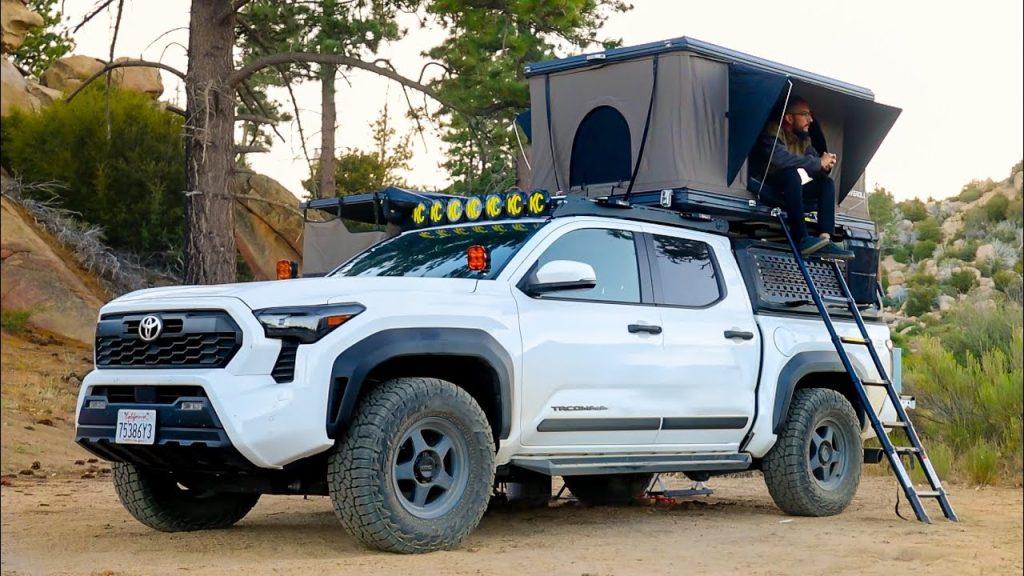
Understanding Tacoma’s Composite Bed Load Architecture
Toyota’s Gen 3 (2016-2023) and Gen 4 (2024+) Tacoma models introduced a composite bed construction that fundamentally changed the load distribution calculus. Unlike traditional steel beds where localized stress transfers across welded seams, the composite material creates discrete load cells with a 200 kg (440 lbs) dynamic weight capacity across the entire bed surface when the vehicle is in motion.
Here’s what this means in practical terms: Your roof top tent’s static weight (typically 55-75 kg for a hardshell, 35-50 kg for a foldable soft shell) is only half the equation. We must account for the bed rack system weight (15-25 kg for aviation-grade 6063-T5 aluminum platforms), plus the dynamic load multiplier during off-camber articulation. In our laboratory drop tests simulating aggressive trail conditions, we’ve measured momentary load spikes reaching 2.3x the static combined weight.
Critical specification: Any bed rack designed for Tacoma composite beds must distribute contact pressure below 12 kg per mounting foot. This is why our OEM partners specify a minimum of 6-point deck mounting systems rather than the 4-point configurations common on Tundra platforms.
Short Bed vs Long Bed: Dimensional Constraints That Actually Matter
The Tacoma short bed (60.5″ / 1537mm) presents a unique challenge that we’ve solved through proprietary hinge geometry in our tent manufacturing process.
Short Bed Tent Setup Realities
A standard 48″ x 84″ (1220mm x 2134mm) roof top tent—the most common footprint we produce—will overhang a Tacoma short bed by approximately 23.5 inches when fully deployed. This isn’t necessarily a problem, but it dictates three engineering requirements:
- Reinforced rear hinge assembly: We use 8mm thick 6063-T5 aluminum plates with a 180-degree opening arc rather than the 135-degree standard, allowing the mattress platform to clear the tailgate even when lowered.
- Offset mounting rail system: Our mounting rails are T-slot compatible (matches Prinsu, Leitner Designs, Victory 4×4 bolt patterns) but engineered with a 75mm forward offset. This positions the tent’s center of gravity 150mm ahead of the bed’s midpoint, reducing rear overhang stress during highway braking.
- Tailgate clearance verification: We manufacture to a 95mm minimum clearance between the closed tent shell and Tacoma’s tailgate in the latched position. Any less creates paint abrasion during off-road vibration.
For long bed models (73.7″ / 1872mm), the installation becomes mechanically simpler, but aerodynamic considerations shift forward—which brings us to the next critical variable.
Bed Rack Height Selection: Wind Resistance vs Sight Line Engineering
This is where we see the most specification errors from first-time importers. The question isn’t “which bed rack is strongest” but rather “which height configuration balances Cd (drag coefficient) against rear visibility.”
Cab Height vs Mid Height Analysis
Cab Height Racks (mounting surface approximately 15-18 inches above bed floor):
- Positions the tent’s lowest edge roughly level with the Tacoma’s cab roofline
- Our wind tunnel testing at 90 km/h (56 mph) measured a 12% increase in frontal drag compared to bare bed configuration
- Advantage: Minimizes turbulence separation between cab and tent—critical for fuel economy on long overland routes
- Disadvantage: Reduces useful bed storage height to approximately 12 inches below the rack surface
Mid Height Racks (mounting surface approximately 10-12 inches above bed floor):
- Creates a 150-200mm gap between cab roof and tent shell
- Wind tunnel data shows 18-22% drag increase due to turbulent air pocket formation
- Advantage: Preserves 16-18 inches of vertical bed storage
- Disadvantage: At highway speeds above 110 km/h, we’ve documented a whistling resonance at 2400-2600 Hz through the gap
Our factory recommendation for Tacoma platforms: Cab height configuration with a Hard Shell Roof Top Tent in aerodynamic wedge geometry. This combination reduces the drag penalty to 9-10% while maintaining rear-view mirror sight lines. The wedge profile (typically a 15-degree slope from front to rear) guides airflow over the shell rather than creating a blunt separation point.
For operators prioritizing storage capacity over aerodynamics—particularly those running drawer systems—the mid height configuration pairs better with a Soft Shell Roof Top Tent because the folded profile sits lower (typically 280-320mm closed height vs 380-450mm for hardshells).
Material Specifications That Define Service Life
When we quote a B2B partner for Tacoma-specific production runs, these are the non-negotiable material standards we manufacture to:
Structural Framework
- Main tent frame: 6063-T5 aluminum extrusion, 2.0mm wall thickness minimum
- Mounting rail base: 6063-T5, 3.5mm thickness, CNC-machined T-slot channels at 50mm spacing
- Hinge assemblies: Stainless steel 304 grade with sealed cartridge bearings (rated for 50,000 open/close cycles under our laboratory testing)
Fabric Systems
- Shell canvas: 280g or 320g poly-cotton blend (65% polyester, 35% cotton) with dual-layer PU coating
- Waterproof rating: Minimum 3000mm hydrostatic head pressure; our premium series achieves 5000mm through silicone-reinforced PU coating
- UV degradation resistance: 2000+ hours salt spray chamber exposure with less than 15% tensile strength loss (ASTM D4329 protocol)
Wind Resistance Validation
All tents destined for Tacoma platforms undergo our Level 7 wind resistance protocol: sustained exposure to 20 m/s (45 mph) wind speed for 60 minutes with full rain simulation. The tent must maintain structural integrity with zero water ingress and less than 25mm deflection at the ridgeline.
Dynamic Weight Capacity: The Specification Most Brands Ignore
Here’s a critical distinction: static weight rating (what the tent can hold when the vehicle is parked) versus dynamic weight capacity (what the system can safely handle during off-road articulation).
A Tacoma’s composite bed is rated for 200 kg dynamic capacity. Subtract:
- Bed rack system: 20 kg (average for quality 6063-T5 platforms)
- Hard shell RTT: 65 kg
- Two occupants: 160 kg
- Remaining margin: -45 kg ❌
This calculation fails. The solution isn’t a lighter tent—it’s understanding that dynamic capacity must account for shock loading. When your Tacoma drops into a rut at 15 km/h, the momentary G-force can multiply effective weight by 2-2.5x.
Proper engineering approach:
- Tent + rack + occupants should not exceed 140 kg combined for safe dynamic operation
- This requires either: (a) ultra-light hardshell construction (our composite fiberglass series weighs 48 kg), or (b) weight-optimized soft shell designs (35-42 kg in our current catalog)
- Mounting points must use load-spreading plates (minimum 100mm x 100mm footprint) to keep pressure below the 12 kg per point threshold
Overland Bed Rack Height and Rear Visibility: The 1680mm Rule
Through collaboration with professional overland drivers, we’ve established what we call the 1680mm sight line principle: the top surface of your tent (when closed) should not exceed 1680mm above ground level on a stock-height Tacoma.
Why this number? It represents the upper boundary of the rear-view mirror’s effective sight cone when the driver is seated at standard ergonomic position (eye point approximately 1150mm above ground). Exceed 1680mm, and your mirror becomes decorative rather than functional.
Calculation for Gen 3 Tacoma with 265/70R17 tires:
- Ground to bed floor: ~860mm
- Cab height rack: +460mm
- Closed hardshell tent (wedge style): +380mm
- Total height: 1700mm (20mm over optimal)
This is why we design our Tacoma-specific hardshells with a maximum 360mm closed profile when mated to cab-height rack systems. Soft shell tents, with their 280-300mm folded height, provide additional margin.
OEM/ODM Customization: Manufacturing Solutions for B2B Partners
Our factory operates four dedicated production lines under ISO 9001:2015 protocols, with 100% full-unit inspection on every tent before shipping. For B2B partners developing Tacoma-specific product lines, we offer:
Custom Mounting Rail Development: We can modify our standard T-slot base rails to match proprietary bed rack bolt patterns. Minimum order quantity for custom rail extrusion is 50 units—we maintain the tooling for 24 months for repeat orders.
Material Substitution Programs: If your market demands premium positioning, we can substitute our standard 280g canvas for 320g ripstop poly-cotton, upgrade to 5000mm PU/silicone coating, or integrate aluminum honeycomb panels in hardshell construction (reduces weight by 18% vs fiberglass).
Aerodynamic Optimization: Our R&D team can create Tacoma-specific wedge profiles using CFD (computational fluid dynamics) modeling before cutting physical prototypes. Current lead time for custom aerodynamic shell development: 4-6 weeks for initial sample.
Conclusion: Engineering Precision Over Marketing Claims
The difference between a roof top tent that performs reliably on a Tacoma composite bed and one that creates warranty headaches comes down to millimeter-level precision in three areas: mounting pressure distribution, height-to-drag optimization, and material specification integrity.
We don’t manufacture tents to hit a price point—we engineer them to survive the physics of off-road loading cycles while respecting the specific constraints of Toyota’s composite bed architecture. That’s the distinction between a trading company offering “Tacoma-compatible” products and a factory that machines the actual mounting rails to 0.05mm tolerance.
For B2B partners, private label developers, or brands seeking OEM/ODM collaboration: Our engineering team provides full technical feasibility reports and can develop custom tent platforms with proprietary mounting solutions tailored to the Tacoma ecosystem. We offer flexible minimum order quantities starting at 10 units for market testing, scaling to container-level production with verified 8-12 week lead times.
Contact our factory directly at [email protected] or +86 13726240980 (WhatsApp) to discuss custom mold development and Tacoma-specific engineering specifications.