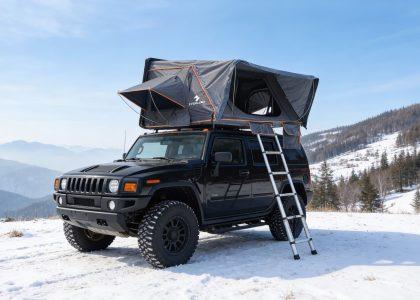
It is the nightmare scenario every first-time buyer imagines: You climb into your new roof top tent (RTT), settle in for the night, and suddenly—CRUNCH—your car roof caves in.
Let’s stop the panic right there.
As manufacturing engineers who have designed thousands of tent structures, we can tell you a secret: Your car is stronger than you think. In fact, 95% of modern vehicles—from rugged SUVs to modest hatchbacks—are perfectly capable of supporting a roof top tent.
The problem isn’t usually the car; it’s the math.
Confusion about “Dynamic” versus “Static” weight ratings leads many people to buy the wrong gear or, worse, install it unsafely. In this guide, we are stripping away the guesswork. We will break down the structural physics of roof loads so you can camp with absolute peace of mind.
The Core Physics: Dynamic vs. Static Weight
The most important math equation you will ever learn for overlanding.
When you look at your vehicle’s manual (or search online), you will see a “Roof Load Rating.” Usually, it’s a surprisingly low number, like 165 lbs (75kg).
You might think: “Wait, my tent weighs 150 lbs. That only leaves 15 lbs for me! How can I sleep up there?”
This confusion comes from not distinguishing between the two types of weight ratings.
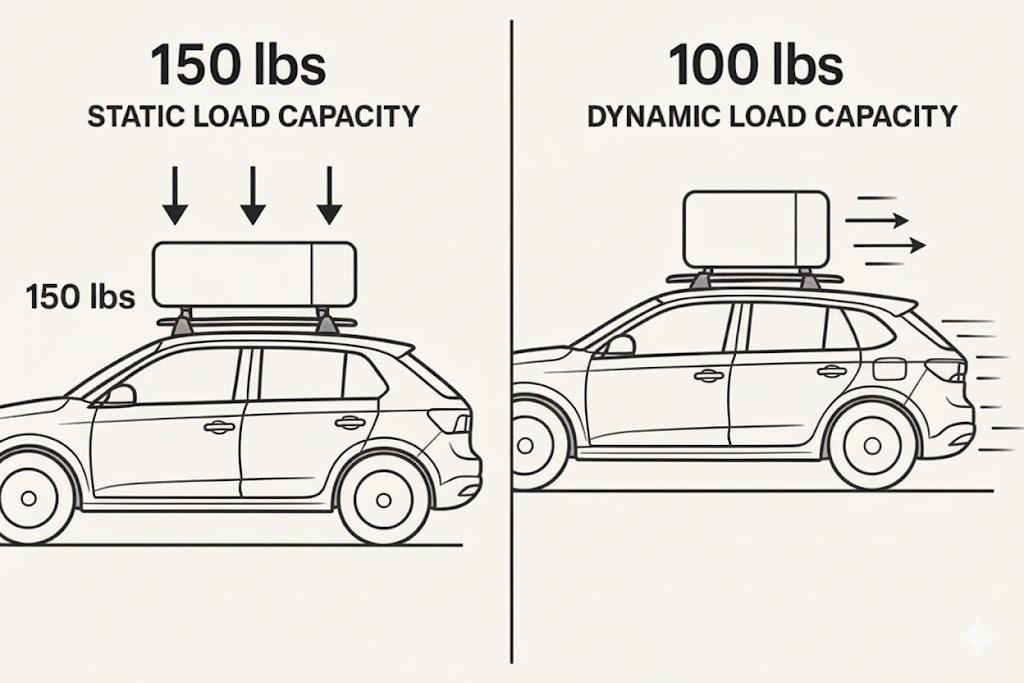
1. Dynamic Weight Rating (DWR) – The “Moving” Limit
This is the number listed in your car manual. It refers to the maximum weight the roof can safely support while the vehicle is in motion.
- The Scenario: You are driving at 70 mph, hitting potholes, or taking a sharp corner. The tent isn’t just sitting there; it’s exerting G-forces (kinetic energy) on your roof bars.
- The Rule: The total weight of your tent + your roof rack crossbars must be LESS than your vehicle’s Dynamic Weight Rating.
- Standard Benchmark: Most cars and SUVs have a DWR of 165 lbs (75kg). This is why lightweight tent engineering is so critical.
2. Static Weight Rating (SWR) – The “Parked” Limit
This is the number that matters when you are actually camping. It refers to the weight the roof can support when the vehicle is stationary.
- The Science: Modern vehicle frames are engineered with high-strength steel pillars (A, B, and C pillars) designed to protect passengers in a rollover accident. They can support the entire weight of the car upside down.
- The Calculation: As a general engineering rule, the Static rating is typically 3 to 5 times the Dynamic rating.
- The Reality Check:
- Dynamic Limit: 165 lbs (75kg)
- Static Limit: ~600 lbs (270kg+)
- Your Setup: Tent (130 lbs) + Two Adults (350 lbs) + Bedding (20 lbs) = 500 lbs.
- Result: You are well within the safety zone.
The Weakest Link: Your Roof Rack System
Your roof won’t fail, but your rack might.
Most “failures” we see in the industry aren’t caused by the car roof collapsing, but by the connection point between the car and the tent. Not all roof racks are created equal.
1. Factory Rails (The “Raised Rails”) ⚠️
Many SUVs come with raised rails running front-to-back.
- The Risk: Check the material. Are the feet made of plastic or metal? Many factory rails are designed for light luggage or ski carriers, not the heavy static load of two people sleeping.
- The Verdict: Do not clamp an RTT directly to plastic-footed factory rails unless the manufacturer explicitly states it is rated for it.
2. Aftermarket Crossbars (The Standard) ✅
To install a tent, you need two bars running side-to-side.
- Clamp-on System: Clamps onto your door frames or raised rails. Ensure they are from a reputable brand (like Thule, Yakima, or heavy-duty equivalents) and have a lock-tight mechanism.
- Bolt-on System: Bolts directly into the factory mounting points (fixed points) on the roof ditch. This is the strongest connection for unibody SUVs.
3. Platform Racks (The Pro Choice) 🏆
Flat aluminum trays (like Pioneer or Front Runner platforms) offer the best stability.
- Why they win: They distribute the weight of the tent across a larger surface area and more mounting points (sometimes 6 or 8 legs instead of 4), significantly reducing stress on any single point of the car roof.
Vehicle Class Analysis: Can YOUR Car Do It?
From compact sedans to heavy-duty trucks, here is what you need to know.
Not all roofs are created equal. We have categorized common vehicles into three classes to help you understand your specific limitations.
Class A: Small Sedans & Hatchbacks (e.g., Civic, Mini Cooper, Golf)
- The Verdict: Yes, but with strict limits.
- The Challenge: These vehicles often have lower dynamic weight ratings (sometimes around 110-132 lbs / 50-60kg) and shorter rooflines.
- The Solution: You must prioritize weight. Look for a lightweight Soft Shell RTT or a specialized “Mini” Hard Shell. You will likely need a high-quality aftermarket clamp-on roof rack system, as these cars rarely have factory rails suitable for tents.
- Pro Tip: Avoid long tents that overhang the windshield or trunk, as this creates dangerous aerodynamic lift.
Class B: Mid-Size SUVs & Crossovers (e.g., RAV4, Subaru Outback, CR-V)
- The Verdict: Perfect compatibility.
- The Challenge: Factory crossbars. As mentioned earlier, the stock bars that come with these cars are often too flexible.
- The Solution: Upgrade to a sturdy pair of aero-bars or a platform rack.
- Watch Out: Be careful with panoramic sunroofs. While you can install a tent over a sunroof, you must ensure the rack towers are tall enough so the tent floor doesn’t touch the glass when the chassis flexes off-road.
Class C: Trucks & Large SUVs (e.g., F-150, Tacoma, Land Cruiser, Jeep)
- The Verdict: Built for this.
- The Challenge: Height. Putting a tent on top of a lifted truck can make it hard to access garages and affects the center of gravity.
- The Solution: For pickup trucks, we highly recommend a Bed Rack (instead of a roof rack). It keeps the tent lower (behind the cab), reducing wind drag to near zero and keeping your center of gravity low for technical off-roading.

The “Everlead Solution”: Engineering for Compatibility
How we make tents that fit more cars.
At the factory level, we don’t just build tents; we battle gravity. Our engineering team focuses on two key areas to ensure our tents are safe for a wider range of vehicles:
- Weight Reduction: By using Aviation-Grade T6 Aluminum and honeycomb base structures, we have shaved off critical pounds without sacrificing strength. Our flagship models are up to 30% lighter than older fiberglass generations, making them safe for Class A and B vehicles.
- Universal Mounting 2.0: We redesigned our mounting brackets to be wider and more secure. They feature rubber-coated stainless steel to grip your crossbars tightly without scratching your vehicle’s paint.
Safety Checklist Before You Buy
Don’t guess. Check these 4 boxes.
Before you place an order, perform this simple audit:
- [ ] Check Your Manual: Find the “Roof Load” section in your vehicle’s owner’s manual. Confirm the Dynamic rating is at least 165 lbs (75kg).
- [ ] Inspect Your Rack: Ensure you have an aftermarket rack system rated for “Dynamic Load.” If you have stock plastic bars, plan to upgrade them.
- [ ] Do The Math: (Tent Weight) + (Rack Weight) < (Vehicle Dynamic Limit).
- [ ] Check The Sunroof: If you have a sunroof, measure the clearance to ensure the rack towers give you at least 2-3 inches of gap.
Conclusion
Can your car handle a roof top tent? Almost certainly, yes.
The fear of a crushed roof is largely a myth. Modern vehicles are incredibly strong. The real secret is simply matching the right tent weight to a quality roof rack system. Once you get the math right, you unlock a new world of freedom—sleeping comfortably wherever your tires can take you.
About Everlead Outdoor
Everlead Outdoor is a premier OEM/ODM Roof Top Tent Manufacturer based in Dongguan, China. Since 2016, we have been engineering high-performance outdoor gear for global brands.
We specialize in Lightweight Aluminum Hard Shells and Aerodynamic Designs that solve the compatibility challenges discussed in this article. With our ISO 9001 certified facility and 100% full-unit inspection protocol, we ensure that every tent we ship is safe, durable, and ready for adventure.
Looking for a reliable manufacturing partner? [Contact our engineering team] today for a consultation on our latest lightweight RTT models.