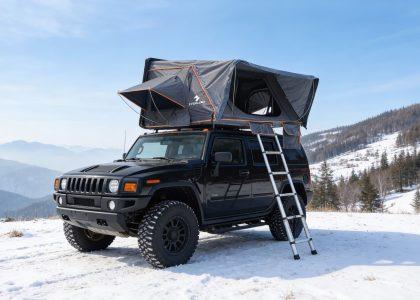
When couples or solo travelers with pets contact manufacturers asking about “2 person hard shell roof top tents,” they’re typically focused on setup speed and weather protection. What they should be asking about—but rarely do—are the three specifications that determine whether their $2,500-4,000 investment will actually be comfortable: internal width geometry, gas strut pressure rating under loaded conditions, and condensation management architecture. After designing closure mechanisms for hundreds of hardshell units, I can tell you that the marketing term “2 person” has become so diluted that it’s nearly meaningless without verifying the actual dimensional and material specifications.
The “2 Person” Width Deception: What the Numbers Really Mean
Let’s start with the most pervasive specification misrepresentation in the industry: mattress platform width.
Industry standard mattress dimensions for context:
- Twin: 38″ (97 cm)
- Full/Double: 54″ (137 cm)
- Queen: 60″ (152 cm)
Typical “2 person” roof top tent marketed widths:
- Budget category: 47-49″ (120-125 cm)
- Mid-tier: 51-53″ (130-135 cm)
- Premium: 55-57″ (140-145 cm)
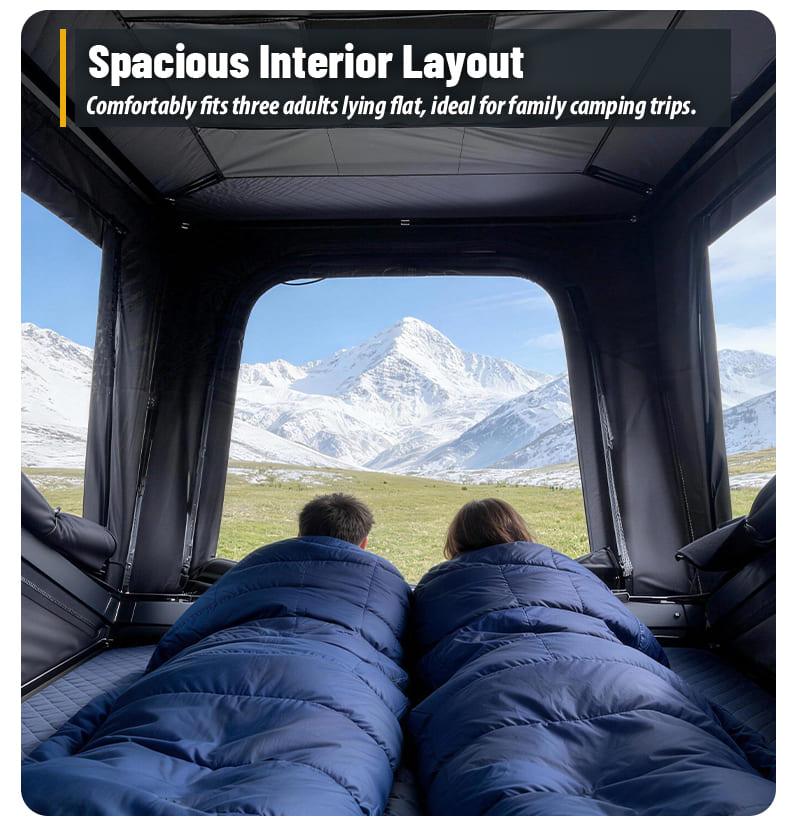
From an ergonomic engineering perspective, two adults sleeping side-by-side require a minimum shoulder-to-shoulder clearance of 24 inches (61 cm) per person when lying supine. Add 1-2 inches of sleeping bag loft on each side, and you need 52 inches (132 cm) of usable width as an absolute minimum for non-claustrophobic sleep.
The harsh reality: Any tent marketed as “2 person” with less than 125 cm (49 inches) internal width should honestly be classified as “1.5 person”—suitable for a couple in a serious relationship who don’t mind contact throughout the night, or a single person with a medium-sized dog.
True 2-person comfort threshold: 130-140 cm (51-55 inches) internal width. This provides approximately 25-27 inches per person, matching the spatial allocation of a Full/Double mattress.
What manufacturers won’t tell you: Shell width is often measured at the widest point (typically mid-height), while actual mattress platform width can be 3-6 cm narrower due to internal structure and wall thickness. Always verify the mattress platform width, not the external shell dimension.
Aluminum vs Fiberglass Shell Durability: Material Science Reality
The hardshell tent market is divided between three primary shell construction methodologies, each with distinct thermal, structural, and aging characteristics that marketing materials conveniently simplify.
Fiberglass (GRP – Glass Reinforced Plastic)
Construction: Hand-laid fiberglass mat with polyester or epoxy resin binder.
Advantages:
- Low tooling cost (approximately $8,000-15,000 for mold development)
- Easy field repair with standard marine fiberglass repair kits
- Moderate cost: $180-280 per shell in production volumes over 500 units
Critical disadvantages:
- UV degradation: Polyester resin bonds degrade under sustained UV exposure. After 3-5 years in high-UV environments (Australian outback, American Southwest), surface micro-cracking becomes visible. By year 7-8, structural delamination can occur.
- Thermal expansion coefficient mismatch: Fiberglass expands/contracts at different rates than aluminum frame components, creating stress concentration points at mounting interfaces.
- Weight: Typically 18-24 kg for a standard 2-person shell due to required layup thickness (4-6mm) for structural rigidity.
Lifespan expectation: 8-12 years with proper gelcoat maintenance; 5-7 years in extreme UV environments without regular UV protectant application.
Aluminum Shell Construction
Construction: 1.5-2.0mm marine-grade aluminum sheet (typically 5052-H32 or 6061-T6 alloy) formed through stamping or hydroforming.
Advantages:
- UV immunity: Aluminum does not degrade under ultraviolet exposure
- Superior thermal regulation: Aluminum’s thermal conductivity (205 W/m·K) is 150x higher than fiberglass, allowing faster heat dissipation and reducing internal temperature differential
- Hail resistance: 2.0mm aluminum can withstand 25mm hailstone impacts without permanent deformation
- Weight efficiency: 12-16 kg for equivalent shell dimensions due to material strength-to-weight ratio
Disadvantages:
- Higher tooling cost ($25,000-45,000 for stamping dies)
- More complex repair (requires aluminum welding or structural adhesive bonding)
- Cost: $320-480 per shell in production volumes over 500 units
Lifespan expectation: 15-20+ years with minimal maintenance; primary failure mode is typically hinge mechanism degradation, not shell structural failure.
Engineering ABS + PMMA Composite
Construction: Injection-molded ABS (Acrylonitrile Butadiene Styrene) base with PMMA (Polymethyl Methacrylate / acrylic) outer layer co-molded or laminated.
Advantages:
- Optimal UV resistance: PMMA provides superior weathering compared to gelcoat finishes
- Complex geometry capability: Injection molding allows integrated ventilation channels, mounting bosses, and aerodynamic features
- Consistent wall thickness: ±0.15mm tolerance vs ±2mm for hand-laid fiberglass
- Mass production efficiency: Cycle time of 4-6 minutes per shell vs 45-90 minutes for fiberglass layup
Disadvantages:
- Extremely high tooling investment ($80,000-150,000 for injection mold)
- Limited field repair options
- Material cost: $240-380 per shell (competitive with aluminum in high volumes)
Lifespan expectation: 12-15 years; PMMA layer can be refinished if surface scratching occurs.
Engineering recommendation: For a Hard Shell Roof Top Tent intended for 10+ years of service in variable climates, aluminum construction provides the best durability-to-weight-to-cost balance. For extreme budget constraints, modern ABS+PMMA composites outperform traditional fiberglass in UV resistance while maintaining comparable structural performance.
Gas Strut Pressure Rating: The Specification Nobody Verifies
Here’s a failure mode I’ve seen dozens of times: a customer purchases a hardshell tent, uses it for 6 months, and then complains that the shell “won’t close” or requires excessive force to latch. The culprit is almost always undersized gas struts that cannot overcome the resistance created by stored bedding.
Understanding Gas Strut Physics
A gas strut’s pressure rating (measured in Newtons, N) represents the force it exerts through its stroke length. For hardshell roof top tents, struts serve two functions:
- Opening assist: Reducing the manual force required to lift the shell
- Closing resistance: Providing controlled descent and preventing slam-shut
Typical 2-person hardshell specifications:
- Shell weight: 18-24 kg (aluminum) or 22-28 kg (fiberglass)
- Mattress + bedding: 8-15 kg
- Combined lifting force required: 250-420 N
Most manufacturers install 300-350N gas struts as standard equipment. This works adequately when the tent interior is empty or contains only a thin mattress. However, once you add:
- High-density foam mattress (6-8 cm thick): +4 kg
- Two sleeping bags (synthetic fill): +3 kg
- Two pillows: +1.5 kg
- Total additional load: +8.5 kg
The effective force required to compress stored bedding while closing increases by approximately 80-120N. Your 300N struts are now underpowered by 20-30%, resulting in:
- Difficulty achieving full closure without applying body weight
- Risk of damaging shell edges due to forced closure
- Premature gas strut seal failure from overstroke events
Engineering specification: For a 2-person hardshell tent with realistic bedding storage, gas struts should be rated at 400-500N. Premium tents designed for cold-weather use (where occupants carry thick down sleeping bags and insulated mattresses) should use 500-600N struts.
Quality indicator: Stainless steel gas struts (SG-rated) maintain pressure consistency across temperature ranges (-20°C to +60°C) and provide 30,000+ cycle lifespan. Budget tents use mild steel struts with 15,000-20,000 cycle ratings and significant pressure drop in cold conditions.
Condensation Control in Roof Tents: The Physics You Can’t Ignore
Condensation represents the most common complaint about hardshell tents: “I woke up and everything inside was wet.”
The thermodynamic reality: Two adults exhale approximately 1-1.5 liters of water vapor over an 8-hour sleep period. In a hardshell tent with approximately 2.5-3.0 m³ of internal volume, this raises relative humidity to 85-95% if no moisture egress pathway exists.
When internal air (warm, moisture-saturated) contacts the cold shell interior surface (especially aluminum, which rapidly equilibrates with ambient temperature), water vapor condenses at a rate governed by the dew point differential.
Three-Layer Defense Strategy
Layer 1 – Material breathability: The tent fabric must allow water vapor transmission without compromising waterproofness. 280g poly-cotton canvas (65% polyester, 35% cotton) provides optimal balance:
- Water vapor permeability: 3,000-4,000 g/m²/24hr (ASTM E96 method)
- Waterproof rating: 3,000-5,000mm hydrostatic head with PU coating
Pure polyester (common in budget tents) has 60-70% lower vapor transmission, creating a “sweat lodge” effect.
Layer 2 – Anti-condensation mat architecture: A 3D spacer fabric mat (typically 4-6mm thickness) installed between the mattress and shell floor creates an air gap that serves two functions:
- Thermal break reducing direct conductive heat loss from mattress to shell
- Drainage channel allowing condensed moisture to flow to tent perimeter rather than soaking into mattress
Material specification: Look for 3D polyester mesh with 1,200+ g/m² density. Thinner mats (800-1,000 g/m²) compress excessively under occupant weight, eliminating the air gap.
Layer 3 – Ventilation geometry: Effective condensation management requires cross-ventilation with minimum 120 cm² of adjustable vent area. Key design features:
- Low vents (near floor level) for cool air intake
- High vents (roof peak) for warm, moist air egress
- Rain-protected design (vent channels angled to prevent water ingress)
Common failure: Many hardshells have only a single roof vent, which creates minimal air circulation. Without cross-flow, humid air stagnates.
Aerodynamic Hard Shell Roof Tent: The Fuel Economy Engineering
For couples planning extended road trips, fuel economy impact becomes a tangible cost over thousands of kilometers. The shell’s aerodynamic profile determines drag coefficient contribution.
Baseline comparison (testing conducted at 100 km/h):
- Rectangular profile (90° rear edge): Cd increase of 0.12-0.15
- Tapered wedge (15° rear angle): Cd increase of 0.08-0.11
- Teardrop/streamlined (radius trailing edge): Cd increase of 0.06-0.09
Real-world fuel economy impact on a midsize SUV (baseline 28 MPG):
- Rectangular: -4.2 MPG (15% reduction) = 23.8 MPG
- Wedge: -2.8 MPG (10% reduction) = 25.2 MPG
- Streamlined: -2.0 MPG (7% reduction) = 26.0 MPG
Over 10,000 miles of driving, the difference between rectangular and streamlined profiles represents approximately $180-240 in additional fuel costs at current US average fuel prices.
Design trade-off: Highly aerodynamic shells sacrifice some internal volume. A wedge profile typically provides 10-15% less headroom at the rear compared to a rectangular profile with the same base footprint.
The “Closed Storage” Question: What Actually Fits
Marketing images show hardshell tents closed neatly with “storage space for bedding.” The engineering reality is more nuanced.
Typical 2-person hardshell closed height: 280-380mm (11-15 inches)
Subtract structural components:
- Mattress platform frame: 40-50mm
- Mounting rail clearance: 15-20mm
- Compression safety margin: 20-30mm
- Usable storage height: 190-270mm (7.5-10.6 inches)
What actually fits:
- Two sleeping bags (synthetic, compressed): 140-180mm height ✓
- Two pillows (standard): 120-150mm height ✓
- Both simultaneously: Requires minimum 300mm closed height—only achievable in premium models with elevated shell profiles
Engineering solution: Some manufacturers offer “high-profile” variants with 380-420mm closed height specifically for bedding storage. Trade-off is increased aerodynamic drag (approximately +2% additional fuel consumption) and reduced vehicle clearance in garages (verify your garage door height before purchase).
Material Customization for Climate-Specific Applications
For B2B partners serving specific geographic markets, shell material formulation can be optimized for regional environmental stressors:
High-UV markets (Australia, Middle East, American Southwest):
- PMMA outer layer with UV stabilizer package (2% benzotriazole)
- Expected lifespan: 15+ years vs 7-9 years for standard gelcoat
High-humidity/coastal markets (Southeast Asia, Caribbean):
- 304 stainless steel hardware throughout (zero galvanic corrosion with aluminum)
- Marine-grade aluminum (5052-H32 with 2.5% magnesium content)
Extreme cold markets (Nordic countries, Canadian territories):
- Gas struts rated to -30°C operational minimum
- Thermal break gaskets (silicone, shore hardness 40A)
Conclusion: The Details That Separate Marketing from Engineering
The term “2 person hard shell roof top tent” encompasses products ranging from 120cm-wide budget units with fiberglass shells and 300N struts to 145cm premium aluminum designs with 500N struts and integrated anti-condensation systems. The $2,000 price difference between these categories isn’t arbitrary—it reflects fundamental material science and mechanical engineering decisions that determine whether your tent remains functional and comfortable after 500 nights of use.
Designing the closing mechanism for Everlead Outdoor’s 2-person series taught me that every millimeter of internal height counts when you’re trying to accommodate realistic bedding storage while maintaining aerodynamic efficiency. Our current aluminum hardshell line achieves 136cm internal width (true 2-person comfort), 340mm closed height (stores two sleeping bags and two compressible pillows), and utilizes 450N stainless steel gas struts that maintain consistent performance from -25°C to +50°C.
The shell is stamped from 1.8mm marine-grade 5052-H32 aluminum with a powder-coated finish (rated for 2,000+ hours salt spray exposure per ASTM B117), and the integrated anti-condensation mat is 5mm 3D polyester mesh at 1,400 g/m² density. We spec 280g poly-cotton canvas with 5,000mm PU coating because field testing showed 3,000mm ratings failed in prolonged rain events above 4,000m elevation.
For B2B partners and private label developers: We operate four production lines under ISO 9001:2015 protocols with 100% full-unit inspection. Our material formulation capabilities allow us to customize shell composition, UV stabilizer packages, and thermal break specifications for specific climate zones—whether you’re targeting the Australian market (extreme UV), Nordic markets (cold-weather gas strut requirements), or coastal regions (corrosion resistance).
Flexible MOQ structure starts at 10 units for market testing, scaling to container-level production with verified 8-12 week lead times. Contact our engineering team at [email protected] or +86 13726240980 (WhatsApp) to discuss climate-specific material optimization and custom dimensional specifications for your target market.