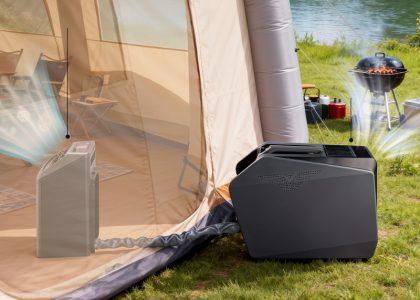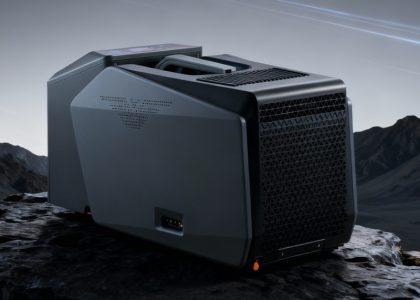
Staying cool while camping doesn’t mean sacrificing comfort in remote locations. Tent air conditioners can be powered through three primary methods: portable power stations with lithium batteries, solar panel systems, and portable generators—each offering distinct advantages for different camping scenarios. Understanding power requirements, runtime expectations, and the practical limitations of each option ensures you select the right solution for your outdoor adventures. This comprehensive guide examines battery capacity calculations, solar charging capabilities, generator specifications, and real-world performance to help you maintain comfortable temperatures wherever your travels take you.
Table of Contents
- How to run a tent air conditioner without electricity?
- Can a portable power station run a tent AC?
- How many watts does a tent air conditioner use?
- How long will a battery last on a tent air conditioner?
- What is the best power source for camping air conditioning?
How to run a tent air conditioner without electricity?
You can run a tent air conditioner without grid electricity using three off-grid power solutions: portable power stations with rechargeable lithium batteries, solar panel arrays paired with battery storage, or fuel-powered portable generators. Each method provides independent power generation, allowing you to operate cooling equipment in remote camping locations where traditional AC outlets are unavailable.
The most popular approach combines a high-capacity portable power station with solar panels for sustainable, quiet operation. This setup converts sunlight into stored electrical energy during the day while simultaneously running your tent AC. The battery reserves then provide cooling during evening hours when solar generation stops.
Battery-Based Power Stations
Modern lithium battery stations offer clean, silent operation without fuel requirements or emissions. Key advantages include:
- Zero noise pollution during nighttime operation
- Immediate power availability with no warm-up period
- Safe for enclosed tent environments with no carbon monoxide risk
- Rechargeable through solar panels, vehicle alternators, or shore power
- Compact, portable designs weighing 15-60 pounds depending on capacity
Typical camping power stations range from 500Wh to 3000Wh capacity, with larger units supporting multiple hours of air conditioning runtime.
Solar Panel Systems
Solar charging extends your off-grid cooling capability indefinitely in sunny conditions. A properly sized solar array can:
- Replenish battery storage while simultaneously powering the AC unit
- Provide 100-400 watts of charging power per panel
- Achieve full battery recharge in 4-8 hours of direct sunlight
- Eliminate fuel costs and resupply requirements for extended trips
The primary limitation involves weather dependency—cloudy conditions significantly reduce charging efficiency, requiring larger battery reserves as backup.
Portable Generator Options
Gas or propane generators deliver the highest continuous power output for demanding cooling needs:
- Sustained operation for days or weeks with fuel resupply
- Power output ranging from 1000 to 3000 watts for camping models
- Ability to run larger, household-style AC units
- Lower initial investment compared to equivalent battery capacity
However, generators produce noise (typically 50-65 decibels), require ventilation to prevent carbon monoxide buildup, and need regular refueling every 6-12 hours depending on load and tank size.
Can a portable power station run a tent AC?
Yes, a portable power station can effectively run a tent air conditioner, provided the station’s capacity and continuous power output match or exceed the AC unit’s wattage requirements. Most camping-specific tent ACs consume 150-500 watts during operation, which falls within the capability range of mid-sized portable power stations rated at 500-1500Wh capacity.
The critical specification is continuous power output rather than total energy storage. Your power station must deliver sufficient sustained wattage to handle the AC’s compressor startup surge and ongoing operation.
Power Output Requirements
Tent air conditioners experience two distinct power demands:
Startup Surge: When the compressor initially engages, power draw spikes to 2-3 times the running wattage for 1-3 seconds. A 300-watt tent AC may briefly require 600-900 watts during startup.
Running Power: Once the compressor stabilizes, the unit settles into its rated continuous consumption, typically 150-500 watts depending on cooling capacity and efficiency rating.
Your portable power station must provide continuous output that exceeds the running wattage and surge capacity that handles the startup spike. Many modern stations include “surge” or “peak” power ratings specifically for this purpose.
Capacity Considerations
Battery capacity, measured in watt-hours (Wh), determines runtime duration. Common configurations include:
| Power Station Capacity | Typical AC Runtime (300W Unit) | Best Use Case |
| 500-700Wh | 1.5-2 hours | Quick cooling sessions, naps |
| 1000-1500Wh | 3-4 hours | Evening comfort, overnight use with cycling |
| 2000-3000Wh | 6-8 hours | Full night operation, extended cooling |
Higher capacity stations enable longer runtime but increase weight, size, and cost proportionally. A 1500Wh unit typically weighs 35-45 pounds, while 3000Wh models exceed 70 pounds.
Recommended Station Features
For optimal tent AC operation, prioritize power stations offering:
- Pure sine wave inverter: Ensures clean power delivery for sensitive compressor motors
- Multiple AC outlets: Allows simultaneous operation of lights, fans, or charging devices
- Solar input capability: Enables daytime recharging to extend off-grid duration
- Battery management system: Protects against over-discharge and maintains cell health
- LCD display: Monitors real-time power consumption and remaining capacity
Stations with LCD screens help you track actual AC power draw and calculate remaining runtime based on current battery levels.
How many watts does a tent air conditioner use?
Tent air conditioners typically consume between 150 and 500 watts during normal operation, with most camping-specific units averaging 200-350 watts of continuous power draw. The exact wattage depends on cooling capacity measured in BTUs (British Thermal Units), compressor efficiency, fan speed settings, and ambient temperature conditions requiring different cooling intensities.
Understanding precise wattage consumption is essential for sizing your power supply and calculating expected runtime on battery systems.
Wattage by Cooling Capacity
Tent AC units are categorized by their cooling output, which directly correlates to power consumption:
| Cooling Capacity (BTU) | Typical Wattage | Cooling Coverage |
| 2,000-3,000 BTU | 150-250 watts | Small 2-person tents, up to 50 sq ft |
| 3,500-5,000 BTU | 250-400 watts | Medium 4-person tents, 50-100 sq ft |
| 5,000-7,000 BTU | 400-600 watts | Large family tents, 100-150 sq ft |
Smaller, battery-powered camping AC units designed specifically for tent use typically operate at the lower end of this spectrum, while larger portable units adapted from RV or residential use consume more power.
Factors Affecting Power Consumption
Several variables influence actual wattage draw beyond rated specifications:
Temperature Differential: Greater differences between outdoor heat and desired indoor temperature force the compressor to work harder, increasing power consumption by 15-30%.
Insulation Quality: Well-insulated tents with reflective fabrics or rainfly coverage reduce cooling load, allowing the AC to cycle off more frequently and average lower power draw.
Fan Speed Settings: Higher fan speeds add 20-50 watts to baseline consumption but improve air circulation and comfort perception.
Humidity Levels: Dehumidification requires additional energy. High-humidity environments can increase power draw by 10-20% compared to dry climates.
Startup vs. Running Wattage
As previously mentioned, compressor-based AC units experience brief power surges during startup:
- Running wattage: The steady-state consumption listed in product specifications
- Startup surge: Typically 2-3x running wattage, lasting 1-3 seconds
- Peak wattage: Maximum instantaneous draw, important for inverter sizing
A tent AC rated at 300 watts running may require 600-900 watts of available power capacity to handle startup without tripping protection circuits.
Energy Efficiency Considerations
Modern tent air conditioners feature various efficiency technologies:
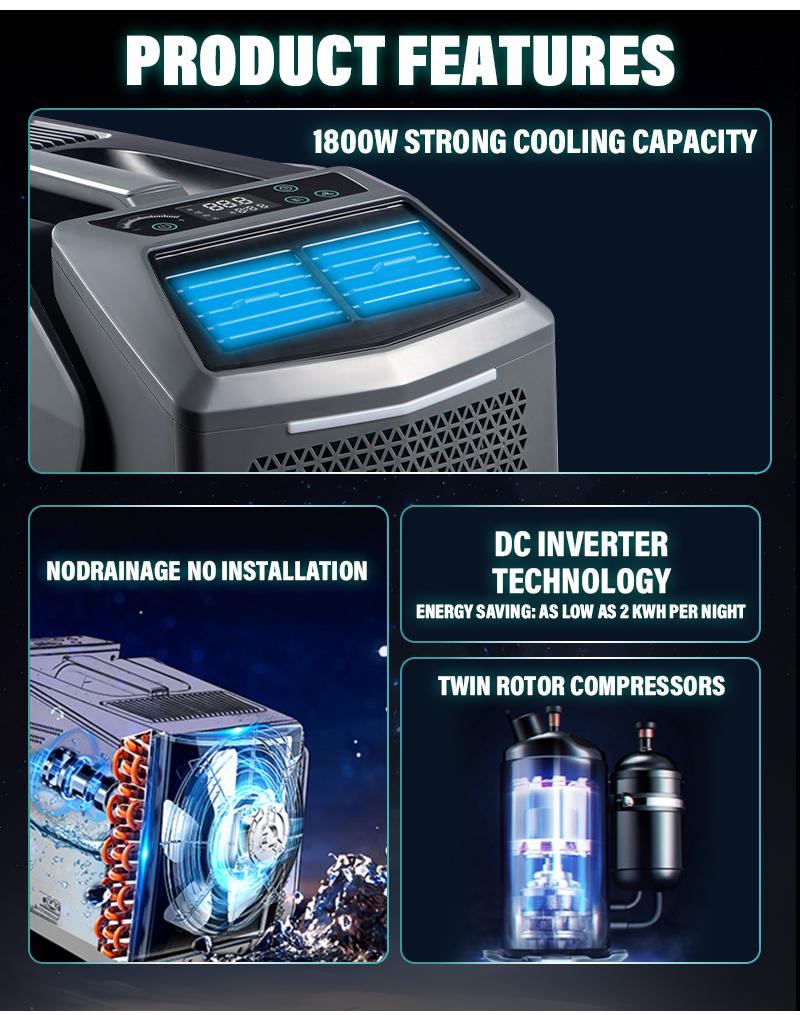
- Inverter compressors: Adjust speed based on cooling demand, reducing average consumption by 20-30%
- Eco modes: Cycle the compressor strategically to minimize power draw while maintaining comfort
- DC power optimization: Some units run directly on 12V/24V DC power, eliminating inverter conversion losses
Energy-efficient models may cost 30-50% more initially but can extend battery runtime significantly, providing better value for off-grid applications.
How long will a battery last on a tent air conditioner?
Battery runtime for a tent air conditioner is calculated by dividing the battery capacity (in watt-hours) by the AC’s power consumption (in watts), with typical results ranging from 2 to 8 hours depending on battery size and AC efficiency. For example, a 1000Wh battery powering a 250-watt tent AC will provide approximately 4 hours of continuous cooling, accounting for inverter efficiency losses of 10-15%.
Accurate runtime estimation requires understanding both your battery’s usable capacity and the AC’s actual power draw under real-world conditions.
Runtime Calculation Formula
The basic formula for estimating battery runtime is:
Runtime (hours) = Battery Capacity (Wh) × 0.85 ÷ AC Power Draw (W)
The 0.85 multiplier accounts for inverter efficiency losses and battery protection systems that prevent complete discharge. Most lithium batteries only allow 80-90% depth of discharge to preserve cell longevity.
Practical Runtime Examples
Here are real-world runtime scenarios based on common equipment combinations:
| Battery Capacity | AC Unit Power | Estimated Runtime | Practical Use |
| 500Wh | 200W | 2-2.5 hours | Afternoon cooling, power naps |
| 1000Wh | 300W | 2.5-3 hours | Evening comfort period |
| 1500Wh | 250W | 5-6 hours | Overnight with cycling |
| 2000Wh | 300W | 5.5-6.5 hours | Full night operation |
| 3000Wh | 350W | 7-8 hours | Extended overnight comfort |
These estimates assume continuous operation. Most tent ACs cycle on and off to maintain temperature, which can extend actual runtime by 30-50%.
Maximizing Battery Runtime
Several strategies help extend cooling duration on limited battery capacity:
Thermostat Management: Set the temperature 2-3 degrees higher than your ideal preference. This allows more frequent compressor cycling, reducing average power consumption.
Pre-Cooling Strategy: Run the AC at maximum capacity during solar charging hours to reduce tent temperature before sunset, then operate at minimal settings overnight.
Tent Insulation: Use reflective sunshades, rainfly coverage, and ground tarps to minimize heat infiltration, allowing the AC to cycle off more frequently.
Strategic Operation: Cool the tent only during sleeping hours (typically 6-8 hours) rather than continuous all-day operation.
Eco Mode Features: Enable energy-saving modes that sacrifice minor comfort for extended runtime.
Temperature Cycling Approach
Rather than continuous operation, consider a cycling strategy:
- Run AC at full power for 30-45 minutes to reach comfortable temperature
- Allow natural cooling for 30-60 minutes as the compressor cycles off
- Resume cooling when temperature rises 3-5 degrees above target
- Repeat throughout the night
This approach can effectively double your runtime compared to continuous operation while maintaining acceptable comfort levels for most campers.
Battery Capacity Recommendations
Based on typical overnight cooling needs:
- Weekend camping (1-2 nights): 1000-1500Wh capacity with solar recharging
- Extended trips (3-7 days): 2000-3000Wh capacity with robust solar array
- Full-time camping: Multiple battery banks or generator backup for reliable daily recharging
Larger capacity systems provide flexibility and reduce stress on battery cells through shallower discharge cycles, extending overall battery lifespan.
What is the best power source for camping air conditioning?
The best power source for camping air conditioning is a hybrid system combining a high-capacity portable power station (1500-3000Wh) with solar panel recharging capability, offering the optimal balance of runtime, sustainability, noise reduction, and operational flexibility. This configuration provides silent overnight cooling from battery reserves while enabling daytime solar recharging to maintain indefinite off-grid capability in sunny conditions.
However, the ideal solution varies based on camping style, trip duration, budget constraints, and campsite access to resources.
Power Source Comparison
Each power option offers distinct advantages and limitations:
| Power Source | Key Advantages | Primary Limitations | Best For |
| Portable Power Station + Solar | Silent operation, zero emissions, sustainable recharging, safe for enclosed spaces | Higher initial cost, weather-dependent charging, limited runtime without sun | Multi-day trips, noise-sensitive environments, eco-conscious campers |
| Portable Generator | Extended continuous runtime, highest power output, lower initial cost | Noise pollution, fuel requirements, carbon monoxide risk, restricted in some campgrounds | High-power demands, established campsites with generator hours, backup power needs |
| Vehicle Power (12V DC) | No additional equipment cost, recharges while driving | Limited capacity, drains vehicle battery, requires engine running or isolator | Short cooling sessions, vehicle-based camping, emergency situations |
| Shore Power + Extension | Unlimited runtime, consistent performance | Requires electrical hookup site, limits campsite selection, not truly off-grid | RV parks, developed campgrounds, semi-permanent setups |
Hybrid System Recommendation
The most versatile solution combines multiple power sources for redundancy:
Primary: 2000Wh portable power station for overnight cooling (6-7 hours runtime)
Recharging: 200-400 watts of portable solar panels for daytime battery replenishment (4-6 hours full recharge in good sun)
Backup: Small 1000-2000 watt inverter generator for extended cloudy periods or emergency situations
This three-tier approach ensures cooling capability regardless of weather conditions while maintaining quiet operation during sleeping hours.
Budget Considerations
Power system costs vary significantly by capacity and quality:
Entry Level ($300-600): 500-1000Wh power station with basic features provides 2-3 hours runtime, suitable for evening cooling sessions and weekend trips.
Mid-Range ($800-1500): 1500-2000Wh power station plus 200W solar panel offers full overnight capability with next-day recharging for extended trips.
Premium ($2000-4000): 3000Wh+ expandable power station with 400W+ solar array enables multi-day autonomy and simultaneous operation of multiple appliances.
Generator Alternative ($400-800): Inverter generator provides unlimited runtime at lower upfront cost but requires ongoing fuel expenses and produces noise.
Camping Style Optimization
Match your power solution to your specific camping approach:
Car Camping at Developed Sites: Portable power station (1000-1500Wh) offers convenience without generator noise that may violate campground quiet hours.
Dispersed/Backcountry Camping: Solar-rechargeable power station maximizes self-sufficiency where generator use may be prohibited or impractical.
RV/Van Life: Integrated house battery system with solar provides permanent solution with higher capacity and daily recharge capability.
Festival/Event Camping: Compact power station avoids generator restrictions while providing cooling during hot weather events.
Emergency/Extreme Heat: Generator backup ensures cooling capability regardless of battery depletion or solar availability.
Environmental and Regulatory Factors
Many campgrounds and wilderness areas impose restrictions affecting power source selection:
- Generator Quiet Hours: Most developed campgrounds prohibit generator operation between 8 PM and 8 AM
- Wilderness Area Regulations: Generators often completely banned in designated wilderness to preserve natural soundscapes
- Noise Ordinances: Some locations limit sound output to 60 decibels or less, effectively requiring battery solutions
- Fire Restrictions: During high fire danger, fuel-powered equipment may be prohibited while battery systems remain permissible
Battery-based systems with solar recharging comply with the most restrictive regulations while providing maximum camping location flexibility.
Long-Term Cost Analysis
While generators appear more economical initially, total ownership costs shift over time:
5-Year Generator Cost: $600 equipment + $500 fuel + $200 maintenance = $1300 total
5-Year Battery System Cost: $1500 equipment + $300 solar panels + minimal maintenance = $1800 total
The battery system’s higher initial investment narrows significantly when accounting for fuel costs, with the advantage increasing for frequent campers who achieve better equipment amortization.
Conclusion
Powering a tent air conditioner in off-grid camping environments requires careful consideration of energy capacity, runtime expectations, and power source characteristics. The optimal solution balances three critical factors: sufficient battery capacity for overnight cooling needs, reliable recharging capability for multi-day trips, and compatibility with your camping style and budget constraints.
For most campers, a portable power station in the 1500-2000Wh range paired with 200-400 watts of solar panels represents the sweet spot of performance, sustainability, and convenience. This configuration delivers 5-7 hours of comfortable overnight cooling while enabling complete battery replenishment during daylight hours, providing genuine off-grid independence without noise pollution or emissions.
Calculate your specific power requirements by identifying your tent AC’s wattage consumption, determining desired runtime hours, and adding 20-30% capacity buffer for efficiency losses. With proper equipment sizing and strategic operation—including pre-cooling during solar generation hours and thermostat management—you can maintain comfortable sleeping temperatures throughout your camping adventures while minimizing environmental impact and maximizing location flexibility.
About Everlead Outdoor
Everlead Outdoor is dedicated to creating luxury automotive camping experiences that blend industrial aesthetics with supremely convenient engineering. Centered around innovative rooftop tent systems, we’ve expanded into essential outdoor appliances including tent air conditioners, portable water heaters, and refrigerators—providing complete climate control solutions for off-grid adventures.
As an ISO 9001-certified direct manufacturer with over a decade of experience, we control every aspect of production through four dedicated production lines and maintain 100% full-unit inspection on every product. Our tent air conditioners are specifically engineered for low power consumption and portable power station compatibility, delivering reliable cooling performance in extreme camping conditions.
Whether in the wilderness or lakeside, Everlead delivers more than durable gear—we build premium outdoor sanctuaries offering all-weather comfort for quality-driven adventurers worldwide.Connect with us:
Email: [email protected] | Phone/WhatsApp: +86 13726240980