Hot showers are often considered a luxury left behind when venturing off-grid, but modern engineering has changed the equation. Yes, portable water heaters work effectively by utilizing rapid heat exchange technology—typically powered by propane or electricity—to raise ambient water temperature by 30°F to 50°F instantly. While they may not replicate the unlimited pressure of a home boiler, they provide a reliable, safe, and consistent hot water supply for camping, overlanding, and emergency sanitation.
This analysis breaks down the mechanics, limitations, and best use cases for these devices, helping you determine if they are the right solution for your inventory or personal setup.
Table of Contents
- How do portable tankless water heaters actually work?
- Can a portable water heater get water hot enough for a shower?
- Gas vs. Electric: Which portable heater is more efficient?
- What water pressure is required for these units to function?
- Are portable gas water heaters safe to use?
- How long does a standard propane tank last?
How do portable tankless water heaters actually work?
Portable tankless water heaters work on an “on-demand” basis; cold water flows through a pipe system where a flow sensor triggers a burner (gas) or heating element (electric) to heat the water instantly as it passes through a heat exchanger. Unlike traditional home water heaters that store gallons of hot water in a large tank, these compact units heat water only when the tap or showerhead is open, ensuring energy is not wasted maintaining the temperature of unused water.
The process relies on three critical components working in unison:
- Flow Sensor: Detects water movement when you turn on the showerhead pump.
- Ignition System: Powered by D-cell batteries or a small lithium battery, this ignites the burner immediately upon detecting flow.
- Heat Exchanger: Usually made of copper or aluminum, this component transfers the intense heat from the burner to the water pipe without the two physically touching.
Because there is no storage tank, the supply of hot water is theoretically endless, limited only by your fuel supply and water source.
Can a portable water heater get water hot enough for a shower?
Absolutely, most portable water heaters can raise the input water temperature by an average of 35°F to 50°F (approx. 20°C to 28°C), easily achieving the comfortable shower range of 98°F to 105°F. However, the final output temperature depends heavily on the temperature of the source water; if you are drawing near-freezing water from a mountain stream, you may need to cycle the water through the system twice or reduce the flow rate to achieve a comfortable temperature.
The relationship between flow rate and temperature is inverse. To get hotter water, you must slow down the water flow, allowing it to spend more time inside the heat exchanger absorbing energy.
- Summer Use: With 60°F source water, the unit easily reaches 110°F at full flow.
- Winter Use: With 35°F source water, the unit may max out at 85°F unless flow is restricted.
Gas vs. Electric: Which portable heater is more efficient?
For high-volume heating and camping applications, portable gas (propane) heaters are significantly more efficient and powerful than electric counterparts, which often struggle to produce instant heat without massive power consumption. Gas contains a much higher energy density, allowing small portable units to generate 30,000+ BTUs of heat, whereas achieving similar results electrically would require a generator or large battery bank that negates the portability factor.
Comparison: Gas vs. Electric Efficiency
| Feature | Portable Propane Heater | Portable Electric Heater |
| Heat Output | High (20,000 – 60,000 BTU) | Low to Moderate |
| Power Source | Compressed Gas (Propane/Butane) | Grid, Generator, or Massive Battery |
| Warm-up Time | Instant (5-10 seconds) | Slow (often requires immersion time) |
| Portability | Excellent (Self-contained) | Poor (Tethered to heavy power source) |
| Best For | Showers, Dishwashing, Groups | Making Tea, Small Basins |
Electric immersion heaters are useful for heating a small bucket of water over 20 minutes, but for a continuous shower, propane is the industry standard.
What water pressure is required for these units to function?
Most portable tankless water heaters require a minimum water pressure of 2.5 PSI to 20 PSI to trigger the ignition sensor, which is why most units come supplied with a specialized 12V submersible pump. If the water pressure is too low (for example, gravity-fed from a bucket that isn’t high enough), the safety sensor will not detect flow and will prevent the burner from igniting to avoid overheating the system.
For off-grid setups, this pressure is typically achieved in one of two ways:
- 12V Electric Pump: Dropped into a lake or jerry can, powered by a car cigarette lighter or portable power station.
- Mains Water: Connecting directly to a garden hose (requires a pressure regulator if the mains pressure exceeds 60 PSI).
Are portable gas water heaters safe to use?
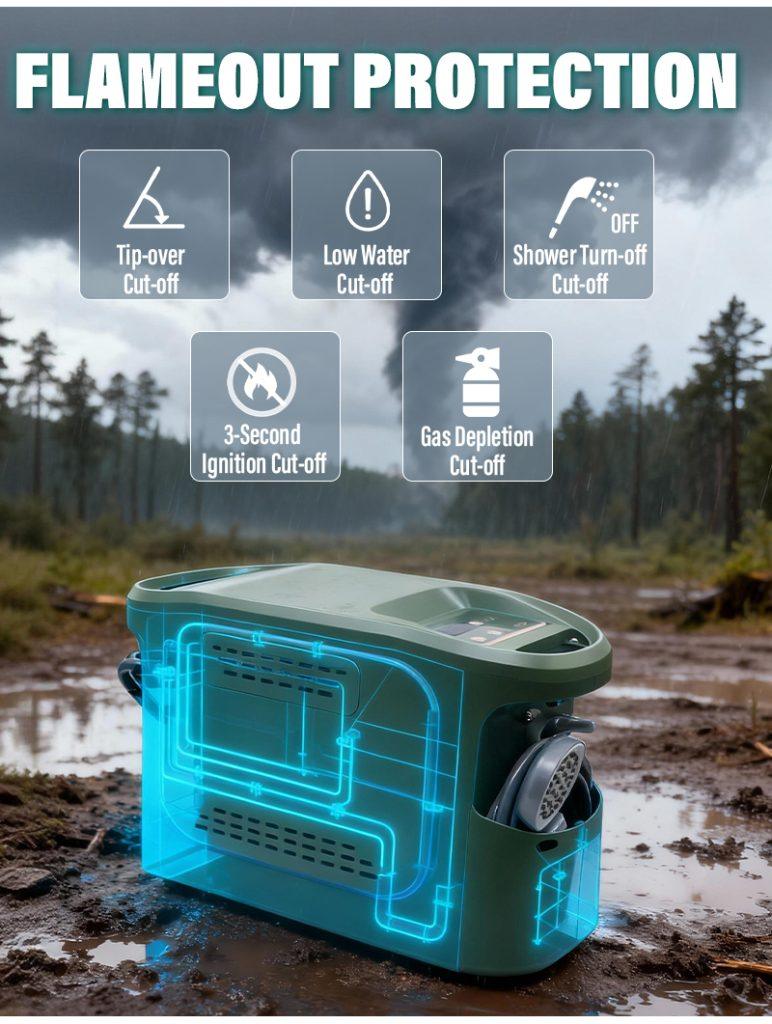
Yes, portable gas water heaters are safe when used outdoors as intended, as they are equipped with multiple safety cut-off sensors including flame failure protection, tilt switches, and oxygen depletion sensors. The primary danger arises from using these units in enclosed spaces like tents or unventilated RV bathrooms, where carbon monoxide (CO) can accumulate rapidly.
Modern manufacturing standards, such as those outlined by CSA Group, mandate rigorous safety features:
- Flame Failure Device: If the wind blows the flame out, the gas valve snaps shut instantly to prevent a gas leak.
- Anti-Freeze Protection: Many units include drain plugs to prevent residual water from freezing and cracking the pipework.
- Overheat Protection: The system shuts down if water temperature exceeds unsafe limits (usually 125°F/52°C) to prevent scalding.
How long does a standard propane tank last?
A standard 20lb propane tank can provide approximately 15 to 20 hours of continuous hot water use, while a smaller 1lb camping canister typically lasts for about 30 to 45 minutes of shower time. Since the burner only consumes gas while the water is flowing, a single small canister is often sufficient for a weekend camping trip for a family of four, assuming quick 5-minute showers.
Efficiency varies based on the BTU rating of the unit. A higher BTU unit (like 60,000 BTU) will consume fuel faster but provides a higher flow rate and hotter water. For extended overland trips, connecting to a larger bulk tank is recommended to reduce waste and cost.
Conclusion
Portable water heaters are not just a gimmick; they are a mature technology that effectively bridges the gap between wilderness survival and civilized comfort. By understanding the mechanics of heat exchange and flow rates, users can enjoy consistent hot showers anywhere. The key lies in selecting a unit with adequate BTU output for your climate and ensuring you have the correct pump setup to trigger the ignition.
About Everlead Outdoor
Everlead Outdoor is a premier OEM/ODM Outdoor Gear Manufacturer based in Dongguan, China. We specialize in engineering solutions that bring home-like comfort to the toughest environments.
Our expertise extends beyond tents to advanced camping appliances. The insights in this article reflect the engineering behind our GWH Series Portable Water Heaters, which feature Smart Thermostatic Control and Active Safety Monitoring. Unlike generic manual units, we integrate intelligent processors that adjust gas flow 40 times per second to maintain a precise temperature, preventing the “scalding spike” common in older technology.
With our ISO 9001 certified production lines, we ensure every gas appliance undergoes rigorous leak and combustion testing before leaving the factory.
Looking to upgrade your outdoor appliance catalog?
Contact our team today for OEM/ODM inquiries on our latest thermostatic water heater models.