The Era of “Roughing It” is Over.
We have all been there. You wake up at 7:00 AM, not because you want to, but because the sun has turned your tent into a sauna. You are sticky, groggy, and your expensive gear feels less like a sanctuary and more like a greenhouse.
For years, the outdoor industry told us this was just “part of the experience.” Or worse, they sold us “swamp coolers” and USB fans that merely pushed hot, humid air around. But as overlanding and technical camping have evolved, so has the technology that powers them.
At Everlead Outdoor, we believe that true adventure shouldn’t require sacrificing sleep. The new standard for outdoor comfort isn’t about ice packs or wet towels; it is about compressor-based, inverter technology.
In this guide, we are dismantling the myths surrounding tent cooling. We will explain the physics of heat exchange, why your choice of power matters, and why the form factor you choose (Monoblock vs. Split-Type) will determine whether you sleep soundly or sweat through the night.
1. The “Swamp Cooler” Myth vs. Real Refrigeration
Before we discuss what works, we must address what doesn’t. The market is flooded with devices marketing themselves as “portable air conditioners” that are, in reality, evaporative coolers (often called “swamp coolers”).
The Science of “Swamp Coolers” (Evaporative Cooling)
These devices work by pulling air through a water-soaked filter. As the water evaporates, it absorbs some heat.
- The Problem: Physics. Evaporation only works efficiently in dry air. If you are camping in a humid forest or near a lake, the air is already saturated. The swamp cooler cannot evaporate water effectively, so it simply blows humid, room-temperature air at you.
- The Result: You end up in a tent that is not only hot but now also damp and muggy.
The Science of True AC (Compressor Refrigeration)
A true air conditioner doesn’t “make cold”; it removes heat. It uses a refrigerant cycle (compressor, condenser, evaporator) to physically absorb heat energy from the air inside your tent and pump it outside.
- The “Dry” Bonus: A critical byproduct of this process is dehumidification. By removing moisture from the air, a real AC makes 80°F (27°C) feel crisp and comfortable, whereas a humid 80°F feels suffocating. For tent camping, drying the air is often just as important as cooling it.
2. Form Factors: Monoblock vs. Split-Type (The Critical Choice)
Once you commit to real refrigeration, you face a fork in the road. Most campers default to the traditional “Portable AC” style they see in homes, but for a tent, this is often a mistake.
The Monoblock (Traditional Portable)
These are the all-in-one units where the compressor, fan, and exhaust are housed in a single box that sits inside your tent. You run a hose out the window to vent hot air.
- The Hidden Flaw (Negative Pressure): This is the dirty secret of monoblock units. To push hot air out through the hose, the unit must pull air in from somewhere to cool its own motor. It sucks this air from inside your tent.
- The Vacuum Effect: This creates a vacuum (negative pressure). Your tent responds by sucking in hot, dirty, bug-filled air from every zipper crack and seam to replace the air that left. You are constantly fighting a losing battle against heat infiltration.
- The Noise: You are sleeping next to a compressor. It buzzes, vibrates, and clicks on and off all night.
The Split-Type (The Pro Choice)
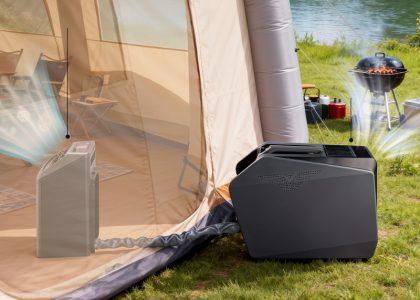
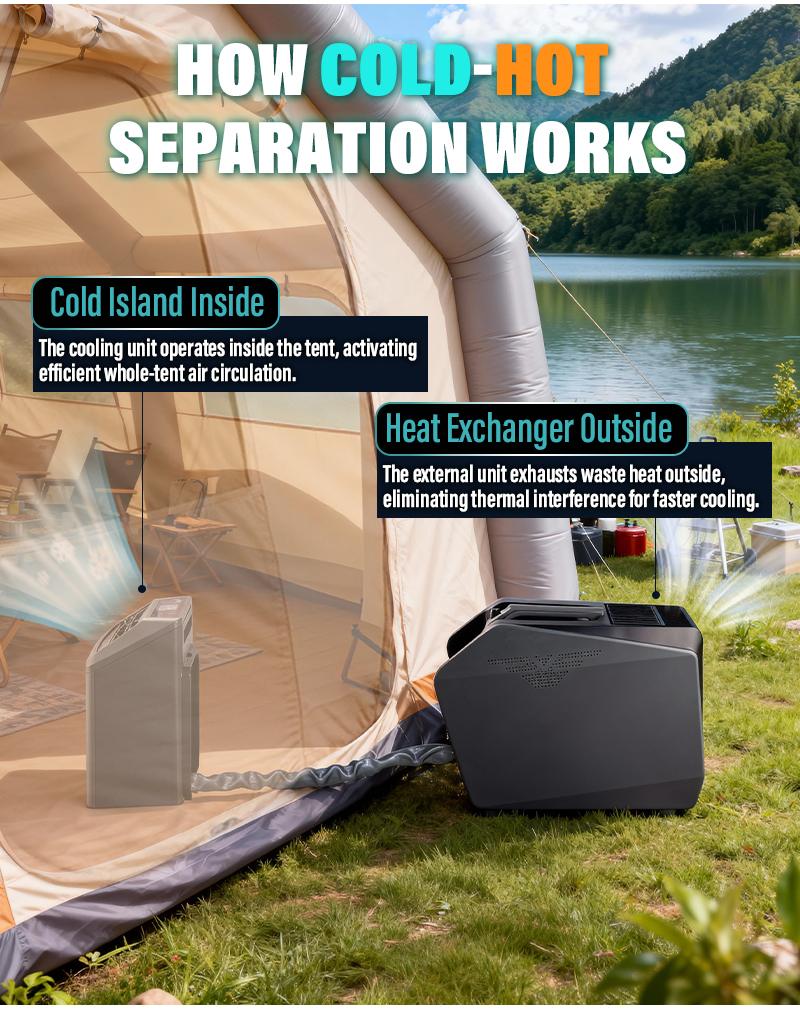
This design separates the noisy, hot components from the cool, quiet ones. The compressor unit sits outside the tent, while the air handler (blower) sits inside.
- Zero Negative Pressure: The internal unit simply recirculates the air already inside the tent, cooling it further with every pass. It does not suck in hot air from outside.
- Whisper Quiet: Since the mechanical noise is outside, the only sound inside is a gentle “whoosh” of airflow—similar to a high-end library.
- Efficiency: By recirculating internal air, the unit doesn’t have to work as hard. It maintains a stable temperature with significantly less energy, which is gold when you are running on battery power.
3. Sizing & Power: The “BTU vs. Battery” Equation
Bigger is not always better. In the world of tent ACs, “oversizing” is a common rookie mistake.
The Goldilocks Zone (2000 – 5000 BTU)
You might think, “Why not get a 10,000 BTU unit?”
- Short Cycling: A powerful unit will cool a small tent in 2 minutes and then shut off. Five minutes later, it kicks back on. This constant on/off cycle (short cycling) destroys efficiency and fails to dehumidify the air properly.
- The Sweet Spot: For most Roof Top Tents (RTTs) and teardrop trailers, 2000 to 5000 BTUs is the perfect range. It allows the unit to run steadily and efficiently, keeping humidity low and comfort high.
The 12V/24V DC Revolution
Most home ACs run on 110V/220V AC power (Alternating Current). But your car and portable batteries store DC power (Direct Current).
- The Inverter Loss: If you use a home AC, your battery must convert DC to AC power. You lose about 15-20% of your energy in this conversion as waste heat.
- The Native DC Solution: Purpose-built camping ACs (like our AC2 and AC3 series) run on Native DC (24V or 12V). This connects directly to your power source with zero conversion loss. It’s like driving a car in high gear—smooth, efficient, and easier on the “engine” (your battery).
4. Installation Masterclass: Don’t Let the Cold Escape
An air conditioner is only as good as the insulation around it. A Roof Top Tent (RTT) or ground tent typically has thin fabric walls with an R-value (insulation rating) near zero. If you don’t manage the environment, you are essentially trying to air condition the outdoors.
Insulation is King
To get the most out of your 2000-5000 BTU unit, you must slow down heat transfer.
- Thermal Liners: Many RTT manufacturers offer quilted thermal inner liners. These trap a layer of air, significantly reducing heat gain in summer and heat loss in winter.
- Reflective Rainflies: Using a silver-coated rainfly reflects solar radiation before it hits the tent fabric. In direct sunlight, this can lower the internal ambient temperature by 10°F before the AC even turns on.
Venting Logistics
For Split-Type units (like our AC2 series), installation is remarkably simple because you only need to pass the refrigerant hose and power cable into the tent.
- The Zipper Hack: Most modern tents have cable access ports. If yours doesn’t, simply run the connecting hose through the main door zipper.
- Sealing the Gap: To prevent bugs from entering where the zipper meets the hose, use a simple foam pipe insulation sleeve (often used for plumbing). It molds around the hose and zipper sliders, creating a bug-proof, airtight seal.
The “No-Drain” Advantage
Traditional ACs drip water constantly. In a campsite, a puddle inside or near your tent is a recipe for mud and mold.
- Self-Evaporating Technology: Look for units that feature a “slinger ring” or atomization system. These systems recycle the condensate water to cool the compressor coils and then mist it out with the hot exhaust air. This means no water tanks to empty and no puddles to wake up to.
5. Beyond Summer: All-Season Climate Control
The newest trend in overlanding isn’t just about staying cool; it’s about staying comfortable year-round. This is where Heat Pump Technology changes the game.
The Rise of the 4-Season AC
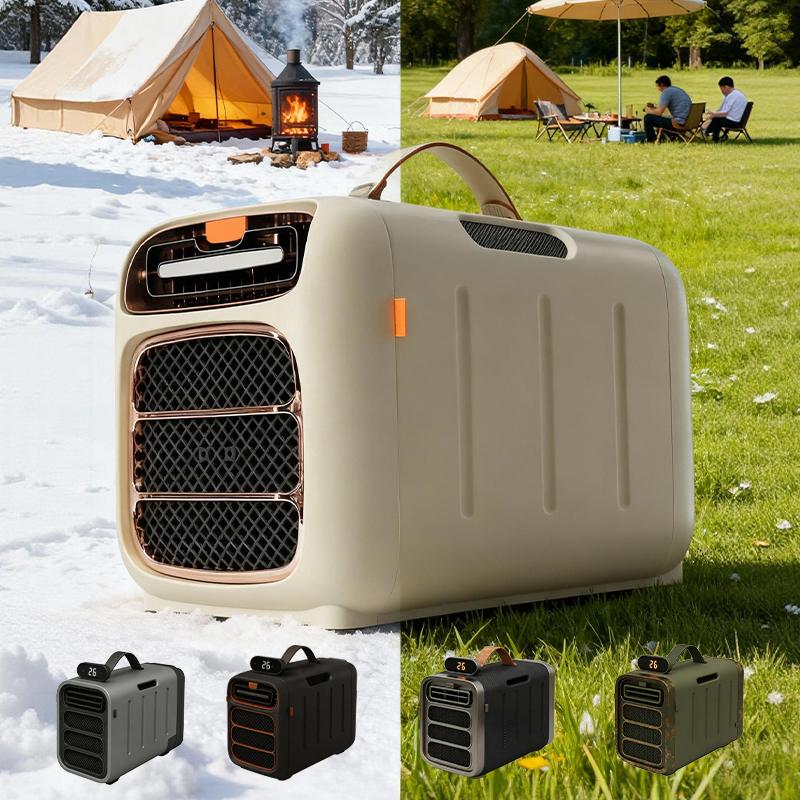
Advanced portable units (like our AC3 model) are not just air conditioners; they are Heat Pumps.
- How it Works: By reversing the refrigeration cycle, the unit extracts heat from the outside air (even when it’s cold) and pumps it into the tent.
- Efficiency vs. Resistance Heating: Old electric space heaters use “resistance coils” (like a toaster), which drain batteries incredibly fast. A heat pump is 300-400% more efficient, meaning you can keep your tent warm all night on a fraction of the battery power.
Moisture Control
Winter camping often leads to condensation buildup—waking up to wet walls and damp sleeping bags. A heat pump circulates dry, warm air, actively managing moisture levels inside the tent. It turns a miserable, damp winter night into a cozy, dry experience.
6. B2B Perspective: Why Retailers Should Stock Purpose-Built Gear
For outdoor gear retailers and distributors, the shift toward technical climate control represents a significant opportunity.
The Shift to “Investment Gear”
Campers are moving away from “disposable” gear. The customer buying a $3,000 Roof Top Tent is not looking for a $50 plastic fan. They are looking for an integrated solution that matches the quality of their rig. Stocking purpose-built, ruggedized ACs aligns with the premium nature of the modern overlanding market.
Durability and Vibration Resistance
Why not just sell a standard home portable AC?
- Road Vibration: Home appliances are designed to sit still. When put in the back of a truck and driven 500 miles off-road, their internal copper piping fractures, leading to refrigerant leaks and returns.
- Ruggedized Engineering: Purpose-built camping ACs use flexible piping, reinforced compressor mounts, and rubberized casings designed specifically to withstand the vibration and shocks of trail driving. This results in significantly lower warranty claim rates for retailers.
7. Conclusion
The days of sweating through a sleepless night in a nylon oven are behind us. The technology exists to create a climate-controlled sanctuary anywhere your vehicle can take you.
By choosing True Refrigeration over swamp coolers, selecting Split-Type designs for silence and efficiency, and prioritizing Native DC Power, you elevate the camping experience from “endurance test” to “luxury adventure.”
Whether you are a solo explorer outfitting your rig or a retailer curating the best gear for your customers, remember: Comfort is not a luxury; it is the fuel for the next day’s adventure.
About Everlead Outdoor
Everlead Outdoor is a premier OEM/ODM Outdoor Gear Manufacturer based in Dongguan, China. Since 2016, we have engineered high-performance solutions for the global overlanding market, specializing in bridging the gap between rugged durability and home-like comfort.
Our expertise in Climate Control Technology sets us apart. We don’t just repackage home appliances; we engineer 12V/24V Native DC Air Conditioners specifically for the harsh conditions of the trail.
- Innovation: From the whisper-quiet architecture of our AC2 Split-Type units to the all-season versatility of our AC3 Heat Pump series, we lead the market in miniaturized compressor technology.
- Durability: Our appliances undergo rigorous vibration and drop testing to ensure they survive the journey as well as the destination.
- Manufacturing Power: With an ISO 9001 certified facility, we offer flexible OEM/ODM services, allowing brands to customize panels, colors, and specifications to fit their unique market needs.
Ready to upgrade your outdoor product line? Contact our engineering team today to discuss how Everlead can power your brand’s next generation of outdoor comfort.